VeloCloud SD-WAN and Microsoft Route Server Integration Overview
VeloCloud SD-WAN allows you to connect remote locations to Microsoft Virtual Network (VNET) in a simple, optimized, and secure way. This section provides an overview of the VeloCloud SD-WAN and Microsoft Route Server Integration, including recommended architecture.
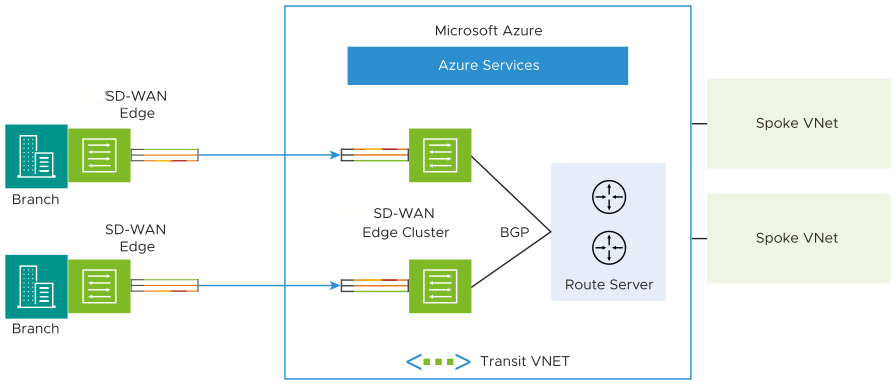
VeloCloud SD-WAN allows you to connect remote locations to Microsoft Virtual Network (VNET) in a simple, optimized, and secure way. SD-WAN leverages the Dynamic Multi-Path Optimization (DMPO) technologies and distributed cloud gateway coverage across the globe. It transforms the unpredictable broadband transport to enterprise-class quality connections and ensures the application performance from on-premises to Microsoft Azure. Azure Route Server simplifies dynamic routing between your network virtual appliance (NVA) and your virtual network. It allows you to exchange routing information directly through Border Gateway Protocol (BGP) routing protocol between any NVA that supports the BGP routing protocol and the Azure Software Defined Network (SDN) in the Azure Virtual Network (VNET) without the need to manually configure or maintain route tables. Azure Route Server is a fully managed service and is configured with high availability.
Azure Route Server simplifies configuration, management, and deployment of your NVA in your virtual network.
The following diagram depicts the branch-to-cloud connectivity using VeloCloud SD-WAN and Microsoft Route Server:
Recommended Architecture
The recommended architecture is to have a hub VPC and this hub VPC should not contain any workloads other than the Network Virtual Appliance. The following diagram depicts the hub and spoke topology based on the recommended architecture:
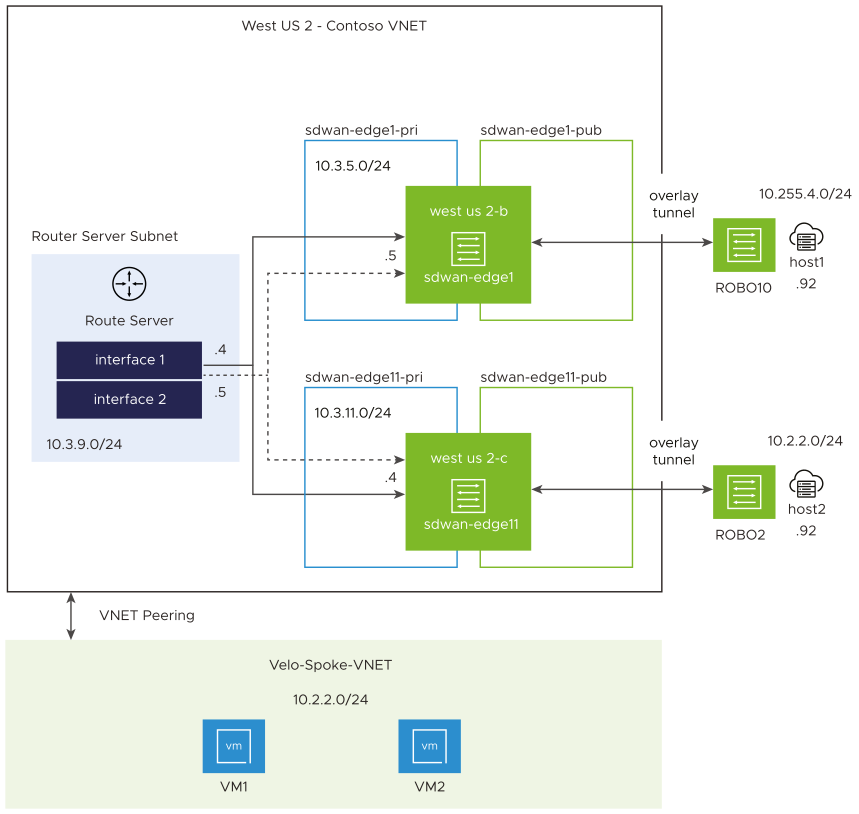
For additional information about Hub-Spoke network topology in Azure, refer to Hub-spoke network topology in Azure.