Arista VeloCloud Orchestrator Deployment and Monitoring Guide
Overview of the VeloCloud Orchestrator Deployment and Monitoring Guide
The VeloCloud Orchestrator Deployment and Monitoring Guide provides guidance on how to install, run, and monitor the VeloCloud Orchestrator.
- How to install the Orchestrator
- How to setup Disaster Recovery
- How to upgrade the Orchestrator
- How to back up the Orchestrator application Data
- How to monitor the Orchestrator application
- How to tune various system properties (depending on the scale of the deployment)
Install Orchestrator
This section discusses Orchestrator installation.
Prerequisites
This section discusses the prerequisites that must be met before installing the Orchestrator .
Instance Requirements
Arista recommends installation of the Orchestrator and Gateway applications as a virtual machine (i.e. guest instance) on an existing hypervisor.
- 8 Intel vCPU's at 2.5 Ghz or higher
Note: Although we recommend using Intel Xeon processors, similar Intel or AMD processors having the same or greater CPU frequency are also acceptable.
- 64 GB of memory
- Required Minimum IOPS: 5,000 IOPS
- Orchestrator requires 4 SSD based persistent volumes (expandable through LVM if needed)
- 192GB x 1- Root
- 1TB x 1- Store
- 500GB x 1- Store2
- 1TB x 1- Store3
- 1 Gbps NIC
- Ubuntu x64 server VM compatibility
- Single public IP address (Can be made available through NAT)
Upstream Firewall Configuration
The upstream firewall needs to be configured to allow inbound HTTP (TCP/80) as well as HTTPS (TCP/443). If a stateful firewall is in place, established connections that are outbound originated should also be allowed to facilitate upgrades and security updates.
External Services
The Orchestrator relies on several external services. Before proceeding with an installation, ensure that licenses are available for each of the services.
Google Maps
Google Maps is used for displaying Edges and data centers on a map. No account needs to be created with Google to utilize the functionality. However, Internet access must be available to the Orchestrator instance in order for the service to be available.
The service is limited to 25,000 map loads each day, for more than 90 consecutive days. Arista does not anticipate exceeding these limits for nominal use of the Orchestrator. For additional information, see System Properties.
Twilio
VeloCloud uses Twilio for SMS-based alerting to enterprise customers to notify them of Edge or link outage events. An account needs to be created and funded at http://www.twilio.com.
The account can be provisioned in the Orchestrator through the Operator Portal's System Properties page. The account will be provisioned through a system property, as described later in the guide. See System Properties for additional information.
MaxMind
MaxMind is a geolocation service. It is used to automatically detect Edge and Gateway locations and ISP names based on IP address. If this service is deactivated, then geolocation information will need to be updated manually. The account can be provisioned in the Orchestrator through the Operator Portal's System Properties page. See System Properties for additional information.
Installation Procedures
This section discusses Orchestrator installation.
Prepare Cloud-init
This section discusses how to use the cloud-init package to handle the early initialization of instances.
Cloud-init consists of a Linux package responsible for handling the early initialization of instances. If available in the distributions, it allows for configuration of many common parameters of the instance directly after installation. This creates a fully functional instance with a configuration based on a series of inputs.
Cloud-init behavior can be configured with user data. Provide the user data at the instance launch time and attach a secondary disk in ISO format that cloud-init searches for at first boot time. This disk contains all early configuration data to apply at that time.
The Orchestrator supports cloud-init and all essential configurations packaged in an ISO image.
Install on VMware
VMware vSphere provides a means of deploying and managing virtual machine resources. This section explains how to run the Orchestrator using the vSphere Client.
Deploy OVA Template
Attach ISO Image as a CD/DVD to Virtual Machine
- Right-click the newly-added Orchestrator VM and select Edit Settings.
- From the Virtual Machine Properties window, select CD/DVD Drive.
- Select the Use an ISO image option.
- Browse to find the ISO image you created earlier and then select it. The ISO can be found in the datastore that you uploaded it to, in the folder that you created.
- Select Connect on Power On.
- Select OK to exit the Properties screen.
Orchestrator Virtual Machine Start Up
Install on KVM
This section explains how to run the Orchestrator using the libvirt. This deployment was tested on an Ubuntu 18.04 LTS instance.
Images
qcow images.
ROOTFSSTORESTORE2STORE3
The images thin provision on deployment.
Start by copying the images to the KVM server. In addition, you must copy the cloud-init ISO build as described in the previous section.
XML Sample
<domain type='kvm' id='49'> <name>vco</name> <uuid>b0ff25bc-72b8-6ccb-e777-fdc0f4733e05</uuid> <memory unit='KiB'>12388608</memory> <currentMemory unit='KiB'>12388608</currentMemory> <vcpu>2</vcpu> <resource> <partition>/machine</partition> </resource> <os> <type>hvm</type> </os> <features> <acpi/> <apic/> <pae/> </features> <cpu mode='custom' match='exact'> <model fallback='allow'>SandyBridge</model> <vendor>Intel</vendor> <feature policy='require' name='vme'/> <feature policy='require' name='dtes64'/> <feature policy='require' name='invpcid'/> <feature policy='require' name='vmx'/> <feature policy='require' name='erms'/> <feature policy='require' name='xtpr'/> <feature policy='require' name='smep'/> <feature policy='require' name='pbe'/> <feature policy='require' name='est'/> <feature policy='require' name='monitor'/> <feature policy='require' name='smx'/> <feature policy='require' name='abm'/> <feature policy='require' name='tm'/> <feature policy='require' name='acpi'/> <feature policy='require' name='fma'/> <feature policy='require' name='osxsave'/> <feature policy='require' name='ht'/> <feature policy='require' name='dca'/> <feature policy='require' name='pdcm'/> <feature policy='require' name='pdpe1gb'/> <feature policy='require' name='fsgsbase'/> <feature policy='require' name='f16c'/> <feature policy='require' name='ds'/> <feature policy='require' name='tm2'/> <feature policy='require' name='avx2'/> <feature policy='require' name='ss'/> <feature policy='require' name='bmi1'/> <feature policy='require' name='bmi2'/> <feature policy='require' name='pcid'/> <feature policy='require' name='ds_cpl'/> <feature policy='require' name='movbe'/> <feature policy='require' name='rdrand'/> </cpu> <clock offset='utc'/> <on_poweroff>destroy</on_poweroff> <on_reboot>restart</on_reboot> <on_crash>restart</on_crash> <devices> <emulator>/usr/bin/kvm-spice</emulator> <disk type='file' device='disk'> <driver name='qemu' type='qcow2'/> <source file='/images/vco/rootfs.qcow2'/> <target dev='hda' bus='ide'/> <alias name='ide0-0-0'/> <address type='drive' controller='0' bus='0' target='0' unit='0'/> </disk> <disk type='file' device='disk'> <driver name='qemu' type='qcow2'/> <source file='/ images/vco/store.qcow2'/> <target dev='hdb' bus='ide'/> <alias name='ide0-0-1'/> <address type='drive' controller='0' bus='0' target='0' unit='1'/> </disk> <disk type='file' device='disk'> <driver name='qemu' type='qcow2'/> <source file='/ images/vco/store2.qcow2'/> <target dev='hdc' bus='ide'/> <alias name='ide0-0-2'/> <address type='drive' controller='0' bus='1' target='0' unit='0'/> </disk> <disk type='file' device='disk'> <driver name='qemu' type='qcow2' /> <source file='/images/vco/store3.qcow2' /> <target dev='hdd' bus='ide' /> <alias name='ide0-0-3' /> <address type='drive' controller='0' bus='1' target='0' unit='1' /> </disk> <disk type='file' device='cdrom'> <driver name='qemu' type='raw'/> <source file='/ images/vco/seed.iso'/> <target dev='sdb' bus='sata'/> <readonly/> <alias name='sata1-0-0'/> <address type='drive' controller='1' bus='0' target='0' unit='0'/> </disk> <controller type='usb' index='0'> <alias name='usb0'/> <address type='pci' domain='0x0000' bus='0x00' slot='0x01' function='0x2'/> </controller> <controller type='pci' index='0' model='pci-root'> <alias name='pci.0'/> </controller> <controller type='ide' index='0'> <alias name='ide0'/> <address type='pci' domain='0x0000' bus='0x00' slot='0x01' function='0x1'/> </controller> <interface type='direct'> <source dev='eth0' mode='vepa'/> </interface> <serial type='pty'> <source path='/dev/pts/3'/> <target port='0'/> <alias name='serial0'/> </serial> <console type='pty' tty='/dev/pts/3'> <source path='/dev/pts/3'/> <target type='serial' port='0'/> <alias name='serial0'/> </console> <memballoon model='virtio'> <alias name='balloon0'/> <address type='pci' domain='0x0000' bus='0x00' slot='0x03' function='0x0'/> </memballoon> </devices> <seclabel type='none' /> <!-- <seclabel type='dynamic' model='apparmor' relabel='yes'/> --> </domain>Create the VM
To create the VM using the standard virsh commands:
virsh define vco.xml virsh start vco.xmlInstall on AWS
This section describes how to install Orchestrator on AWS.
Minimum Instance Requirements
See the first section of the Orchestrator Installation, titled Instance Requirements, and select an AWS instance type matching these requirements. Both CPU and Memory requirements must be satisfied. Example: use c4.2xlarge or larger; r4.2xlarge or larger
Request an AMI Image
Request an AMI ID from VeloWare. It will be shared with the customer account. Have an Amazon AWS account ID ready when requesting AMI access.
Installation
- Launch the EC2 instance in AWS cloud.
Example: http://docs.aws.amazon.com/efs/latest/ug/gs-step-one-create-ec2-resources.html
- Configure the security group to allow inbound HTTP (TCP/80) as well as HTTPS (TCP/443).
- After the instance is launched, point the web browser to the Operator login URL: https://<name>/operator.
Initial Configuration Tasks
- Configure system properties
- Set up initial operator profile
- Set up operator accounts
- Create gateways
- Setup gateway pools
- Create customer account/partner account
Install an SSL Certificate
This section describes how to install an SSL certificate.
To install an SSL certificate:
Configure System Properties
This section describes how to configure System Properties, which provide a mechanism to control the system-wide behavior of the VeloCloud SD-WAN.
System Properties can be set initially using the cloud-init config file. For more information, see Prepare Cloud-init. The following properties need to be configured to ensure proper operation of the service.
System Name
Enter a fully qualified VeloCloud domain name in the network.public.address system property.
Google Maps
- Login into https://console.developers.google.com.
- Create a new project, if one is not already created.
- Locate the button Enable API. Select the Google Maps APIs and enable both Google Maps JavaScript API and Google Maps Geolocation API.
- On the left side of the screen, select the Credentials link
- Under the Credentials page, select Create Credentials, then select API key. Create an API key.
- Set the
service.client.googleMapsApi.keysystem property to API key. - Set
service.client.googleMapsApi.enabletotrue.
Twilio
service.twilio.enableallows the service to be deactivated in the event that no Internet access is available to the VeloCloudservice.twilio.accountSidservice.twilio.authTokenservice.twilio.phoneNumberin (nnn)nnn-nnnn format
Obtain the service at https://www.twilio.com.
MaxMind
service.maxmind.enableallows the service to be deactivated in the event that no Internet access is available to the VeloCloudservice.maxmind.useridholds the user identification supplied by MaxMind during the account creationservice.maxmind.licenseholds the license key supplied by MaxMind
Obtain the license at: https://www.maxmind.com/en/geoip-api-web-services.
mail.smtp.auth.pass- SMTP user password.mail.smtp.auth.user- SMTP user for authentication.mail.smtp.host- relay server for email originated from VeloCloud.mail.smtp.port- SMTP port.mail.smtp.secureConnection- use SSL for SMTP traffic.
Upgrade Orchestrator
This section describes how to upgrade the Orchestrator.
To upgrade the Orchestrator:
Expand Disk Size
All storage volumes are configured as LVM devices. They can be resized online by providing the underlying virtualization technology to support online disk expansion. Disks are expanded automatically via cloud-init when the VM boots.
To expand disks after boot:
System Properties
VeloCloud provides System Properties to configure various features and options available in the Orchestrator portal.
In the Operator portal, navigate to the System Properties page, which lists the available pre-defined system properties. See List of System Properties, which lists some of the system properties that you can modify as an Operator.

To configure the system properties:
- In the New System Property window, configure the following parameters:
Figure 2. Adding a New Property 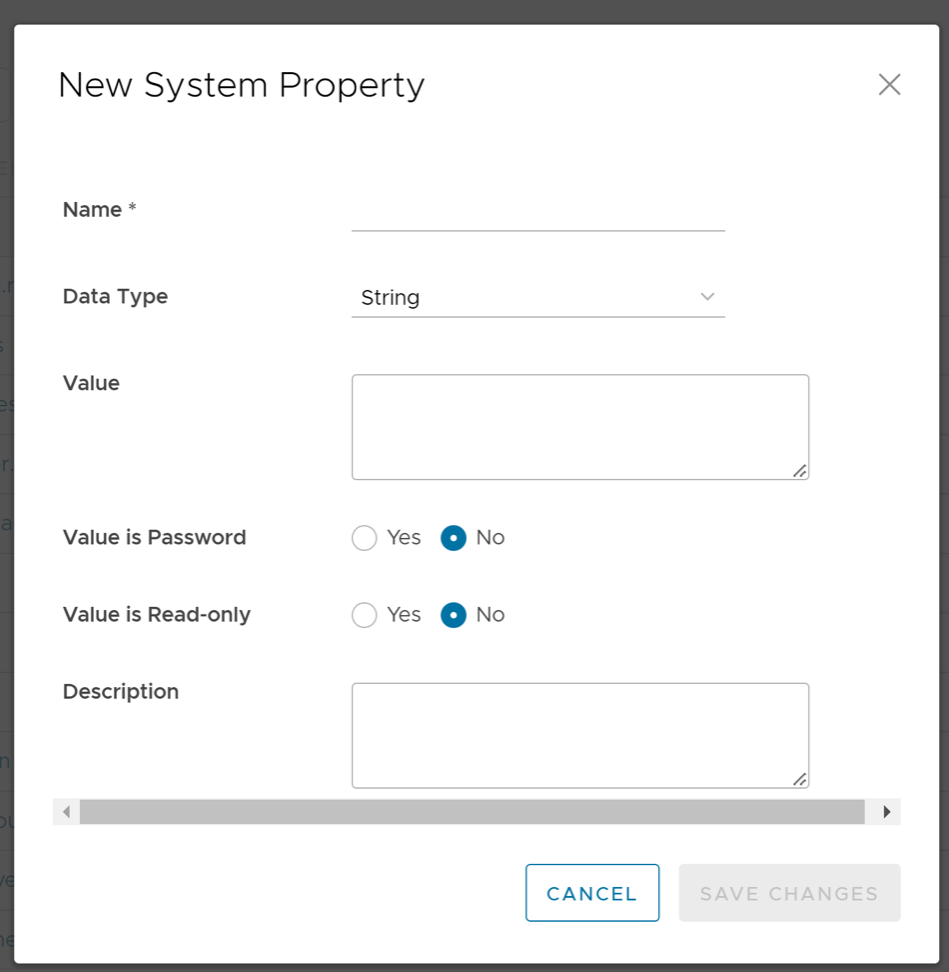
Table 3. System Properties Option Description Name Enter the Name for the new system property. Data Type Choose the required Data Type from the drop-down menu. Value Enter the Value for the property according to the data type. Value is Password Select Yes or No as required. Value is Read-only Select Yes or No for as required. Description Enter the Description for the new system property
List of System Properties
As an Operator, you can add or modify the values of the system properties.
- Alert Emails
- Alerts
- Bastion Orchestrator Configuration
- Certificate Authority
- Customer Configuration
- Data Retention
- Edges
- Edge Activation
- Edge Management
- Enhanced Firewall Services
- LAN-Side NAT Rules
- Monitoring
- Notifications
- Password Reset and Lockout
- Rate Limiting APIs
- Remote Diagnostics
- Security Service Edge
- Segmentation
- Self-service Password Reset
- Syslog Forwarding
- TACACS Services
- Two-factor Authentication
- Tunnel Parameters for Edges
- VNF Configuration
- VPN
- Warning Banner
- Zscaler
| System Property | Description |
|---|---|
vco.alert.mail.to |
When an alert is triggered, a notification is sent immediately to the list of Email addresses provided in the Value field of this system property. You can enter multiple Email IDs separated by commas.
If the property does not contain any value, then the notification is not sent. The notification is meant to alert Arista support / operations personnel of impending issues before notifying the customer. |
vco.alert.mail.cc |
When alert emails are sent to any customer, a copy is sent to the Email addresses provided in the Value field of this system property. You can enter multiple Email IDs separated by commas. |
mail.* |
There are multiple system properties available to control the Alert Emails. You can define the Email parameters like SMTP properties, username, password, and so on. |
| System Property | Description |
|---|---|
vco.alert.enable |
Globally activates or deactivates the generation of alerts for both Operators and Enterprise customers. |
vco.enterprise.alert.enable |
Globally activates or deactivates the generation of alerts for Enterprise customers. |
vco.operator.alert.enable |
Globally activates or deactivates the generation of alerts for Operators. |
| System Property | Description |
|---|---|
session.options.enableBastionOrchestrator |
Enables the Bastion Orchestrator feature.
For more information, see Bastion Orchestrator Configuration Guide. |
vco.bastion.private.enable |
Enables the Orchestrator to be the Private Orchestrator of the Bastion pair. |
vco.bastion.public.enable |
Enables the Orchestrator to be the Public Orchestrator of the Bastion pair. |
| System Property | Description |
|---|---|
edge.certificate.renewal.window |
This optional system property allows the Operator to define one or more maintenance windows during which the Edge certificate renewal is enabled. Certificates scheduled for renewal outside of the windows will be deferred until the current time falls within one of the enabled windows.
Enable System Property: To enable this system property, type "true" for "enabled" in the first part of the Value text area in the Modify System Property dialog box. An example of the first part of this system property when it is enabled is shown below. Operators can define multiple windows to restrict the days and hours of the day during which Edge renewals are enabled. Each window can be defined by a day, or a list of days (separated by a comma), and a start and end time. Start and end times can be specified relative to an Edge's local time zone, or relative to UTC. See image below for an example.  Note: If attributes are not present, the default is false.
When defining window attributes, adhere to the following:
If the above-mentioned values are missing, the attribute defaults in each window definition are as follow:
Note: One of either 'days' or end and start times must be present. However, if they are missing, the defaults will be as indicated above.
Deactivate System Property This system property is deactivated by default, which means the certificate will automatically renew after it expires. "Enabled" will be set to "false in the first part of the Value text area in the Modify System Property dialog box. An example of this property when it is deactivated is shown below. Note: This system property requires that PKI be enabled.
|
gateway.certificate.renewal.window |
This optional system property allows the Operator to define one or more maintenance windows during which the Gateway certificate renewal is enabled. Certificates scheduled for renewal outside of the windows will be deferred until the current time falls within one of the enabled windows.
Enable System Property: To enable this system property, type "true" for "enabled" in the first part of the Value text area in the Modify System Property dialog box. See image below for an example. Operators can define multiple windows to restrict the days and hours of the day during which edge renewals are enabled. Each window can be defined by a day, or list of days (separated by a comma), and a start and end time. Start and end times can be specified relative to an edge's local timezone, or relative to UTC. See image below for an example. 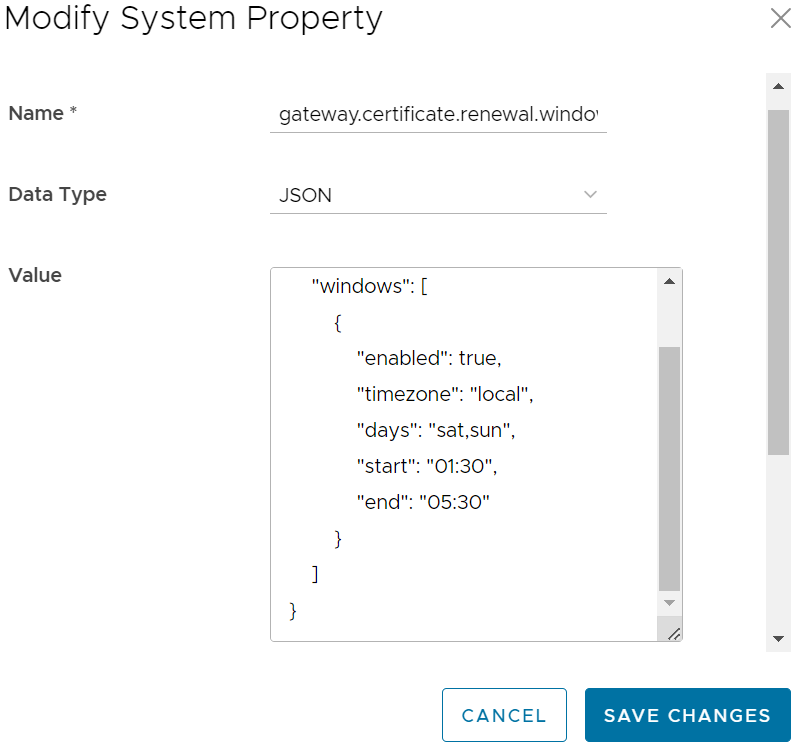 Note: If attributes are not present, the default is enabled
false.When defining window attributes, adhere to the following:
If the above-mentioned values are missing, the attribute defaults in each window definition are as follow:
Deactivate System Property This system property is deactivated by default, which means the certificate will automatically renew after it expires. "Enabled" will be set to "false in the first part of the Value text area in the Modify System Property dialog box. An example of this property when it is deactivated is shown below. Note: This system property requires that PKI be enabled.
|
| System Property | Description |
|---|---|
session.options.enableServiceLicenses |
This system property allows Operator users to manage Service Configuration under , and is set to True, by default. |
| System Property | Description |
|---|---|
retention.highResFlows.days |
This system property enables Operators to configure high resolution flow stats data retention anywhere between 1 and 90 days. |
retention.lowResFlows.months |
This system property enables Operators to configure low resolution flow stats data retention anywhere between 1 and 365 days. |
session.options.maxFlowstatsRetentionDays |
This property enables Operators to query more than two weeks of flows stats data. |
retentionWeeks.enterpriseEvents |
Enterprise events retention period (-1 sets retention to the maximum time period allowed) |
retentionWeeks.operatorEvents |
Operator events retention period (-1 sets retention to the maximum time period allowed) |
retentionWeeks.proxyEvents |
Proxy events retention period (-1 sets retention to the maximum time period allowed) |
retentionWeeks.firewallLogs |
Firewall logs retention period (-1 sets retention to the maximum time period allowed) |
retention.linkstats.days |
Link stats retention period (-1 sets retention to the maximum time period allowed) |
retention.linkquality.days |
Link quality events retention period (-1 sets retention to the maximum time period allowed) |
retention.healthstats.days |
Edge health stats retention period (-1 sets retention to the maximum time period allowed) |
retention.pathstats.days |
Path stats retention period (-1 sets retention to the maximum time period allowed) |
| SD-WAN Data | Date Retention Period |
|---|---|
| Enterprise Events | 1 year |
| Enterprise Alerts | 1 year |
| Operator Events | 1 year |
| Enterprise Proxy Events | 1 year |
| Link Stats | 1 year |
| Link QoE | 1 year |
| Path Stats | 2 weeks |
| Flow Stats (Low Resolution) | 1 year – 1 hour rollup |
| Flow Stats (High Resolution) | 2 weeks – 5 minute rollup |
| Edge Health Stats | 1 year |
| System Property | Description |
|---|---|
edge.offline.limit.sec |
If the Orchestrator does not detect a heartbeat from an Edge for the specified duration, then the state of the Edge is moved to OFFLINE mode. |
edge.link.unstable.limit.sec |
When the Orchestrator does not receive link statistics for a link for the specified duration, the link is moved to UNSTABLE mode. |
edge.link.disconnected.limit.sec |
When the Orchestrator does not receive link statistics for a link for the specified duration, the link is disconnected. |
edge.deadbeat.limit.days |
If an Edge is not active for the specified number of days, then the Edge is not considered for generating Alerts. |
vco.operator.alert.edgeLinkEvent.enable |
Globally activates or deactivates Operator Alerts for Edge Link events. |
vco.operator.alert.edgeLiveness.enable |
Globally activates or deactivates Operator Alerts for Edge Liveness events. |
| System Property | Description |
|---|---|
edge.activation.key.encode.enable |
Base64 encodes the activation URL parameters to obscure values when the Edge Activation Email is sent to the Site Contact. |
edge.activation.trustedIssuerReset.enable |
Resets the trusted certificate issuer list of the Edge to contain only the Orchestrator Certificate Authority. All TLS traffic from the edge are restricted by the new issuer list. |
network.public.certificate.issuer |
Set the value of network.public.certificate.issuer equal to the PEM encoding of the issuer of Orchestrator server certificate, when edge.activation.trustedIssuerReset.enable is set to True. This will add the server certificate issuer to the trusted issuer of the Edge, in addition to the Orchestrator Certificate Authority. |
| System Property | Description |
|---|---|
edge.link.show.limit.sec |
Allows to set the Edge Link Down Limit value for each Edge. |
| System Property | Description |
|---|---|
ntics.public
address |
Specifies the hostname that is used to access the NSX Threat Intelligent Cloud Service (NTICS). |
gsm.public.address |
Specifies the Public address of Global Services Manager (GSM). |
gsm.authentication.key |
Specifies the mTLS key to authenticate with GSM. |
gsm.authentication.cert |
Specifies the mTLS certificate to authenticate with GSM. |
gsm.authentication.passphrase |
Specifies the mTLS passphrase to authenticate with GSM. |
| System Property | Description |
|---|---|
session.options.enableLansidePortRules |
Allows to configure the parameters Inside Port and Outside Port under for an Edge or Profile. |
| System Property | Description |
|---|---|
vco.monitor.enable |
Globally activates or deactivates monitoring of Enterprise and Operator entity states. Setting the Value to False prevents Orchestrator from changing entity states and triggering alerts. |
vco.enterprise.monitor.enable |
Globally activates or deactivates monitoring of Enterprise entity states. |
vco.operator.monitor.enable |
Globally activates or deactivates monitoring of Operator entity states. |
| System Property | Description |
|---|---|
edge.liveData.enterFlowLiveMode.delay.seconds |
How long the Edge waits before giving up on capturing the count configured by edge.liveData.enterFlowLiveMode.delay.seconds. The default value is five seconds. The allowed range is 5- 59 seconds. The invalid input defaults to zero seconds. |
edge.liveData.enterFlowLiveMode.flow.count |
How many flows the Edge will return if met within the configured time controlled by edge.liveData.enterFlowLiveMode.flow.count. The default value is 1000. The allowed range is 1000- 4999 total flows. The invalid input defaults to one flow. |
| System Property | Description |
|---|---|
vco.notification.enable |
Globally activates or deactivates the delivery of Alert notifications to both Operator and Enterprises. |
vco.enterprise.notification.enable |
Globally activates or deactivates the delivery of Alert notifications to the Enterprises. |
vco.operator.notification.enable |
Globally activates or deactivates the delivery of Alert notifications to the Operator. |
| System Property | Description |
|---|---|
vco.object.groups.max.count.per.enterprise |
Maximum allowed number of object groups per Enterprise. The default value is 2000. |
vco.object.groups.max.count.per.edge |
Maximum allowed number of object group associations per Edge and its Profile. The default value is 1000. |
| System Property | Description |
|---|---|
vco.enterprise.resetPassword.token.expirySeconds |
Duration of time, after which the password reset link for an enterprise user expires. |
vco.enterprise.authentication.passwordPolicy |
Defines the password strength, history, and expiration policy for customer users.
Edit the JSON template in the Value field to define the following: strength
Since the new password only varies by 3 characters from the old, “sitting” would be rejected as a new password to replace “kitten”. The default value of-1 signifies that this feature is not enabled. expiry:
history:
|
enterprise.user.lockout.defaultAttempts |
Number of times the enterprise user can attempt to login. If the login fails for the specified number of times, the account is locked. |
enterprise.user.lockout.defaultDurationSeconds |
Duration of time, in seconds, in which the Enterprise user account is locked.
For example, if set to 300, the Enterprise user account will get locked if four incorrect login attempts are made within 300 seconds. If set to 60, the Enterprise user account will get locked if four incorrect attempts are made within one minute. Note: The number of attempts is configurable via the enterprise.user.lockout.defaultAttempts system property.
|
enterprise.user.lockout.enabled |
Activates or deactivates the lockout option for the enterprise login failures. |
vco.operator.resetPassword.token.expirySeconds |
Duration of time, after which the password reset link for an Operator user expires. |
vco.operator.authentication.passwordPolicy |
Defines the password strength, history, and expiration policy for Operator users.
Edit the JSON template in the Value field to define the following: strength
Since the new password only varies by 3 characters from the old, “sitting” would be rejected as a new password to replace “kitten”. The default value of-1 signifies that this feature is not enabled. expiry:
history:
|
operator.user.lockout.defaultAttempts |
Number of times the Operator user can attempt to login. If the login fails for the specified number of times, the account is locked. |
operator.user.lockout.defaultDurationSeconds |
Duration of time, in seconds, in which an Operator user account is locked.
For example, if set to 300, the Operator user account will get locked if four incorrect login attempts are made within 300 seconds. If set to 60, the Operator user account will get locked if four incorrect attempts are made within one minute. Note: The number of attempts is configurable via the operator.user.lockout.defaultAttempts system property.
|
operator.user.lockout.enabled |
Activates or deactivates the lockout option for the Operator login failures. |
| System Property | Description |
|---|---|
vco.api.rateLimit.enabled |
Allows Operator Super users activate or deactivate the rate limiting feature at the system level. By default, the value is False.
Note: The rate-limiter is not enabled in earnest, that is, it will not reject API requests that exceed the configured limits, unless the vco.api.rateLimit.mode.logOnly setting is deactivated.
|
vco.api.rateLimit.mode.logOnly |
Allows Operator Super user to use rate limit in a LOG_ONLY mode. When the value is set as True and if a rate limit exceeds, this option logs only the error and fires respective metrics allowing clients to make requests without rate limiting.
When the value is set to False, the request API is restricted with defined policies and HTTP 429 is returned. |
vco.api.rateLimit.rules.global |
Allows to define a set of globally applicable policies used by the rate-limiter, in a JSON array. By default, the value is an empty array.
Each type of user (Operator, Partner, and Customer) can make up to 500 requests for every 5 seconds. The number of requests is subject to change based on the behavior pattern of the rate limited requests. The JSON array consists of the following parameters: Types: The type objects represent different contexts in which the rate limits are applied. The following are the different type objects that are available:
Policies: Add rules to the policies to apply the requests that match the rule, by configuring the following parameters:
Enabled: Each type limit can be activated or deactivated by including the enabled key in APIRateLimiterTypeObject. By default, the value of enabled is True, even if the key is not included. You need to include "enabled": false key to deactivate the individual type limits. The following example shows a sample JSON file with default values: Note: It is recommended not to change the default values of the configuration parameters.
|
vco.api.rateLimit.rules.enterprise.default |
Comprises the default set of Enterprise-specific policies applied to newly created Customers. The Customer-specific properties are stored in the Enterprise property vco.api.rateLimit.rules.enterprise. |
vco.api.rateLimit.rules.enterpriseProxy.default |
Comprises the default set of Enterprise-specific policies applied to newly created Partners. The Partner-specific properties are stored in the Enterprise proxy property vco.api.rateLimit.rules.enterpriseProxy. |
| System Property | Description |
|---|---|
network.public.address |
Specifies the browser origin address/DNS hostname that is used to access the Orchestrator UI. |
network.portal.websocket.address |
Allows to set an alternate DNS hostname/address to access the Orchestrator UI from a browser, if the browser address is not the same as the value of network.public.address system property.
As remote diagnostics now uses a WebSocket connection, to ensure web security, the browser origin address that is used to access the Orchestrator UI is validated for incoming requests. In most cases, this address is same as the network.public.address system property. In rare scenarios, the Orchestrator UI can be accessed using another DNS hostname/address that is different from the value set in the network.public.address system property. In such cases, you can set this system property to the alternate DNS hostname/address. By default, this value is not set. |
session.options.websocket.portal.idle.timeout |
Allows to set the total amount of time (in seconds) the browser WebSocket connection is active in an idle state. By default, the browser WebSocket connection is active for 300 seconds in an idle state. |
| System Property | Description |
|---|---|
session.options.enableSseService |
Activates or deactivates the Security Service Edge (SSE) feature for Enterprise users. |
| System Property | Description |
|---|---|
enterprise.capability.enableSegmentation |
Activates or deactivates the segmentation capability for Enterprise users. |
enterprise.segments.system.maximum |
Specifies the maximum number of segments allowed for any Enterprise user. Ensure that you change the value of this system property to 128 if you want to enable 128 segments on Orchestrator for an Enterprise user. |
enterprise.segments.maximum |
Specifies the default value for the maximum number of segments allowed for a new or existing Enterprise user. The default value for any Enterprise user is 16.
Note: This value must be less than or equal to the number defined in the system property, enterprise.segments.system.maximum.
It is not recommended for you to change the value of this system property if you want to enable 128 segments for an Enterprise user. Instead, you can enable Customer Capabilities in the Customer Configuration page to configure the required number of segments. |
enterprise.subinterfaces.maximum |
Specifies the maximum number of sub-interfaces that can be configured for an Enterprise user. The default value is 32. |
enterprise.vlans.maximum |
Specifies the maximum number of VLANs that can be configured for an Enterprise user. The default value is 32. |
session.options.enableAsyncAPI |
When the segment scale is increased to 128 segments for any Enterprise user, to prevent UI timeouts, you can enable Async APIs support on the UI by using this system property. The default value is true. |
session.options.asyncPollingMilliSeconds |
Specifies the Polling interval for Async APIs on the UI. The default value is 5000 milliseconds. |
session.options.asyncPollingMaxCount |
Specifies the maximum number of calls to get Status API from the UI. The default value is 10. |
vco.enterprise.events.configuration.diff.enable |
Activates or deactivates configuration diff event logging. Whenever the number of segments for an Enterprise user is greater than 4, the configuration diff event logging will be deactivated. You can enable configuration diff event logging using this system property. |
| System Property | Description |
|---|---|
vco.enterprise.resetPassword.twoFactor.mode |
Defines the mode for the second level for password reset authentication, for all the Enterprise users. Currently, only the SMS mode is supported. |
vco.enterprise.resetPassword.twoFactor.required |
Activates or deactivates the two-factor authentication for password reset of Enterprise users. |
vco.enterprise.selfResetPassword.enabled |
Activates or deactivates self-service password reset for Enterprise users. |
vco.enterprise.selfResetPassword.token.expirySeconds |
Duration of time, after which the self-service password reset link for an Enterprise user expires. |
vco.operator.resetPassword.twoFactor.required |
Activates or deactivates the two-factor authentication for password reset of Operator users. |
vco.operator.selfResetPassword.enabled |
Activates or deactivates self-service password reset for Operator users. |
vco.operator.selfResetPassword.token.expirySeconds |
Duration of time, after which the self-service password reset link for an Operator user expires. |
| System Property | Description |
|---|---|
log.syslog.backend |
Backend service syslog integration configuration. |
log.syslog.portal |
Portal service syslog integration configuration. |
log.syslog.upload |
Upload service syslog integration configuration. |
log.syslog.lastFetchedCRL.backend |
Keeps the last updated CRL as PEM formatted string for service syslog and updated regularly. |
log.syslog.lastFetchedCRL.portal |
Keeps the last updated CRL as PEM formatted string for service syslog and updated regularly. |
log.syslog.lastFetchedCRL.upload |
Keeps the last updated CRL as PEM formatted string for service syslog and updated regularly. |
| System Property | Description |
|---|---|
session.options.enableTACACS |
Activates or deactivates the TACACS services for Enterprise users. |
| System Property | Description |
|---|---|
vco.enterprise.authentication.twoFactor.enable |
Activates or deactivates the two-factor authentication for Enterprise users. |
vco.enterprise.authentication.twoFactor.mode |
Defines the mode for the second level authentication for Enterprise users. Currently, only SMS is supported as the second level authentication mode. |
vco.enterprise.authentication.twoFactor.require |
Defines the two-factor authentication as mandatory for Enterprise users. |
vco.operator.authentication.twoFactor.enable |
Activates or deactivates the two-factor authentication for Operator users. |
vco.operator.authentication.twoFactor.mode |
Defines the mode for the second level authentication for Operator users. Currently, only SMS is supported as the second level authentication mode. |
vco.operator.authentication.twoFactor.require |
Defines the two-factor authentication as mandatory for Operator users. |
| System Property | Description |
|---|---|
session.options.enableNsdPkiIPv6Config |
Activates Certificate Authentication mode and IPv6 Local Identification Type. |
| System Property | Description |
|---|---|
edge.vnf.extraImageInfos |
Defines the properties of a VNF Image.
You can enter the following information for a VNF Image, in JSON format in the Value field:
Example of JSON file for Check Point Firewall Image:
Example os JSON file for Fortinet Firewall Image:
|
edge.vnf.metric.record.limit |
Defines the number of records to be stored in the database. |
enterprise.capability.edgeVnfs.enable |
Allows VNF deployment on supported Edge models. |
enterprise.capability.edgeVnfs.securityVnf.checkPoint |
Activates Check Point Networks Firewall VNF. |
enterprise.capability.edgeVnfs.securityVnf.fortinet |
Activates Fortinet Networks Firewall VNF. |
enterprise.capability.edgeVnfs.securityVnf.paloAlto |
Activates Palo Alto Networks Firewall VNF. |
session.options.enableVnf |
Activates VNF feature. |
vco.operator.alert.edgeVnfEvent.enable |
Activates or deactivates Operator alerts for Edge VNF events globally. |
vco.operator.alert.edgeVnfInsertionEvent.enable |
Activates or deactivates Operator alerts for Edge VNF Insertion events globally. |
edge.vnf.extraImageInfos. |
Allows selection of the Check Point VNF image. |
| System Property | Description |
|---|---|
vpn.disconnect.wait.sec |
The time interval for the system to wait before disconnecting a VPN tunnel. |
vpn.reconnect.wait.sec |
The time interval for the system to wait before reconnecting a VPN tunnel. |
| System Property | Description |
|---|---|
login.warning.banner.message |
This optional system property allows the Operator to configure and display a Security Administrator-specified advisory notice and consent warning message regarding the use of Orchestrator. The warning message is displayed in the Orchestrator prior to user login.
For instructions about how to configure this system property, see the topic Configure Advisory Notice and Consent Warning Message for SD-WAN Orchestrator. |
| System Property | Description |
|---|---|
session.options.enableZscalerProfileAutomation |
Enables to configure Zscaler settings at the Profile level. |
Configure Orchestrator Disaster Recovery
This section provides disaster recovery (DR) instructions for Orchestrator .
Orchestrator Disaster Recovery Overview
The Orchestrator Disaster Recovery (DR) feature prevents the loss of stored data and resumes Orchestrator services in the event of system or network failure.
- The recovery time objective (RTO), therefore, is dependent on explicit action by the operator to trigger promotion of the standby.
- The recovery point objective (RPO), however, is essentially zero, regardless of the recovery time, because all configuration is instantaneously replicated. Monitoring data that would have been collected during the outage is cached on the Edges and Gateways pending promotion of the standby.
Active/Standby Pair
In a Orchestrator DR deployment, two identical Orchestrator systems are configured as an active / standby pair. The operator can view the state of DR readiness through the web UI on either of the servers. Edges and Gateways are aware of both Orchestrators, and while they receive configuration changes only from the active Orchestrator, they periodically send DR heartbeats to both systems to report their view of both servers and to query the DR system status. When the operator triggers a failover, the Edges and Gateways are informed of the change in their next DR heartbeat.
DR States
From the view of an operator, and of the edges and gateways, a Orchestrator has one of four DR states:
| DR State | Description |
|---|---|
| Standalone | No DR configured. |
| Active | DR configured, acting as the primary Orchestrator server. |
| Standby | DR configured, acting as an inactive replica Orchestrator server. |
| Zombie | DR formerly configured and active but no longer acting as the active or standby. |
Run-time Operation
When DR is configured, the standby server runs in a limited mode, blocking all API calls except those related to the DR status and the DR heartbeats. When the operator invokes a failover, the standby is promoted to become fully operational as a Standalone server. The server that was formerly active is automatically transitioned to a Zombie state if it is responsive and visible from the promoted standby. In the Zombie state, management configuration services are blocked and any contact from Edges and Gateways that have not transitioned to the new active Orchestrator are redirected to the promoted server.

Set Up Orchestrator Replication
- The selected standby is put into a STANDBY_CANDIDATE state, enabling it to be configured by the active server.
- The active server is then given the address and credentials of the standby and it enters the ACTIVE_CONFIGURING state.
When a STANDBY_CONFIG_RQST is created from Active to Standby, the two servers synchronize through the state transitions.
- The Gateway time zone must be set to Etc/UTC. Use the following command to view the NTP time zone.
vcadmin@vcg1-example:~$ cat /etc/timezone Etc/UTC
vcadmin@vcg1-example:~$
If the time zone is incorrect, use the following commands to update the time zone.
echo "Etc/UTC" | sudo tee /etc/timezone sudo dpkg-reconfigure --frontend noninteractive tzdata - The NTP offset must be less than or equal to 15 milliseconds. Use the following command to view the NTP offset.
sudo ntpqvcadmin@vcg1-example:~$ sudo ntpq -p remote refid st t when poll reach delay offset jitter
==============================================================================
*ntp1-us1.prod.v 74.120.81.219 3 u 474 1024 377 10.171 -1.183 1.033 ntp1-eu1-old.pr .INIT. 16 u - 1024 0 0.000 0.000 0.000
vcadmin@vcg1-example:~$
If the offset is incorrect, use the following commands to update the NTP offset.
sudo systemctl stop ntp sudo ntpdate <server> sudo systemctl start ntp - By default, a list of NTP Servers are configured in the
/etc/ntpd.conffile. The Orchestrators on which DR need to be established must have Internet to access the default NTP Servers and ensure the time is in sync on both the Orchestrators. Customers can also use their local NTP server running in their environment to sync time.
network.public.address system property.Set Up the Standby Orchestrator
To set up Orchestrator replication, perform the following steps:
- Select Replication from the Navigation panel to display the Orchestrator Replication screen.
Figure 6. Orchestrator Replication 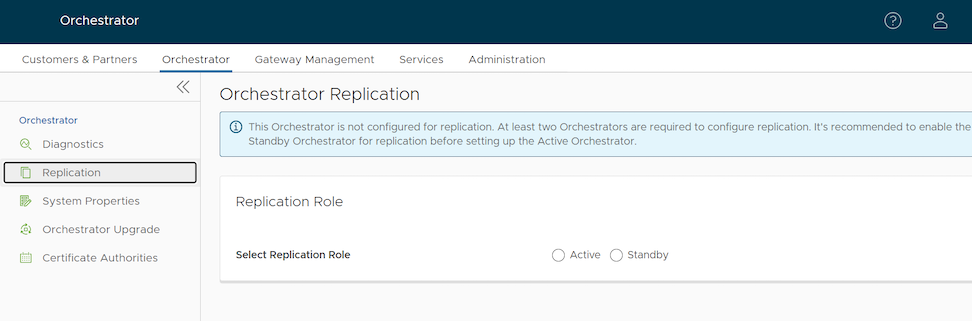
- Enable the Standby Orchestrator by selecting the Standby (Replication Role) radio button.
Figure 7. Enabling Standby Orchestrator 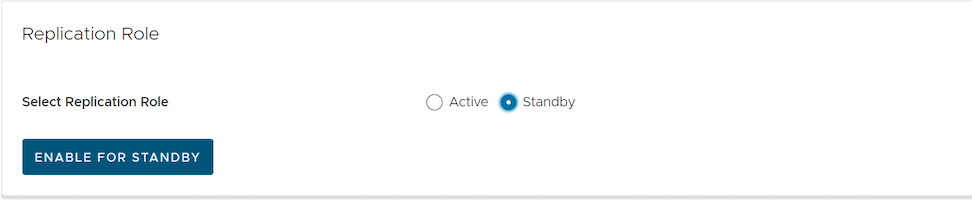
- Select the Enable for Standby button.
The Prepare this Orchestrator for Standby Role dialog displays.
Figure 8. Preparing Orchestrator for Standby Role 
- Select OK.
Figure 9. Configuring Standby Orchestrator 
After the Standby Orchestrator has been configured for replication, configure the Active Orchestrator according to the instructions described in Set Up the Active Orchestrator.
Set Up the Active Orchestrator
To configure the second Orchestrator to be the Active Orchestrator:
- Type in the Standby Orchestrator Address and the Standby Orchestrator UUID. The Orchestrator Address and Uuid display in the Standby Orchestrator screen.
Figure 10. Active Orchestrator Replication 
- Select Make Active. The Active Orchestrator screen displays showing a status of the current state.
Figure 11. Active Orchestrator Replication Settings 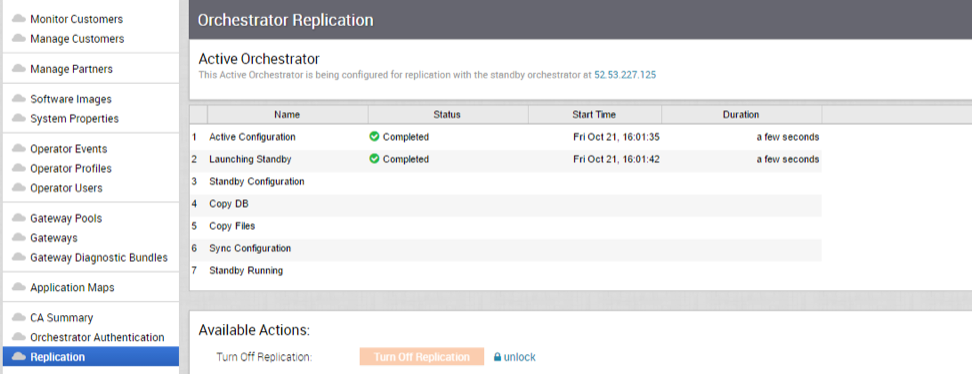
When configuration is complete, both Orchestrators (Standby and Active) will be in sync.
Standby Orchestrator in Sync

You can select the toggle history link to view the status of each state.
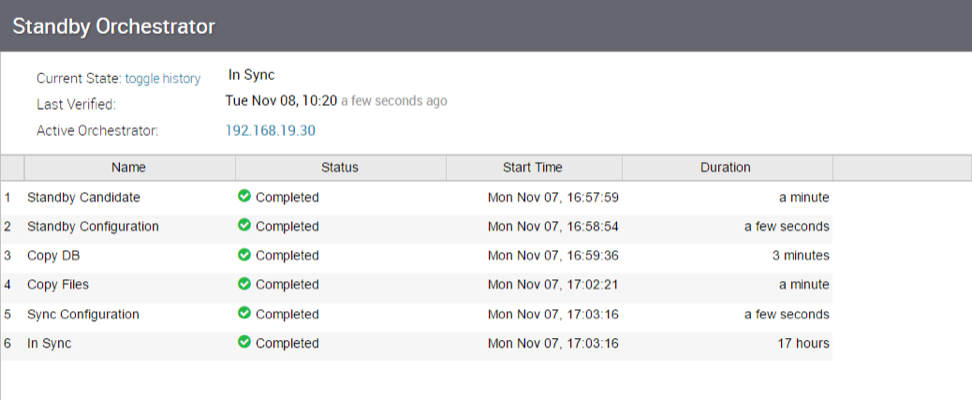
Active Orchestrator in Sync

Test Failover
The following testing failover scenarios are forced failovers for example purposes. You can perform these actions in the Available Actions area of the Active and Standby screens.
Promote a Standby Orchestrator
This section describes how to promote a Standby Orchestrator.
To promote a Standby Orchestrator, perform the following steps:
- Select the Promote Standby button in the Available Actions area on the Standby Orchestrator screen.
Figure 15. Available Actions 
The following dialog box appears, indicating that when you promote your Standby Orchestrator, administrators will no longer be able to manage the Orchestrator using the previously Active Orchestrator.
Figure 16. Promoting the Orchestrator 
- Select OK to promote the Orchestrator.
Figure 17. Promoting to Standby 
A final dialog box appears indicating that the Orchestrator is no longer a Standby and will restart in Standalone mode.
Figure 18. Removing the Standby Orchestrator 
When you promote a Standby Orchestrator, it restarts in Standalone mode.
If the Standby can communicate with the formerly Active Orchestrator, it instructs the Orchestrator to enter a Zombie state. In Zombie state, the Orchestrator communicates with its clients (edges, gateways, UI/API) that it is no longer active, and that they must communicate with the newly promoted Orchestrator. If the promoted Standby cannot communicate with the formerly Active Orchestrator, the operator should, if possible, manually demote the formerly Active Orchestrator.
Figure 19. Quiesced Orchestrator 
Return to Standalone Mode
To return the Zombie to standalone mode, select Return to Standalone Mode in the Available Actions area on the Active Orchestrator or Standby Orchestrator screens.

vco.disasterRecovery.zombie.expirySeconds which defaults to 1800 seconds.Troubleshooting Orchestrator DR
This section discusses the failure states of the system. These are also listed in the UI, along with a more detailed description of the failure. Additional information is available in the VeloCloud log.
Recoverable Failures
FAILURE_SYNCING_FILESFAILURE_GET_STANDBY_STATUSFAILURE_MYSQL_ACTIVE_STATUSFAILURE_MYSQL_STANDBY_STATUS
Unrecoverable Failures
FAILURE_ACTIVE_CONFIGURINGFAILURE_LAUNCHING_STANDBYFAILURE_STANDBY_CONFIGURINGFAILURE_COPYING_DBFAILURE_COPYING_FILESFAILURE_SYNC_CONFIGURINGFAILURE_GET_STANDBY_CONFIGFAILURE_STANDBY_CANDIDATEFAILURE_STANDBY_UNCONFIGFAILURE_STANDBY_PROMOTIONFAILURE_ACTIVE_DEMOTION
Replication
The Orchestrator Disaster Recovery (DR) feature prevents the loss of stored data and resumes Orchestrator services in the event of system or network failure.
- The Recovery Time Objective (RTO), therefore, is dependent on explicit action by the operator to trigger promotion of the standby.
- The Recovery Point Objective (RPO), however, is essentially zero, regardless of the recovery time, because all configuration is instantaneously replicated. Monitoring data that would have been collected during the outage is cached on the Edges and Gateways pending promotion of the standby.
Active/Standby Pair
In a Orchestrator DR deployment, two identical Orchestrator systems are configured as an active / standby pair. The operator can view the state of DR readiness through the web UI on either of the servers. Edges and gateways are aware of both Orchestrators, and while they receive configuration changes only from the active Orchestrator, they periodically send DR heartbeats to both systems to report their view of both servers and to query the DR system status. When the operator triggers a failover, the Edges and Gateways are informed of the change in their next DR heartbeat.
DR States
From the view of an operator, and the Edges and Gateways, a Orchestrator has one of the following four DR states:
| DR State | Description |
|---|---|
| Standalone | No DR configured. |
| Active | DR configured, acting as the primary Orchestrator server. |
| Standby | DR configured, acting as an inactive replica Orchestrator server. |
| Zombie | DR formerly configured and active but no longer acting as the active or standby. |
Run-time Operation
When DR is configured, the standby server runs in a limited mode, blocking all API calls except those related to the DR status and the DR heartbeats. When the operator invokes a failover, the standby is promoted to become fully operational as a Standalone server. The server that was formerly active is automatically transitioned to a Zombie state if it is responsive and visible from the promoted standby. In the Zombie state, management configuration services are blocked and any contact from edges and gateways that have not transitioned to the new active Orchestrator are redirected to the promoted server.
Set Up Orchestrator Replication
- The selected standby is put into a STANDBY_CANDIDATE state, enabling it to be configured by the active server.
- The active server is then given the address and credentials of the standby and it enters the ACTIVE_CONFIGURING state.
When a STANDBY_CONFIG_RQST is made from active to standby, the two servers synchronize through the state transitions.
- The Gateway time zone must be set to Etc/UTC. Use the following command to view the NTP time zone.
vcadmin@vcg1-example:~$ cat /etc/timezone Etc/UTC vcadmin@vcg1-example:~$If the time zone is incorrect, use the following commands to update the time zone.
echo "Etc/UTC" | sudo tee /etc/timezone sudo dpkg-reconfigure --frontend noninteractive tzdata - The NTP offset must be less than or equal to 15 milliseconds. Use the following command to view the NTP offset.
sudo ntpqvcadmin@vcg1-example:~$ sudo ntpq -p remote refid st t when poll reach delay offset jitter ============================================================================== *ntp1-us1.prod.v 74.120.81.219 3 u 474 1024 377 10.171 -1.183 1.033 ntp1-eu1-old.pr .INIT. 16 u - 1024 0 0.000 0.000 0.000 vcadmin@vcg1-example:~$If the offset is incorrect, use the following commands to update the NTP offset.
sudo systemctl stop ntp sudo ntpdate <server> sudo systemctl start ntp - By default, a list of NTP Servers are configured in the
/etc/ntpd.conffile. The Orchestrators on which DR need to be established must have Internet to access the default NTP Servers and ensure the time is in sync on both the Orchestrators. Customers can also use their local NTP server running in their environment to sync time.
Set Up the Standby Orchestrator
- In the SD-WAN service of the Enterprise Portal, select the Orchestrator tab and then from the left pane select the Replication button to display the Orchestrator Replication screen.
- Activate the Standby Orchestrator by selecting the Standby (Replication Role) radio button.
- Select Enable for Standby button.
Figure 22. Set Up the Standby Orchestrator 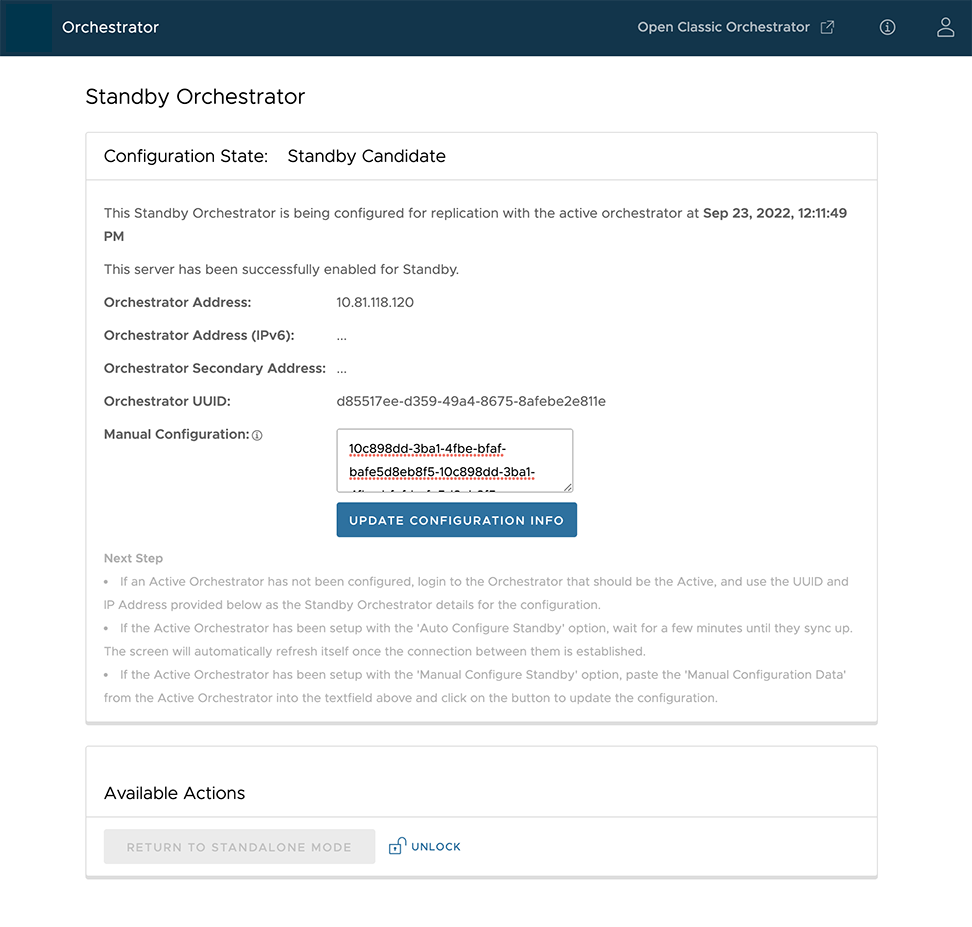
The Standby Orchestrator page appears.
- Enter the manual configuration parameters and select the Update configuration info button.
After the Standby Orchestrator has been configured for replication, configure the Active Orchestrator according to the instructions below.
Set Up the Active Orchestrator
To set up the Active Orchestrator, select the Replication Role as Active and configure the following:
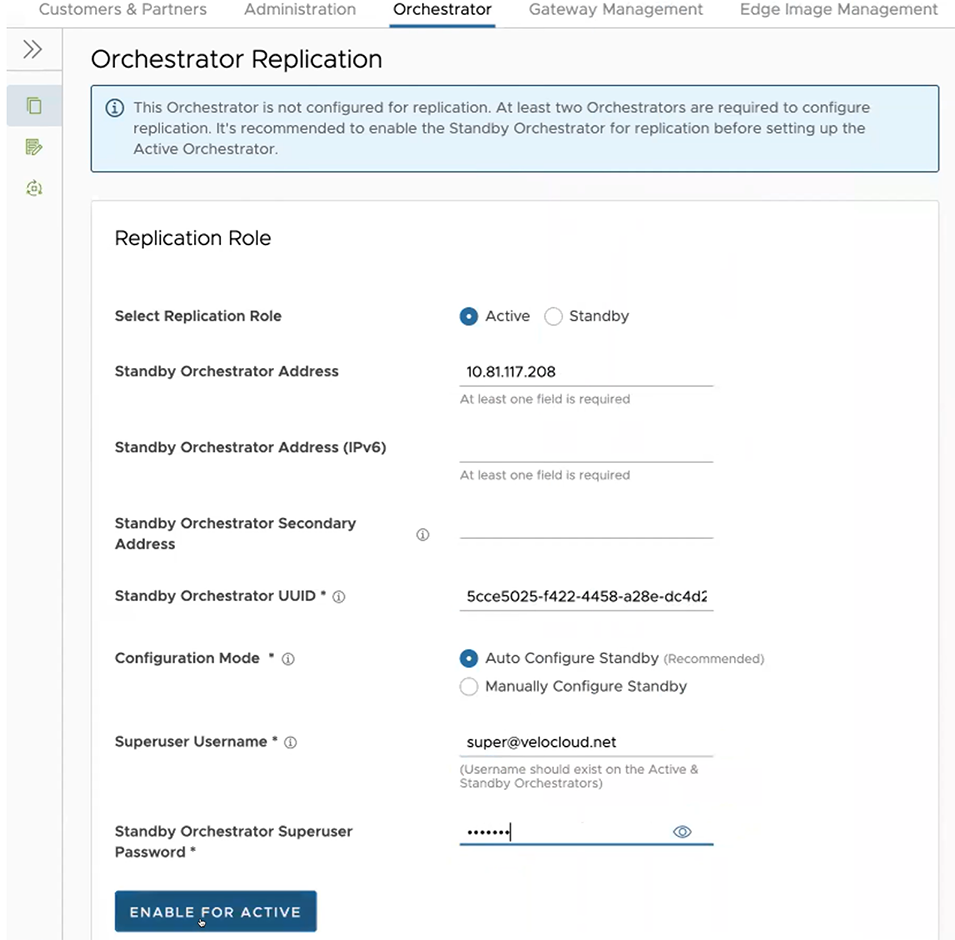
| Option | Description |
|---|---|
| Select Replication Role | Select the Active radio button for the replication role. |
| Standby Orchestrator Address | Enter the primary Standby Orchestrator IP Address. |
| Standby Orchestrator Address (IPv6) | Enter the Standby Orchestrator IPv6 Address. |
| Standby Orchestrator Secondary Address | Enter the address of the standby Orchestrator's secondary interface. This address is used for replication if the standby is promoted to active. Users can add Ipv4/Ipv6 or FQDN address here. |
| Standby Orchestrator UUID | Enter the UUID of the standby Orchestrator. |
| Configuration Mode | Select the Auto Configure Standby or Manually Configure Standby radio button based on the requirement.
When configured manually, paste a string value from ACTIVE VCO to STANDBY_WAIT. |
| Superuser Username | Enter the display name for the Orchestrator Superuser. |
| Standby Orchestrator Superuser Password | Enter the password for the Orchestrator Superuser.
Note: Starting from the 4.5 release, the use of the special character "<" in the password is no longer supported. In cases where users have already used "<" in their passwords in previous releases, they must remove it to save any changes on the page.
|
- Select the Enable for Active button to activate replication role.
When configuration is complete, both Orchestrators (Standby and Active) are in sync.
Standby Orchestrator in Sync

Active Orchestrator in Sync

Test Failover
The following testing failover scenarios are forced failovers for example purposes. You can perform these actions in the Available Actions area of the Active and Standby screens.
Promote a Standby Orchestrator
This section discusses how to promote a Standby Orchestrator.
To promote a Standby Orchestrator, perform the following steps:
- Select the unlock link.
- Select the Promote Standby button in the Available Actions area on the Standby Orchestrator screen.
Figure 26. Available Actions 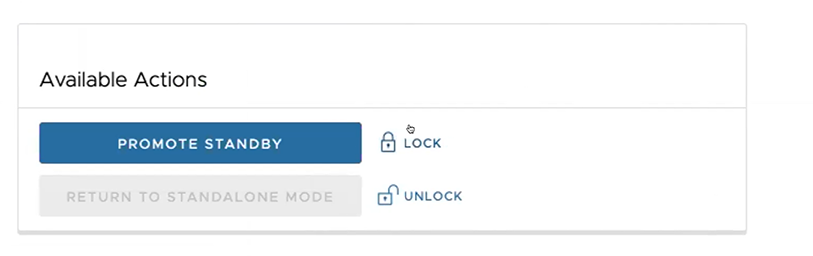
The following dialog box appears, indicating that when you promote your Standby Orchestrator, administrators can no longer be able to manage the Orchestrator using the previously Active Orchestrator.
Figure 27. Promote Standby 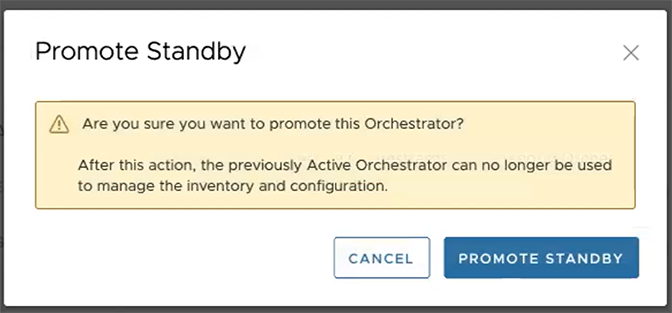
- Select the Promote Standby button to promote the Standby Orchestrator.
- Select Force Promote Standby to promote the Orchestrator.
Figure 28. Force Promote Standby 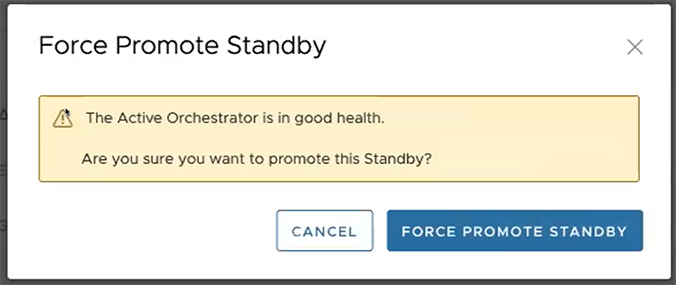
A final dialog box appears indicating that the Orchestrator is no longer a Standby and restarts in Standalone mode.
Figure 29. Final Dialog Box 
When you promote a Standby Orchestrator, it restarts in Standalone mode.
If the Standby can communicate with the formerly Active Orchestrator, it instructs that Orchestrator to enter a Zombie state. In Zombie state, the Orchestrator communicates with its clients (edges, gateways, UI/API) that it is no longer active, and that they must communicate with the newly promoted Orchestrator. If the promoted Standby cannot communicate with the formerly Active Orchestrator, the operator should, if possible, manually demote the formerly Active Orchestrator.

Return to Standalone Mode
To return the Zombie to standalone mode, select the Return to Standalone Mode button in the Available Actions area on the Active Orchestrator or Standby Orchestrator screens.

vco.disasterRecovery.zombie.expirySeconds, which is defaulted to 1800 seconds.Troubleshooting Orchestrator DR
This section discusses the failure states of the system. These are also listed in the UI, along with a more detailed description of the failure. Additional information is available in the VeloCloud log.
Recoverable Failures
- FAILURE_SYNCING_FILES
- FAILURE_GET_STANDBY_STATUS
- FAILURE_MYSQL_ACTIVE_STATUS
- FAILURE_MYSQL_STANDBY_STATUS
Unrecoverable Failures
- FAILURE_ACTIVE_CONFIGURING
- FAILURE_LAUNCHING_STANDBY
- FAILURE_STANDBY_CONFIGURING
- FAILURE_COPYING_DB
- FAILURE_COPYING_FILES
- FAILURE_SYNC_CONFIGURING
- FAILURE_GET_STANDBY_CONFIG
- FAILURE_STANDBY_CANDIDATE
- FAILURE_STANDBY_UNCONFIG
- FAILURE_STANDBY_PROMOTION
- FAILURE_ACTIVE_DEMOTION
Upgrade Orchestrator
This section describes how to upgrade the Orchestrator.
Orchestrator Upgrade Overview
- Prepare for the Orchestrator Upgrade.
- Send Upgrade Announcement.
- Proceed with the Orchestrator Upgrade.
- Complete the Orchestrator Upgrade.
Upgrade an Orchestrator
This section discusses how to upgrade an Orchestrator.
Step 1: Prepare for the Orchestrator Upgrade
Contact the Arista Support team to prepare for the Orchestrator upgrade.
To upgrade Orchestrator:
- Arista Support will assist you with your upgrade. Collect the following information prior to contacting Support.
- Provide a screenshot of the replication dashboard of the Orchestrator as shown below.
Figure 32. Orchestrator Dashboard 
- Hypervisor Type and version (i.e. vSphere 6.7)
- Commands from the Orchestrator:
Note: Commands must be run as root (e.g. ‘sudo <command>’ or ‘sudo -i’).
- Run the script
/opt/vc/scripts/vco_upgrade_check.shto check:- LVM layout
- Memory Information
- CPU Information
- Kernel Parameters
- Some system properties
- ssh configurations
- Mysql schema and database sizes
- File_store locations and sizes
- Copy of
/var/logtar -czf /store/log-`date +%Y%M%S`.tar.gz --newer-mtime="36 hours ago" /var/log
- From the Standby Orchestrator:
sudo mysql
--defaults-extra-file=/etc/mysql/velocloud.cnf
velocloud -e 'SHOW SLAVE STATUS \G'
- Run the script
- From the Active Orchestrator:
sudo mysql
--defaults-extra-file=/etc/mysql/velocloud.cnf
velocloud -e 'SHOW MASTER STATUS \G'
- Provide a screenshot of the replication dashboard of the Orchestrator as shown below.
- Contact Arista Support, with the above-mentioned information for assistance with the Orchestrator upgrade.
Step 2: Send Upgrade Announcement
The Upgrade Announcement area enables you to configure and send a message about an upcoming upgrade. This message will be displayed to all users the next time they login to the Orchestrator.
To send an upgrade announcement:
- In the Upgrade Announcement area, type in your message in the Banner Message text box.
Figure 33. Type your Banner Message 
- Select the Announce Orchestrator Upgrade button.
A popup message appears indicating that you have successfully created your announcement, and that your banner message is displayed at the top of the Orchestrator.
Figure 34. Banner Message is Displayed 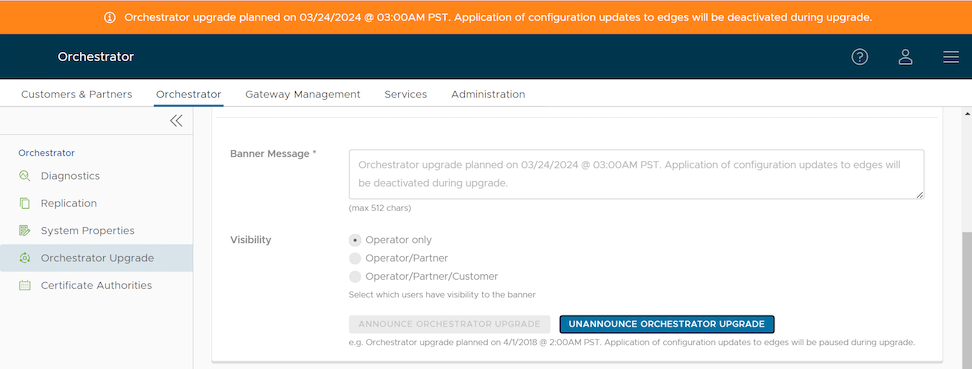
Step 3: Before Proceeding with the Orchestrator Upgrade
This section provides important information to consider prior to upgrading the Orchestrator, as well as how the image-based upgrade works. Contact Arista Support to assist you with the 5.4 to 6.0 upgrade.
- The Orchestrator OS, database, and several other dependent components currently in use have reached their end of life, and will no longer be supported.
- The benefit to upgrading to the 6.0 release is better security due to components with active LTS.
- Starting from the 6.0.0 release, existing events data is migrated from mySQL to ClickHouse, and all the new events data is stored in ClickHouse for a duration of 1 year.
Consider the following when upgrading to the 6.0 Release:
- This upgrade work does not modify any existing APIs.
- Just like other releases, there are schema changes with the 6.0 release. However, these changes will not impact the upgrade process.
- The OS version is changing from Ubuntu 18.04 to 22.04.
- Image based upgrade instead of a Debian based upgrade.
Important Notes for Upgrading from 5.4 to 6.0
- Any non-supported binaries installed on top of Orchestrator will be removed. These can include the off-the-shelf monitoring applications, remote access applications, etc.
- Back up any configurations if you want to continue using them. After the upgrade, you must reinstall them manually and configure them accordingly.
- For a successful upgrade, a reboot of the Orchestrator is required.
- The upgrade process requires a mandatory system-level REBOOT of the Orchestrator.
- After a successful upgrade, the Orchestrator does not support rolling back to the previous release. Therefore, ensure you have backups of the entire system, including
/store,/store2,/store3, and so forth, before upgrading. - At least 30GB of free space is required on the physical disk before upgrading the Orchestrator from 5.4.0 to 6.0.0.
Image-based Upgrade Process
- An Ubuntu 22.04-based VCO image is prepared with all required binaries with LVM partitions “
/” and “/var/" - The “
/” and “/var/” LVM partitions are "snapshotted" to represent new image rooftfs - These snapshots are packaged with upgrade scripts as shown in the below diagram to serve two primary functions:
- Transferring specific configurations, notably those associated with mysql, nginx, ssh, and their respective keys, from the existing system to the new snapshots.
- Adjusting the boot configuration to ensure the system boots using the new LVM partitions, thus ensuring the upgrade is complete and effective.
- As seen in the above diagram, the image-based upgrade replaces the old file system with a new one. As mentioned, this might result some unsupported files and packages being lost. Contact Arista Support before upgrade to ensure a safe and successful upgrade.
Best Practices/Recommendations:
- From the System Properties page in the Orchestrator, make a note of the value of the
edge.heartbeat.spread.factorsystem property. Then, change the heartbeat spread factor to a relatively high value for a large Orchestrator (e.g. 20, 40, 60). This will help reduce the sudden spike of the resource utilization (CPU, IO) on the system. Make sure to verify that all Gateways and Edges are in a connected state before restoring the previousedge.heartbeat.spread.factorvalue from the System Property page in the Orchestrator. - Leave the demoted Orchestrator up for a few hours before complete shutdown or decommission.
- Freeze configuration modifications to avoid any additional configuration changes until the upgrade process is completed.
Step 4: Proceed with the Orchestrator Upgrade
Contact Arista Support for assistance with the Orchestrator upgrade.
Step 5: Complete the Orchestrator Upgrade
After you have completed the Orchestrator upgrade, select the Complete Orchestrator Upgrade button. This re-enables the application of the configuration updates of Edges at the global level.
dpkg -l|grep vcoOrchestrator Disaster Recovery
This section discusses how to set up and upgrade disaster recovery in the Orchestrator.
Set Up DR in the VeloCloud Orchestrator
To set up disaster recovery in the Orchestrator:
- Install a new Orchestrator whose version matches the VeloCloud version that is currently the Active Orchestrator.
- Set the following properties on the Active and Standby Orchestrator, if necessary.
vco.disasterRecovery.transientErrorToleranceSecsto a non-zero value (Defaults to 900 seconds in version 3.3 and later, zero in earlier versions). This prevents any transient errors from resulting in an Edge/Gateway management plane update.vco.disasterRecovery.mysqlExpireLogsDays(Defaults to 1 day). This is the amount of time the Active Orchestrator keeps the myself bin log data.
- Set up the
network.public.addressproperty on the Active and Standby to the address contacted by the Edges (Heartbeats). - Set up DR by following the usual DR Setup procedure that is described in Orchestrator Disaster Recovery.
Upgrade the DR Setup
To upgrade a DR-enabled Orchestrator pair, follow the steps below.
- Prepare for the Upgrade. For instructions, see Step 1: Prepare for the Orchestrator Upgrade.
- Proceed with the Orchestrator Upgrade. For instructions, see Step 4: Proceed with the Orchestrator Upgrade.
Troubleshooting Orchestrator
This section discusses Orchestrator troubleshooting.
Orchestrator Diagnostics Overview
The Orchestrator Diagnostics bundle is a collection of diagnostic information that is required for Support and Engineering to troubleshoot the Orchestrator. For Orchestrator on-prem installation, Operators can collect the Orchestrator Diagnostic bundle from the Orchestrator UI and provide it to the Arista Support team for offline analysis and troubleshooting.
- Diagnostic Bundles Tab: Request and download a diagnostic bundle. See Diagnostics Bundle Tab.
- Database Statistics Tab: Provides a read-only access view of some of the information from a diagnostic bundle. See Database Statistics Tab.
Diagnostics Bundle Tab
Users can request and download a diagnostic bundle in the Diagnostics Bundle tab.
Columns in the Diagnostics Bundle Tab
The Orchestrator Diagnostics table grid includes the following columns:
| Column Name | Description |
|---|---|
| Request Status | There are two types of status requests:
If a bundle has not completed the download, the In Progress status appears. |
| Reason for Generation | The specific reason given for generating a diagnostic bundle. Select the Request Diagnostic Bundle button to include a description of the bundle. |
| User | The individual logged into the Orchestrator. |
| Generated | The date and time when the diagnostic bundle request was sent. |
| Cleanup Date | The default Cleanup Date is three months after the generated date, when the bundle will be automatically deleted. If you need to extend the Cleanup date period, select the Cleanup Date link located under the Cleanup Date column. For additional information, see the step Update the Cleanup Date. |
Request a Diagnostic Bundle
- From the Orchestrator navigation panel, select Diagnostics.
Figure 35. Diagnostic Bundle tab 
- In the Request Diagnostic Bundle dialog, enter the reason for the request in the appropriate area.
Figure 36. Reason for Generation 
- Update the Cleanup Date: The Cleanup date represents the date when the generated bundle will be automatically deleted, which by default is three months after the Generated date. You can change the Cleanup date or choose to keep the bundle indefinitely.
To update the Cleanup date:
- From the Update Cleanup Date dialog, select the Calendar icon to change the date.
Figure 37. Update the Cleanup Date 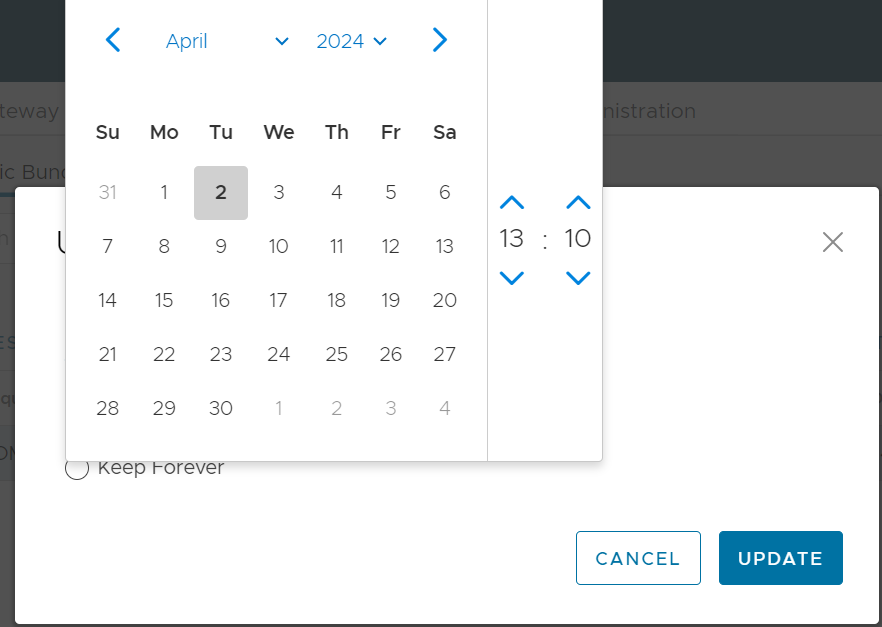
- You can also choose to keep the bundle indefinitely by selecting the Keep Forever radio button.
Figure 38. Keep Forever 
- Select OK.
The Orchestrator Diagnostics table grid updates to reflect the changes to the Cleanup Date.
Figure 39. Updated Cleanup Date 
- From the Update Cleanup Date dialog, select the Calendar icon to change the date.
Database Statistics Tab
The Database Statistics tab provides a read-only access view of some of the information from a diagnostic bundle.
If you require additional information, go to the Diagnostic Bundles tab, request a diagnostic bundle, and download it locally. For additional information, see Request Diagnostic Bundle in the Arista VeloCloud SD-WAN Troubleshooting Guide.

| Option | Description |
|---|---|
| Database Sizes | Sizes of the Orchestrator databases. |
| Database Table Statistics | Statistical details of all tables in the Orchestrator database. |
| Database Storage Info | Storage details of the mounted locations. |
| Database Process List | The top 20 records of long-running SQL queries. |
| Database Status Variable | The status variables of the MySQL server. |
| Database System Variable | System variables of the MySQL server. |
| Database Engine Status | The InnoDB engine status of the MySQL server. |
System Metrics Monitoring
This section discusses System Metrics Monitoring on the Orchestrator.
Orchestrator System Metrics Monitoring Overview
The Orchestrator comes with a built-in system metrics monitoring stack, which includes a metrics collector and a time-series database. With the monitoring stack, you can easily check the health condition and the system load for the Orchestrator.
To enable the monitoring stack, run the following command on the Orchestrator:
sudo /opt/vc/scripts/vco_observability_manager.sh enableTo check the status of the monitoring stack, run:
sudo /opt/vc/scripts/vco_observability_manager.sh statusTo deactivate the monitoring stack, run:
sudo /opt/vc/scripts/vco_observability_manager.sh disableThe Metrics Collector
Telegraf is used as the Orchestrator system metrics collector, which includes plugins to collect system metrics. The following metrics are enabled by default.
| Metric Name | Description |
|---|---|
| inputs.cpu | Metrics about CPU usage. |
| inputs.mem | Metrics about memory usage. |
| inputs.net | Metrics about network interfaces. |
| inputs.system | Metrics about system load and uptime. |
| inputs.processes | The number of processes grouped by status. |
| inputs.disk | Metrics about disk usage. |
| inputs.diskio | Metrics about disk IO by device. |
| inputs.procstat | CPU and memory usage for specific processes. |
| inputs.nginx | Nginx's basic status information (ngx_http_stub_status_module). |
| inputs.mysql | Statistic data from the MySQL server. |
| inputs.clickhouse | Metrics from one or many ClickHouse servers. |
| inputs.redis | Metrics from one or many redis servers. |
| inputs.filecount | The number and total size of files in specified directories. |
| inputs.ntpq | Standard NTP query metrics (requires ntpq executable). |
| Inputs.x509_cert | Metrics from a SSL certificate. |
-
sudo vi /etc/telegraf/telegraf.d/system_metrics_input.conf -
sudo systemctl restart telegraf
The Time-series Database
Prometheus is used to store the system metrics collected by Telegraf. The metrics data will be kept in the database for three weeks at the most. By default, Prometheus listens on port 9090. If you have an external monitoring tool, provide the Prometheus database as a source, so that you can view the Orchestrator system metrics on your monitoring UI.
Rate Limiting API Requests
When there are too many API requests sent at a time, it affects the performance of the system. You can enable Rate Limiting, which enforces a limit on the number of API requests sent by each user.
The Orchestrator makes use of certain defence mechanisms that curb API abuse and provides system stability. API requests that exceed the allowed request limits are blocked and returned with HTTP 429 (Too many Requests). The system needs to go through a cool down period before making the requests again.
- Leaky bucket limiter – Smooths the burst of requests and only allows a pre-defined number of requests. This limiter takes care of limiting the number of requests allowed in a given time window.
- Concurrency limiter – Limits the number of requests that occur in parallel which leads to concurrent requests fighting for resources and may result in long running queries.
- Large number of active or concurrent requests.
- Sudden spikes in request volume.
- Requests resulting in long running queries on the Orchestrator holding system resources for long being dropped.
- Handle HTTP 429 response code when requests exceed rate limits.
- The penalty time duration is 5000 ms when the rate limiter reaches the maximum allowed requests in a given period. If blocked, the clients are expected to have a cool down period of 5000 ms before making requests again. The requests made during the cool down period of 5000 ms will still be rate limited.
- Use shorter time intervals for time series APIs which will not let the request to expire due to long running queries.
- Prefer batch query methods to those that query individual Customers or Edges whenever possible.
Configure Rate Limiting Policies using System Properties
vco.api.rateLimit.enabledvco.api.rateLimit.mode.logOnlyvco.api.rateLimit.rules.globalvco.api.rateLimit.rules.enterprise.defaultvco.api.rateLimit.rules.enterpriseProxy.default
For additional information on the system properties, see List of System Properties.
Configure Rate Limiting Policies using APIs
enterpriseProxy/insertOrUpdateEnterpriseProxyRateLimits– Used to configure Partner-specific policies.enterprise/insertOrUpdateEnterpriseRateLimits– Used to configure Customer-specific policies.
For additional information on the APIs, see hthttps://www.arista.com/en/support/product-documentation.
Enterprise Deployment and Operations for Orchestrator
This section provides information about the available options to monitor, backup, and upgrade Enterprise On-Premises deployments in a two-day operation scenario.
Overview
- Isolation of the solution: The VeloCloud team will not have access to apply hotfixes and upgrades.
- Restrictions on change management limit the frequency of patching and upgrades.
- Inadequate or insufficient solution monitoring: This situation may happen due to a lack of personnel capable of managing the infrastructure, resulting in functional issues, slower resolution of problems, and customer dissatisfaction.
This approach always requires a significant investment in people and time to manage, operate, and patch properly. The table below outlines some of the elements that must be considered when managing a system on-premises.
| System | Description | Arista Hosted Responsibility | On-Premises Responsibility |
|---|---|---|---|
| SD-WAN Orchestration | Application QoS and link steering policy | Yes | Yes |
| Security policy for apps and SD-WAN appliances | Yes | Yes | |
| SD-WAN appliance provisioning and troubleshooting | Yes | Yes | |
| Handling of SD-WAN alerting & events | Yes | Yes | |
| Link performance and capacity monitoring | Yes | Yes | |
| Hypervisor | Monitoring / alerting | No | Yes |
| Compute and memory resourcing | No | Yes | |
| Virtual networking and storage | No | Yes | |
| Backup | No | Yes | |
| Replication | No | Yes | |
| Infrastructure | CPU, memory, compute | No | Yes |
| Switching and routing | No | Yes | |
| Monitoring & management systems | No | Yes | |
| Capacity planning | No | Yes | |
| Software upgrades/patching | No | Yes | |
| Troubleshooting application/infrastructure issues | No | Yes | |
| Backup and Infrastructure DR | Backup infrastructure | No | Yes |
| Regular testing of backup regime | No | Yes | |
| DR infrastructure | No | Yes | |
| DR testing | No | Yes |
Two-day operation scenarios for Enterprise On-Premises deployments are explained in the two sections below, respectively (Day One Operations and Day Two Operations).
Day One Operations
Subscribe to Security Advisories
Security Advisories document remediation for security vulnerabilities that are reported in VeloCloud products. Please subscribe to the link below to receive an alert if an action is required in an on-prem component.
Deactivate Cloud-init on the Orchestrator
The data-source contains two sections: meta-data and user-data. Meta-data includes the instance ID and should not change during the lifetime of the instance, while user-data is a configuration applied on the first boot (for the instance ID in meta-data).
After the first boot up, it is recommended to deactivate the cloud-init file to speed up the Orchestrator boot sequence. To deactivate cloud-init, run:
./opt/vc/bin/cloud_init_ctl -d
- Go to the folder
/opt/vcrepo/pool/main/v/vco-tools - Install the Orchestrator tool package from the folder: “
sudo dpkg -i
vco-tools_3.4.1-R341-20200423-GA-69c0f688bf.deb
”. The vco-tools package name may change depending on your release. Check the correct file name with the command "ls vco-tools."
NTP Timezone
The Orchestrator and Gateway timezone must be set to "Etc/UTC."
vcadmin@vco1-example:~$ cat /etc/timezone Etc/UTC vcadmin@vco1-example:~$echo "Etc/UTC" | sudo tee /etc/timezone sudo dpkg-reconfigure --frontend noninteractive tzdataNTP Offset
The expectation is that the NTP offset is <= 15 milliseconds.
vcadmin@vco1-example:~$ sudo ntpq -p remote refid st t when poll reach delay offset jitter ============================================================================== *ntp1-us1.prod.v 74.120.81.219 3 u 474 1024 377 10.171 -1.183 1.033 ntp1-eu1-old.pr .INIT. 16 u - 1024 0 0.000 0.000 0.000 vcadmin@vco1-example:~$sudo service ntp stop sudo ntpdate <server> sudo service ntp startOrchestrator Storage
When the Orchestrator is initially deployed, three partitions are created: /, /store, /store2, /store3 (version 4.0 and onwards). The partitions are created with default sizes. Please follow the instructions in the section titled, "Increasing Storage in the Orchestrator" for guidance in modifying the default sizes to match the design.
Additional Tasks
- Configure System Properties.
- Set up the initial Operator Profile.
- Set up Operator accounts.
- Create Gateways.
- Setup Orchestrator.
- Create the customer account/partner account.
The configurations in the list above are out of this document's scope and can be found in the deployment guides in the Arista documentation. Detailed instructions can be found in the topic Install Orchestrator.
Day Two Operations
Orchestrator Backup
This section provides the available mechanisms to periodically backup the Orchestrator database to recover from Operator errors or catastrophic failure of both the Active and Standby Orchestrator.
Remember that the Disaster Recovery feature or DR is the preferred recovery method. It provides a Recovery Point Objective of nearly zero, as all configurations on the Active Orchestrator is instantly replicated. For additional details on the Disaster recovery feature, refer to the next section.
Backup Using the Embedded Script
The Orchestrator provides an in-built configuration backup mechanism to periodically Backup the configuration to recover from Operator errors or catastrophic failure of both the Active and Standby Orchestrator. The mechanism is script-driven and is located at /opt/vco/scripts/db_backup.sh.
The script essentially takes a database dump of the configuration data and events, while excluding some of the large monitoring tables during the database dump process. Once the script is executed, backup files are created in the local directory path provided as input to the above script.
The Backup consists of two .gzs files, one containing the database schema definition and the other one containing the actual data without definition. The administrator should ensure that the backup directory location has enough disk space for the Backup.
- Mount a remote location and configure the backup script to it. The remote location should have the same storage as /store if flows are also being Backup.
- Before using the Backup Script, check the Disaster Recovery (DR) replication status from the Orchestrator replication page. They should be in sync, and no errors should be present.
- Additional to this, execute a MySQL query and check the replication lag.
- SHOW SLAVE STATUS \G
- In the above query, look at the field seconds_behind_master. Ideally, it should be zero, but under 10 would be sufficient as well.
- For the large Orchestrators, it is recommended to use the Standby for the Backup script execution. There will be no difference in the Backup that is generated from both Orchestrators.
Caveats- The Script only takes a backup of the configuration; flow stats or events are not included.
- Restoring the configuration requires assistance from the Support/Engineering team.
- How long does the Script take to run?
The duration of the Backup depends on the scale of the actual customer configuration. Since the monitoring tables are excluded from the Backup operation, it is expected that the configuration Backup operation will complete quickly. For a large Orchestrator with thousands of Edge and lots of historical events, it could take up to an hour, while a smaller Orchestrator should be completed within a few minutes.
- What is the recommended frequency to run the Backup script?
Depending on the size and time it takes to complete the initial backup, the Backup operation frequency can be determined. The Backup operation should be scheduled to run during off-peak hours to reduce the impact on Orchestrator resources.
- What if the root filesystem doesn't have enough space for the backup?
It is recommended that other mounted volumes are used to store the backup. Note, it is not a best practice to use the root filesystem for the backup.
- How does one verify if the Backup operation completed successfully?
The script
stdoutandstderrshould be sufficient to determine the success or failure of the Backup operation. If the script invocation is automated, the exit code can determine the Backup operation's success or failure. - How is the configuration recovered?
Currently, Arista requires that the customer work with Arista Support to recover the configuration data. Arista Support will help to recover the customer's configuration. Customers should refrain from making any additional configuration changes until the configuration is restored.
- What is the exact impact of executing this Script?
Even though a backup of the configuration should have little impact on performance, there will be an increase in resource utilization for the MySQL process. It is recommended that the Backup be run during off-peak hours.
- Are any configuration changes allowed during the run of the Backup operation?
It is safe to make configuration changes while the Backup operation is running. However, to ensure up-to-date backups, it is recommended that no configuration operations are done while the Backup is running.
- Can the configuration be restored on the original Orchestrator, or does it require a new Orchestrator?
Yes, the configuration can, and ideally should, be restored on the same Orchestrator if it is available. This will ensure that the monitoring data is utilized after the Restore operation is completed. If the original Orchestrator cannot be recovered and the Standby Orchestrator is down, the configuration can be restored on a new Orchestrator. In this instance, the monitoring data will be lost.
- What actions should be taken in case the configuration needs to be restored to a new Orchestrator?
Contact Arista Support for the recommended set of actions on the new Orchestrator as the steps vary depending on the actual deployment.
- Do Edges have to re-register on the newly restored Orchestrator?
No, Edges are not required to register on the new Orchestrator, as all needed information is preserved as part of the Backup.
Orchestrator Disaster Recovery
States
- Standalone (no DR configured)
- Active (DR configured, acting as the primary Orchestrator server)
- Standby (DR configured, acting as an inactive replica Orchestrator server)
- Zombie (DR formerly configured and Active, but no longer working as the Active or Standby)
| Phases | Orchestrator A Role | Orchestrator B Role |
|---|---|---|
| Initial | Standalone | Standalone |
| Pairing | Active | Standby |
| Failover | Zombie | Standalone |
- Locate the Orchestrator DR in a geographically separate datacenter.
- Before promoting a Standby Orchestrator as Active, confirm that the DR replication Status is in Sync. The previously Active Orchestrator will no longer be able to manage the inventory and configuration.
Figure 41. Active Orchestrator - If the Standby can communicate with the formerly Active Orchestrator, it will instruct that Orchestrator to enter a Zombie state. In the Zombie state, the Orchestrator communicates with its clients ( Edges, Gateways, UI/API) that it is no longer Active, and they must communicate with the newly promoted Orchestrator.
- If the promoted Standby cannot communicate with the formerly Active Orchestrator, the Operator should, if possible, manually demote the previously Active.
- Detailed instructions can be found in the official Orchestrator documentation under "Configure Orchestrator Disaster Recovery."
Upgrade Procedure for the Orchestrator
- Arista Support will assist with the upgrade. Collect the following information before contacting Arista Support.
- Provide the current and target Orchestrator versions, for example, the current version (i.e., 3.4.2), target version (3.4.3).
Note: For the current version, this information can be found on the top, right corner of the Orchestrator by selecting the Help link and choosing About.
- Provide a screenshot of the replication dashboard of the Orchestrator, as shown below.
Figure 42. Replication Dashboard - Hypervisor Type and version (i.e., vSphere 6.7)
- Commands from the Orchestrator (Commands must be run as root (e.g. sudo <command> or sudo-i)).
- LVM layout
pvdisplay -vvgdisplay -vlvdisplay -vdf -hcat /etc/fstab
- Memory information
free -mcat /proc/meminfops -eftop -b -n 2
- CPU Information
cat /proc/cpuinfo
- Copy of
/var/logtar -czf /store/log-`date +%Y%M%S`.tar.gz --newer-mtime="36 hours ago" /var/log
- From the Standby Orchestrator:
sudo mysql
--defaults-extra-file=/etc/mysql/velocloud.cnf
velocloud -e 'SHOW SLAVE STATUS \G'
- From the Active Orchestrator:
sudo mysql
--defaults-extra-file=/etc/mysql/velocloud.cnf
velocloud -e 'SHOW MASTER STATUS \G'
- LVM layout
- Provide the current and target Orchestrator versions, for example, the current version (i.e., 3.4.2), target version (3.4.3).
- Contact Arista VeloCloud Support at with the above-mentioned information for assistance with the Orchestrator upgrade.
- ESXi Snapshot guidelines are provided in the next section in case the customer wants a quick rollback solution after an upgrade.
ESXi Snapshot
The ESXi snapshot capability can be used before the Orchestrator upgrades to provide a quick rollback to the previous Orchestrator version.
ESXi Snapshot Best Practices
- Standby and Active Orchestrator must be powered off before performing or restoring from the Snapshot to avoid any database inconsistencies.
- All Snapshot-related tasks must be done in the Standby and Active Orchestrator to avoid any database inconsistencies.
- It is essential to consolidate the Snapshot if the upgrade process was successful. The snapshot file continues to grow when it is retained for a more extended period. This can cause the snapshot storage location to run out of space and impact the system performance.
- Deactivate alerting in the Orchestrator while creating snapshots to avoid false alarms.
- Do not use a single snapshot for more than 72 hours.
- It is not recommended to use Snapshots as backups.
- Feature validation was done with ESXi 6.7 and Orchestrator version 3.4.4.
Snapshot best practices can be found in the following KB article Best practices for using VMware snapshots in the vSphere environment.
Create ESXi Snapshot
- Deactivate alert, notification, and monitoring System Properties on the Active Orchestrator. The approximate duration is 10 Minutes.
- In the Operator portal, select System Properties. Change the following System Properties to false.
vco.alert.enablevco.notification.enablevco.monitor.enable
- In the Operator portal, select System Properties. Change the following System Properties to false.
- Deactivate alert, notification, and monitoring System Property on the Standby Orchestrator.
- Change the following System Properties to false.
vco.alert.enablevco.notification.enablevco.monitor.enable
- Change the following System Properties to false.
- Power off the Active Orchestrator.
Go to .
- Power off the Standby Orchestrator.
Go to
- Take a Snapshot of the Active Orchestrator. Confirm that the VM is powered off before performing this step.
Go to .
- Take a Snapshot of Standby Orchestrator. Confirm that the VM is powered off before performing this step.
Go to .
Consolidation of the ESXi Snapshot
- After confirming a successful upgrade on the Active and Standby Orchestrators, you can consolidate the Snapshots starting with the Active Orchestrator.
Go to .
- Consolidate the Snapshot in the Standby Orchestrator.
Go to .
- Re-enable alert, notification, and monitoring System Properties on the Active Orchestrator and the Standby Orchestrator.
In the Operator portal, select System Properties. Change the following system properties to true.
vco.alert.enablevco.notification.enablevco.monitor.enable
- If the Delete All snapshots does not work with vSphere 6.x/7.x, you can try to Consolidate Snapshots. For additional information, see the Consolidate Snapshots section in the vSphere Product Documentation.
Restore from the ESXi Snapshot
- Power off the Active Orchestrator.
Go to .
- Power off the Standby Orchestrator.
Go to .
- Restore the Snapshot of the Active Orchestrator.
Go to .
Select the Snapshot you want to restore the VM → Revert to.
- Restore the Snapshot of Standby Orchestrator.
Go to .
Select the Snapshot you want to restore the .
- Re-enable the alert, notification, and monitoring System Properties on the Active Orchestrator and the Standby Orchestrator. In the Operator portal, select System Properties. Change the following System Properties to true.
vco.alert.enablevco.notification.enablevco.monitor.enable
Controller Minor Software Upgrade (Ex. from 3.3.2 P3 to3.4.4)
The software upgrade file contains Gateway and system updates. Do NOT run ‘apt-get update && apt-get –y upgrade.’
Before proceeding with the SD-WAN Controller's upgrade, ensure that the Orchestrator was upgraded before to the same or a higher version.
- Download the SD-WAN Controller update package.
- Upload the image to the SD-WAN Controller storage (using, for example, the SCP command). Copy the image to the following location on the system:
/var/lib/velocloud/software_update/vcg_update.tar. - Connect to the SD-WAN Controller console and run:
sudo /opt/vc/bin/vcg_software_update.
root@VCG:/var/lib/velocloud/software_update# wget -O 'vcg_update.tar' <image location>
Resolving <image location> (<image location>)... Connecting to <image location>
(<image location>)| <ip address>|:443... connected.
HTTP request sent, awaiting response... 200 OK Length: unspecified [application/octet-stream]
Saving to: 'vcg_update.tar' [ <=> ]
325,939,200 3.81MB/s in 82s 2020-05-23 21:59:27 (3.79 MB/s) - ‘vcg_update.tar’ saved [325939200]
Controller major software upgrade (Ex from 3.3.2 or 3.4 to 4.0)
- A new system disk layout based on LVM to allow more flexibility in volume management
- A new kernel version
- New and upgraded base OS packages
- Improved security hardening based on the Center for Internet Security benchmarks
Due to these changes, the standard upgrade procedure which uses the upgrade script does not work. A particular upgrade procedure is required. It is in the product manual below. This procedure is to replace the 3.3.2 or 3.4 Gateway VM with the new 4.0 Gateway VM. Refer to the following KB article: SD-WAN Partner Gateway Upgrade and Migration 3.3.2 or 3.4 to 4.0.
This upgrade procedure requires Orchestrator system property configuration, which only Orchestrator Operator accounts can run. Create a support ticket with the Arista Support team to request the System Property change.
Monitoring
- SD-WAN Controller Monitoring
You can monitor the status and usage data of Controllers available in the Operator portal.
The procedure is as follows:
- In the Operator portal, select Gateways.
- The Gateways page displays the list of available Controllers.
- Select the link to a Gateway. The details of the selected Controller displays.
- Select the Monitor tab to view the usage data of the selected Controller.
The Monitor tab of the selected Controller displays the required details.
You can choose a specific period to view the Controller's details for the selected duration at the top of the page.
The page displays a graphical representation of usage details of the following parameters for the period of selected time duration, along with the minimum, maximum, and average values.
| Usage | Description |
|---|---|
| CPU Percentage | Percentage of usage of CPU |
| Memory Usage | Percentage of usage of memory |
| Flow Counts | Count of traffic flow |
| Handoff Queue Drops | Count of packets dropped due to queued handoff |
| Tunnel Count | Count of tunnel sessions |
SD-WAN Gateway Controller Recommended Values to Monitor
The following list shows values that should be monitored and their thresholds. The list below is given as a start point, and it is not exhaustive. Some deployments may require assessing additional components such as flows, packet loss, etc.
Whenever a warning threshold is reached, it is recommended to review the current device scale configuration and add more resources if required. When a critical alarm is triggered, it is crucial to contact Arista Support representatives to check the solution and provide further advice.
| Service Check | Service Check Description | Warn Threshold | Critical Threshold |
|---|---|---|---|
| CPU Load | Check System Load. | 60 | 80 |
| Memory | Checks the memory utilization buffer, cache, and used memory. | 70 | 80 |
| Tunnels | Number of tunnels from connected Edges. | 60% of max Scale | 80% of max Scale
Note: A sudden loss of all tunnels or an abnormal low quantity should also be a concern. |
| Handoff Drops | Due to the busy nature of traffic through a Controller, occasional drops are expected. | Consistent drops in specific queues may indicate a capacity problem. | |
| Disk Space | Current disk utilization | 40% Free | 20% Free |
| Controller NTP | Check for Time offset | Offset of 5 Seconds | Offset of 10 Seconds |
Orchestrator Integration with Monitoring Stacks
The Orchestrator comes with a built-in system metrics monitoring stack, which can attach to an external metrics collector and a time-series database. With the monitoring stack, you can quickly check the health condition and the system load for the Orchestrator.
-
- To enable the monitoring stack, run the following command on the Orchestrator:
sudo /opt/vc/scripts/vco_observability_manager.sh enable - To check the status of the monitoring stack, run:
sudo /opt/vc/scripts/vco_observability_manager.sh status - To deactivate the monitoring stack, run:
sudo /opt/vc/scripts/vco_observability_manager.sh disable
- To enable the monitoring stack, run the following command on the Orchestrator:
The Metrics Collector
| Metric Name | Description | Supported in Version |
|---|---|---|
| inputs.cpu | Metrics about CPU usage. | 3.4/4.0 |
| inputs.mem | Metrics about memory usage. | 3.4/4.0 |
| inputs.net | Metrics about network interfaces. | 4.0 |
| inputs.system | Metrics about system load and uptime. | 4.0 |
| inputs.processes | The number of processes grouped by status. | 4.0 |
| inputs.disk | Metrics about disk usage. | 4.0 |
| inputs.diskio | Metrics about disk IO by device. | 4.0 |
| inputs.procstat | CPU and memory usage for specific processes. | 4.0 |
| inputs.nginx | Nginx's basic status information (ngx_http_stub_status_module). |
4.0 |
| inputs.mysql | Statistic data from MySQL server. | 3.4/4.0 |
| inputs.redis | Metrics from one or many redis servers. | 3.4/4.0 |
| inputs.system | API and system metrics. | 3.4/4.0 (additional metrics are included in 4.0) |
| inputs.filecount | The number and the total size of files in specified directories. | 4.0 |
| inputs.ntpq | Standard NTP query metrics, requires ntpq executable. | 4.0 |
| Inputs.x509_cert | Metrics from a SSL certificate. | 4. |
sudo vi /etc/telegraf/telegraf.d/system_metrics_input.conf
sudo systemctl restart telegraf
The Time-series Database
A time Series Database can be used to store the system metrics collected by Telegraf. A time-series database (TSDB) is a database optimized for time series data.
Dashboard and Alerting Agent
The Dashboard and Alerting Agent allows you to query, visualize, alert, and explore the data stored in the TSDB. The image is an example of a dashboard using Telegraph (a TSDB and a dashboard engine) that can be created to monitor the solution.
Time-series Database Setup
Follow the instructions below to setup the time-series database.
- Add the potables entry to allow for external monitoring systems to access to telegraf port. The source IP address should be specified for security reasons.
- Example. The IP address of the external monitoring system is 191.168.0.200 Add "-A INPUT-p tcp -m tcp --source 191.168.0.200 --dport 9273 -m comment --comment "allow telegraf port" -j ACCEPT" to /etc/potables/rules.v4
- Restart potables.
sudo service iptables-persistent restart (Orchestrator 3.4.x)
sudo systemctl restart netfilter-persistent (Orchestrator 4.x)
- Make sure the potables entry is added.
- Add the time-series database details in the telegraf configuration. Create an output configuration file. Example with prometheus is as follows:
/etc/telegraf/telegraf.d/prometheus_out.conf
- Orchestrator Recommended Values to Monitor
The following list shows a list of values that should be monitored and their thresholds. The list below is given as a starting point, as it is not exhaustive. Some deployments may require assessing additional components such as database transactions, automatic backups, etc.
Whenever a warning threshold is reached, it is recommended to review the current device scale configuration and add more resources if required. When a critical alarm is triggered, it is crucial to contact the Arista Support representatives to check the solution and give further advice.Table 45. Orchestrator Recommended Values to Monitor Service Check Service Check Description Warn Threshold Critical Threshold CPU Load Check System Load – Telegraf input plugin: inputs.cpu. 60 70 Memory Checks the memory utilization buffer, cache, and used memory – Telegraf input plugin: inputs.memory. 70 80 Disk Usage Disk Utilization in the different Orchestrator partitions, /, /store, /store2 and /store3 (version 4.0 and onwards) – Telegraf input plugin: inputs.disk (version 4.0 and onwards). 40% Free 20% Free MySQL Server Checks MySQL Connections -Telegraf input plugin: inputs.mysql. Above 80% of max connection define in mysql.conf(/etc/mysql/my.cnf) Orchestrator Time Check for Time offset -Telegraf input plugin: inputs.ntpq (version 4.0 and onwards). Offset of 5 Seconds Offset of 10 Seconds Orchestrator SSL Certificate Checks Certificate Expiration - Telegraf input plugin: inputs.x509_cert (version 4.0 and onwards). 60 Days 30 Days Orchestrator Internet (not applicable for MPLS only topologies) Check for Internet access. Response time > 5 secs Response time > 10 secs Orchestrator HTTP Make sure HTTP on localhost is responding. The localhost is not responding. Orchestrator Total Cert Count Check Total – Example mysql query: SELECT count(id) FROM VELOCLOUD_EDGE_CERTIFICATE WHERE validFrom <= NOW() AND validTo >=NOW()', 'SELECT count(id) FROM VELOCLOUD_GATEWAY_CERTIFICATE WHERE validFrom <= NOW() AND validTo >=NOW()
CRL When Total Cert count exceeds 5000 DR Replication Status Confirm the Standby Orchestrator is up-to-date. Review that the DR Orchestrator is no more than 1000 seconds behind the Active Orchestrator. Seconds_Behind_Master: from mysql command: show slave STATUS\G;
DR Replication Edge Gateway delta Confirm that Edges and Gateways can talk to the DR Orchestrator. Different values between the Active and the Standby Orchestrators can be due to a difference in the timezone in Edges and Gateways.
The same amount of Edges talking with the Active Orchestrator should be able to reach the Standby Orchestrator. This value can be checked on the "replication" tab or via the API.
API Best Practices
- The Orchestrator Portal
The Orchestrator Portal allows network administrators (or scripts and applications acting on their behalf) to manage network and device configuration and query the current or historical network and device state. API clients may interact with the Portal via a JSON-RPC interface or a REST-like interface. It is possible to invoke all of the methods described in this document using either interface. There is no Portal functionality for which access is constrained exclusively to either JSON-RPC clients or REST-like ones.
Both interfaces accept exclusively HTTP POST requests. Both also expect that request bodies, when present, are JSON-formatted -- consistent with RFC 2616, clients are furthermore likely to formally assert where this is the case using the Content-Type request header, e.g., Content-Type: application/json.
additional information about the SD-WAN API can be found here: https://www.arista.com/en/support/product-documentation.
- Best Practices for enterprises and service providers Using APIs
Some of the best practices while using APIs are:
- Wherever possible, aggregate API calls should be preferred to enterprise-specific ones. e.g., a single call to monitoring/getAggregateEdgeLinkMetrics may be used to retrieve transport stats across all Edges concurrently.
- Arista requests that clients limit the number of API calls in flight at any given time to no more than a handful (i.e., <2-4). If a user feels there is a compelling reason to parallelize API calls, Arista requests that they contact Arista Support to discuss alternative solutions.
- We ordinarily don't recommend polling the API for stats data more frequently than every 10 min. New stats data arrives at the Orchestrator every 5 minutes. Due to jitter in reporting/processing, clients polling every 5 minutes might observe "false-positive" cases where stats aren't reflected in API calls' results. Users tend to find the best result using request intervals of 10 minutes or greater in duration.
- Avoid querying the same information twice.
- Use sleep between APIs.
- For complex software automations, run your scripts and evaluate the CPU/Memory impact. Then adjust as required.
Orchestrator Syslog Configuration
The Orchestrator Syslog capability can be configured independently for the following Orchestrator processes: portal, upload, and backend.
- Portal: The Portal process runs as an internal HTTP server downstream from NGINX. The Portal service handles incoming API requests, either from the Orchestrator web interface or from an HTTP/SDK client, primarily in a synchronous fashion. These requests allow authenticated users to configure, monitor, and manage the various services provided by the Orchestrator.
This log is very useful for AAA activities as it has all actions taken by users in the Orchestrator.
Log files:
/var/log/portal/velocloud.log(Logs all info, warn, and error logs) - Upload: The Upload process runs as an internal HTTP server downstream from NGINX. The Upload service handles incoming requests from Edges and Gateways, either synchronously or asynchronously. These requests primarily consist of activations, heartbeats, flow statistics, link statistics, and routing information sent by Edges and Gateways.
Log files:
/var/log/upload/velocloud.log(Logs all info, warn, and error logs) - Backend: Job runner that primarily runs scheduled or queued jobs. Scheduled jobs consist of cleanup, rollup, or status update activities. Queued jobs consist of processing link and flow statistics.
Log files:
/var/log/backend/velocloud.log(Logs all info, warn, and error logs)
- Navigate to System Properties in the Orchestrator,
log.syslog.<server>(e.g. log.syslog.portal). Go to type “log.syslog” in the search bar. - Change the “enable”: false value to true for one or more of the servers. Change the Host IP and port accordingly to your implementation.
Increasing Storage in the Orchestrator
For detailed instructions to increase the Storage in the Orchestrator, see the topics Install Orchestrator and Expand Disk Size.
- Best Practices:
- Make sure that the same LVM distribution is applied to the Standby Orchestrator.
- It is not recommended to reduce the size of the volumes once they were increased. Use thin provisioning instead.
- In 3.4, when increasing the disk size, the following percentage/value distribution may be used:
- “/” Volume: This volume is used for the operative system. Production Orchestrators are usually set to 140GBs and have from 40% to 60% usage.
- /store and /Store2: The proportion applied in production Orchestrators is close to 85% for /Store and 15% for /Store2.
- The following guidelines in the table below should be used in the 4.x release and onwards.
Table 46. Guidelines Instance Size /store /store2 /store3 /var/log Small (5000 Edges) 2 TB 500 GB 8 TB 100 GB Medium (10000 Edges) 2 TB 500 GB 12 TB 125 GB Large (15000 Edges) 2 TB 500 GB 16 TB `150 GB
Managing Certificates in the Orchestrator
The Orchestrator5 uses a built-in certificate server to manage the overall PKI lifecycle of all Edges and SD-WAN Controllers. X.509 certificates are issued to the devices in the network.
Detailed instructions to configure the CA can be found in the topics Install Orchestrator and Install an SSL Certificate.
- Management plane TLS 1.2 tunnels between the Orchestrator and Edge SD-WAN Controller.
- Control and Data plane IKEv2/IPsec tunnels between SD-WAN Edges and between Edge and SD-WAN Controller.
Certificate Revocation List
vcadmin@vcg1-example:~$ openssl crl -in /etc/vc-public/vco-ca-crl.pem -text | grep 'Serial Number' | wc -l 14 vcadmin@vcg1-example:~Support Interaction
Our Customer Support organization provides 24x7x365 world-class technical assistance and personalized guidance to Arista customers.
- Diagnostic Bundles
While investigating an incident, a diagnostic bundle of the Orchestrator and SD-WAN Controller can be created. The resulting file will assist the Arista Support team to further analyze the events around an issue.
- Share Access with Support
On occasion assistance from Arista Support representatives for the Orchestrator and SD-WAN Controllers may be required.
Some common ways to grant access are:- Remote sessions with Support: The customer would either grant remote control to the SSH jump server or follow the Support representative's instructions.
- Creating an account for the Support team in the Orchestrator. This helps the Support team gather logs without customer interaction.
- Through the Bastion Host: SSH permissions and keys can be configured to allow the Support engineers to access the on-premises Orchestrator and SD-WAN Controller using a Bastion Host.
When contacting Arista VeloCloud Support to assist triaging an issue, include the data described in the table below.
| Required | Suggested |
|---|---|
| Partner Case Number | Issue Start/Stop |
| Partner Return Email/Phone | Impacted Flow SRC/DST IP |
| Orchestrator URL | Impacted Flow SRC/DST Port |
| Customer Name in Orchestrator | Flow Path (E2E, E2GW, Direct) |
| Customer Impact (High/Med/Low) | SD-WAN Gateway Name(s) |
| Edge Name(s) | Link to PCAP in the Orchestrator |
| Link to Diagnostic Bundle in Orchestrator | |
| Short Problem Statement | |
| Analysis & Requested Assistance |