Route Summarization
Route Summarization or route aggregation provides a method to minimize the number of routes that a router advertises to its neighbor. It consolidates selected route prefixes into a single route advertisement. This differentiates it from regular routing, in which every unique route prefix in a route table is advertised to the neighbor.
Overview
Route Summarization or supernetting advertises a single route prefix instead of sending a bunch of contiguous route prefixes. However, with Route Summarization, there is a need to design the networks with summarization in mind,or there is a possibility for introducing suboptimal routing and forwarding traffic for unused networks. Similarly, if the router does not find a matching destination route prefix in its routing table that advertised the summary prefix, the router drops the traffic.
When using the Route Summarization feature, the network administrator must take into consideration the network design before they specify the summarized prefix, which needs to be advertised to its neighbor.
Route Summarization Use Case
In the example topology, a router learns route prefixes from multiple sources. When the router advertises route prefixes to its neighbor via BGP, it advertises the unique route prefixes.The router advertises eight unique route prefixes. Instead, with Route Summarization, the router can advertise a single summary prefix to the neighbor through BGP.
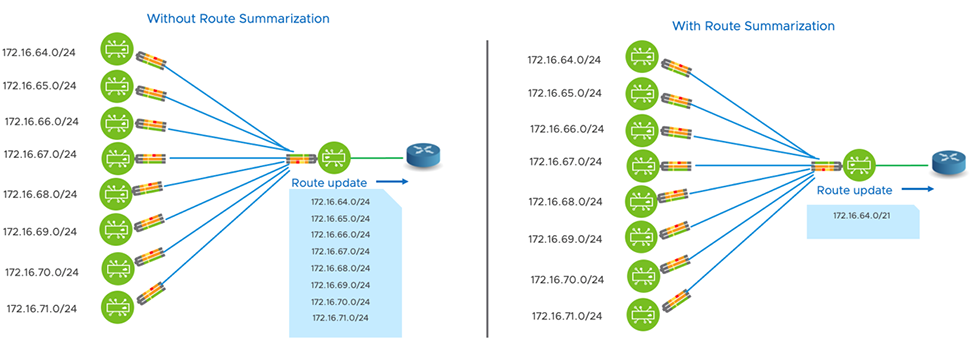
- In the case of the VeloCloud SD-WAN Edge:
- Summary prefix via BGP to a neighbor setup over Routed (LAN) interface
- Summary prefix via BGP to a neighbor setup over NSD (IPsec/BGP) tunnel
- Summary prefix via OSPF to a neighbor setup over Routed (LAN) interface
- In the case of the VeloCloud SD-WAN Gateway:
- Summary prefix via BGP to a neighbor setup over NSD (IPsec/BGP) tunnel
- Summary prefix via BGP to a Partner Hand off router over the Partner Hand off Interface
Black Hole Routing
A black hole route, also known as a null route, is a network route where traffic gets discarded. In reference to Route Summarization, black hole routing is used to drop traffic to a destination that is a part of a summary route, but not a part of the prefixes that are learned locally. From the 5.2 release, this process is required because when a summary route is advertised to the peer, all of the traffic is destined to the whole supernet summary route, including the destination prefix that is not present in the Edge/Gateway. Whenever a summary route is configured, a black hole route for summary prefix automatically installs in the route table, and it remains until you unconfigure it.
Configuring Route Summarization
In the 5.2 release, the Route Summarization feature can be configured in the Orchestrator UI for the following topics below.
Route Summarization Configuration
- Configure BGP from Edge to Underlay Neighbors for Profiles
- Configuring BGP over IPSec from Edge to Non SD-WAN Neighbors
- Activating OSPF for Profiles
- Configuring BGP Over IPsec from Gateways
- Configure Hand Off, see the VeloCloud SD-WAN Operator Guide.