Configure Alerts and Notifications
Orchestrator allows you to configure alerts that notify the Operators, Enterprise Administrators or other support users, whenever an event occurs.
In the SD-WAN service of the Enterprise portal, select . The Alert Configuration screen appears.
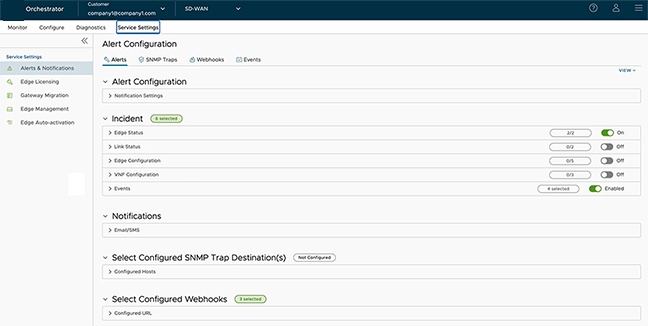
For information on how to configure Alerts, see Configure Alerts.
For information on how to configure SNMP Traps, see Configure SNMP Traps.
For information on how to configure Webhooks, see Configure Webhooks.
For information on how to configure events to be delivered as alerts, see Configure Events to be Alerted.
Configure Alerts
The Alerts page in the Alert Configuration window allows you to select the events for which the alerts need to be sent. You can also add and edit the contact details of existing admin users.
The alerts can be sent to both, the Operators managing the Orchestrator and the Customers. Alerts sent to the Operators are called Operator Alerts (formerly known as Pre-Notifications), and are sent as soon as the event occurs. Alerts sent to the Customers are called Enterprise Alerts and are activated only when a Customer turns on the Enable Enterprise Alerts option under Alert Configuration. Enterprise Alerts can be subject to delays as configured by the Enterprise Admin(s).
- In the Alert Configuration window, the Alerts tab is displayed by default.
Figure 2. Alert Display 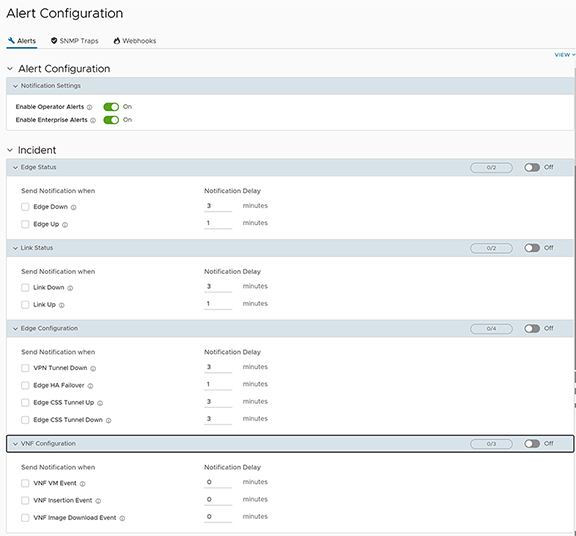
- Configure the Notification Settings as required.
- Under the Incident section, select the check boxes as required, and enter the corresponding Notification Delay time in minutes.
Note:
- The On/Off toggle button is automatically set to On if all the events are selected.
- Hover over the information icon next to each event for more information.
- You can use the event ALERT_CONFIGURATION_UPDATED to filter the events triggered by changes to the Enterprise Alert configurations.
- Expand Email/SMS in the Notifications section to display the contact details of existing admin users.
Figure 3. Email Notification 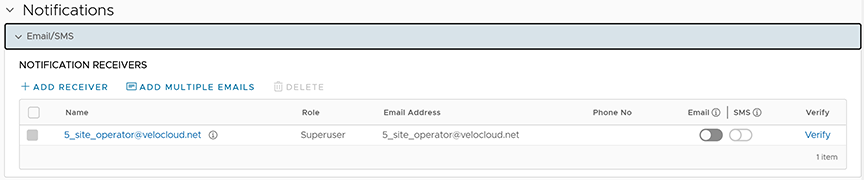
- Following contact details are displayed:
Table 1. Contact Detail Option Descriptions Option Description Name This field is auto-populated based on the configured administrators. Role Displays the role of the corresponding admin user. Email Address Displays the email address of the corresponding admin user. Phone No Displays the phone number of the corresponding admin user. Email Activate the toggle switch to send email notification to the admin user's email address. SMS Activate the toggle switch to send SMS notification to the admin user's mobile number. Note: This option is available only if the admin user has a valid phone number.Verify Select to validate the email address and/or phone number of the user. - The following additional options are available:
Table 2. Additional Option descriptions Option Description Add Receiver Selecting this option creates a new row for the admin user. Enter the name and phone number. Add Multiple Emails Select this option to add multiple email addresses for the admin user. The email addresses must be added in a comma separated list. Delete Select this option to delete all the contact details of the selected admin user. - Expand Configured Hosts under Select Configured SNMP Trap Destination(s) to display the configured SNMP Traps. You can select one or multiple traps using the drop-down menu.
Figure 4. Configured SMTP Traps 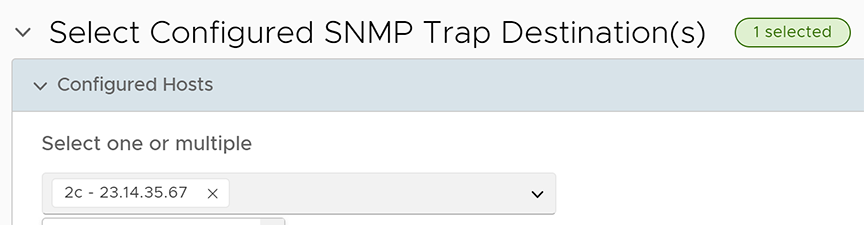 Note: If no SNMP Trap is configured, this section displays a link to the SNMP Traps page.
 - Expand Configured URL under Select Configured Webhooks to display the configured webhooks. You can select one or multiple webhooks using the drop-down menu.
Figure 5. Configured Webhooks 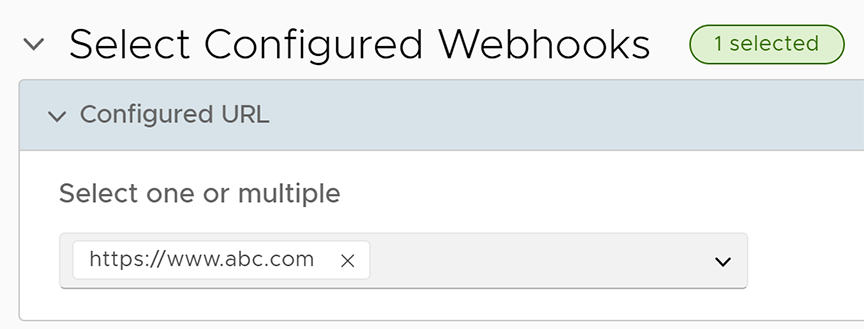 Note: If no webhook is configured, this section displays a link to the Webhooks page.
 - Select Save Changes.
Configure SNMP Traps
Simple Network Management Protocol (SNMP) Traps are notifications sent to an SNMP Agent to indicate that an event has occurred. Orchestrator sends SNMP Traps corresponding to the existing alerts like Edge Down and Edge Up.
The SNMP Traps page in the Alert Configuration window, allows you to configure v2c and v3 SNMP Trap Destinations.
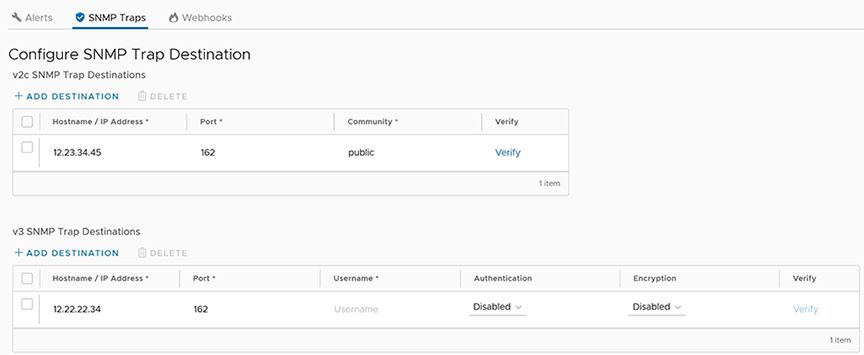
| Option | Description |
|---|---|
| Hostname/IP Address | Enter the IP address. |
| Port | Enter the port number. |
| Community | Enter the community. Community can be private or public. |
| Verify | Select this option to validate the IP address. |
| Add Destination | Select this option to add a new v2c SNMP Trap Destination. |
| Delete | Select this option to remove the selected entry from the table. |
| Option | Description |
|---|---|
| Hostname/IP Address | Enter the IP address. |
| Port | Enter the port number. |
| Username | Enter the username. |
| Authentication | Select one of the following:
|
| Encryption | Select one of the following:
|
| Verify | Select this option to validate the IP address. |
Select Save Changes to save the configured SNMP Trap Destinations.
Configure Webhooks
Webhooks deliver data to other applications, triggered by certain alerts using HTTP POST. Whenever an alert occurs, the source sends an HTTP request to the target application configured for the webhook. Orchestrator supports Webhooks that automatically send messages through HTTP POST to target apps when an event occurs. You can set the target URL in the Enterprise portal and automate actions in response to the alerts triggered by Orchestrator. The webhook recipients must support HTTPS and must have valid certificates, to ensure the privacy of potentially sensitive alert payloads. This also prevents the tampering of payloads. Any application that supports incoming webhooks with HTTPS can integrate with VeloCloud SD-WAN.

| Option | Description |
|---|---|
| URL | Enter a valid HTTPS URL. This serves as the target application for the webhooks. |
| Code | Enter an expected HTTP response status code for each webhook recipient. By default, the Orchestrator expects webhook recipients to respond to HTTP POST requests with a status code as HTTP 200.When Orchestrator receives an unexpected status code from a recipient server or a proxy server, it considers that the alert delivery has failed, and generates an ALERT_DELIVERY_FAILED customer event. This event helps to identify when a webhook recipient server may fail to function as expected. |
| Secret | This field is optional. Specify a secret token for each configured webhook recipient, which is used to compute an HMAC for each webhook request sent to the corresponding recipient. The HMAC is embedded in a X-Webhook-Signature HTTP header, along with a version parameter, which identifies the signature algorithm and a timestamp.
X-Webhook-Signature: v=<signature-version>&t=<timestamp>&s=<hmac>The recipient interprets the components as follows:
The message used to compute the HMAC is formed by concatenating the request body, a single period, and the value of the timestamp parameter that appears in the signature header. The specific HMAC algorithm used to produce the code is HMAC-SHA256.After receiving a Webhook request, the listening server can verify the authenticity of the request by computing its own HMAC-SHA256 signature according to the same algorithm and compare the newly-computed signature with the one generated by the Orchestrator. |
| JSON Payload Template | This is a required field. Orchestrator delivers alert notifications to each webhook recipient, through a JSON payload contained within the body of an outgoing HTTP POST request. Orchestrator generates payload content dynamically, as notifications are sent by performing variable interpolation. The supported placeholder variables in the user-configured payload template are replaced with alert-specific values. |
| Verify | Select this option to validate the entered details. |
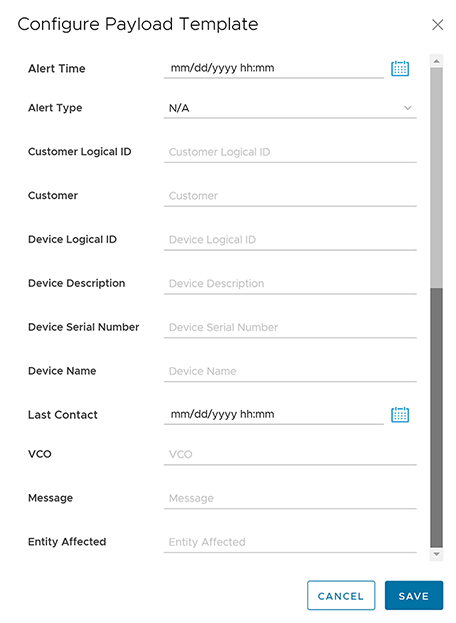
| Option | Description |
|---|---|
| Alert Time | Enter the date and time at which the alert must be triggered. |
| Alert Type | Select the type of alert from the drop-down menu. By default, it is displayed as N/A. |
| Customer Logical ID | Enter the logical ID of the customer to whom the notification must be sent. |
| Customer | Enter the name of the customer to whom the notification must be sent. |
| Device Logical ID | Enter the logical ID of the Edge to which the alert must be applied. |
| Device Description | Enter a brief message describing the Edge to which the alert must be applied. |
| Device Serial Number | Enter the serial number of the Edge to which the alert must be applied. |
| Device Name | Enter the name of the Edge to which the alert must be applied. |
| Last Contact | Enter the date and time at which the affected Edge most recently communicated with the Orchestrator. This is applicable only for the Edge alerts. |
| VCO | Enter the Hostname or public IP of the Orchestrator from which the notification must be sent. |
| Message | Enter a brief message describing the event that must trigger the alert. |
| Entity Affected | Enter the name of the entity: Edge or link or VNF, to which the alert must be applied. |
{
  "alertTime": "alertTime",
  "alertType": "alertType",
  "customer": "customer",
  "customerLogicalId": "customerLogicalId",
  "entityAffected": "entityAffected",
  "deviceLogicalId": "deviceLogicalId",
  "lastContact": "lastContact",
  "message": "message",
  "vco": "vco",
  "deviceName": "deviceName",
  "deviceDescription": "deviceDescription",
  "deviceSerialNumber": "deviceSerialNumber"
}
Select Save, and then select Save Changes on the Webhooks page to save the webhook configurations.
Whenever an alert is triggered, an alert message along with relevant information is sent to the target URL.
Configure Events to be Alerted
Orchestrator allows you to configure custom events to be alerted via Webhooks, SNMP, and e-mail that automatically send alert notifications to target recipients when the configured event occurs. Alert notification via SMS is not supported.
- In the SD-WAN service of the Enterprise portal, select . The Alert Configuration screen appears.
Figure 9. Event Alert Configuration 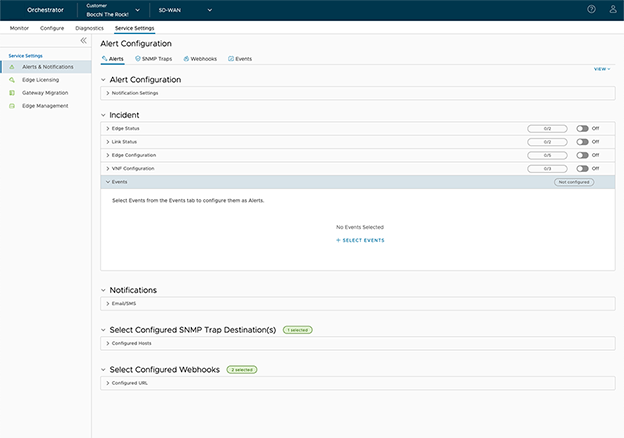
- Select . The Events page appears.
Figure 10. Events page 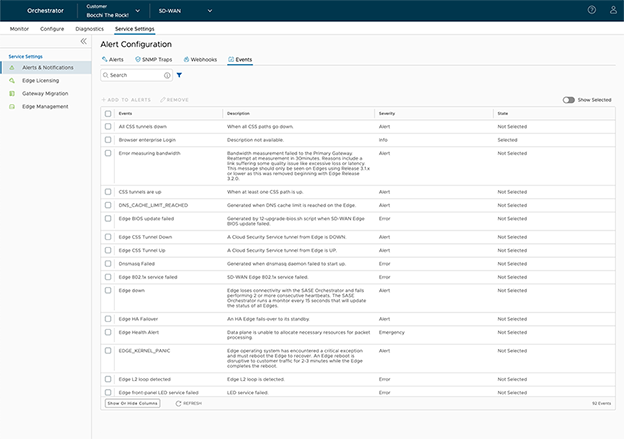
- In the Events page, you can use the Search filter to find the events to be delivered as alerts. You can filter the events by Event Name and Severity. Once you select the events, select the Show Selected toggle button to preview the selected events, and select +Add To Alerts.
The selected events will be configured as Alerts, using the existing configured Alert Notification method, and will appear under the Events area of the Alert Configuration screen.
Figure 11. Alert Configuration > Events - Select Save Changes.
In the Events page, select an event and select Remove to remove the event from the Events list. To add new custom events to the existing Events list, contact your Operator User.
Monitor Alert Notification Delivery Status
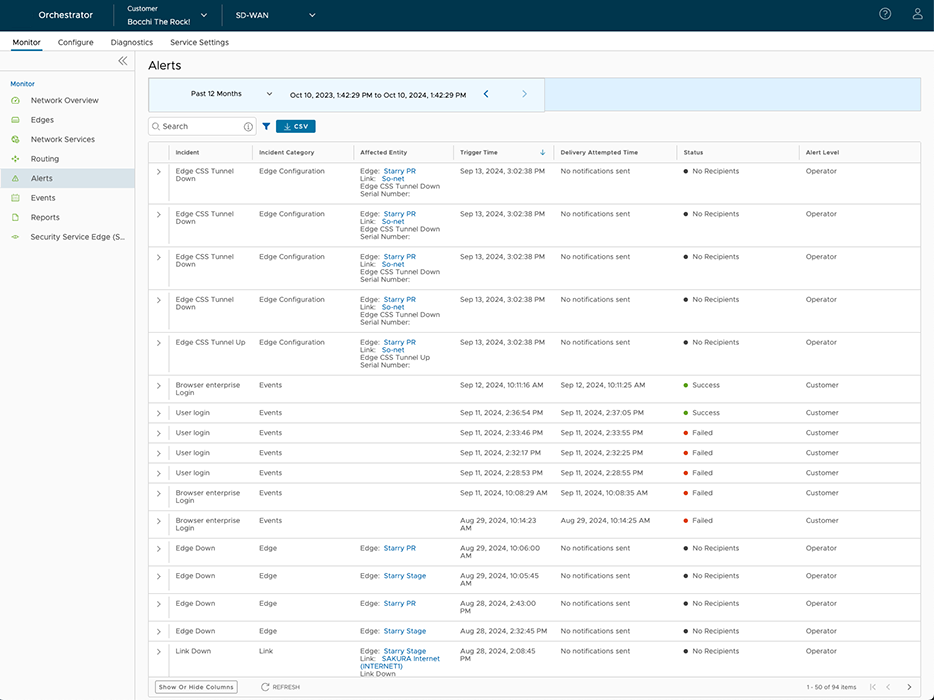
Once events are configured to be alerted, you can view the Alert notification delivery status under the page.