Overview
VeloCloud SD-WAN is a cloud network service solution enabling sites to quickly deploy Enterprise-grade access to legacy and cloud applications over both private networks and Internet broadband.
Cloud-delivered software-defined WAN assures enterprises of cloud application performance over the Internet and hybrid WAN, while simplifying deployments and reducing costs.
The following figure and sections describe the VeloCloud SD-WAN solution components in more detail.
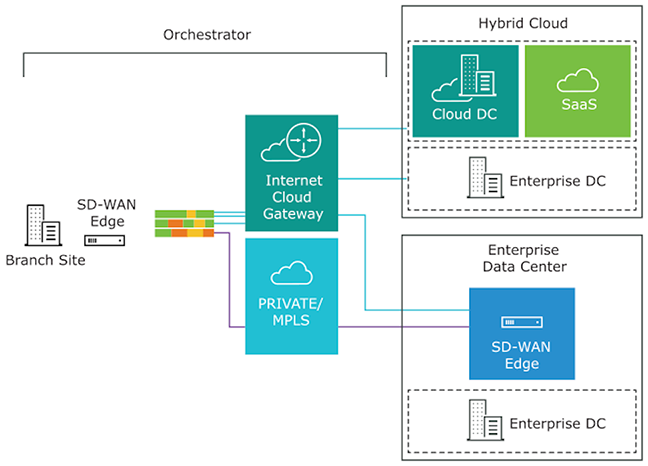
To become familiar with the basic configuration and Edge activation, see Activate Edges.
Arista VeloCloud SD-WAN Routing Overview
This section provides an overview of VeloCloud SASE
routing functionality, including route types, connected and static routes, and dynamic routes with tie-breaking scenarios and preference values in Overlay Flow Control (OFC) with Distributed Cost Calculation (DCC).
Overview
VeloCloud SASE routing is built on a proprietary protocol called VCRP, which is multi-path capable and secured through VCMP transport. The SD-WAN endpoints are connected using VCRP, similar to the iBGP full mesh. The SD-WAN Gateway acts as a BGP route reflector, which reflects the routes from one SD-WAN Edge to another SD-WAN Edge within the customer enterprise based on the profile settings.
The following diagram illustrates a typical SD-WAN deployment with Multi-Cloud non-SD-WAN destinations, where the Orchestrator performs the route calculation (as opposed to the newer and preferred method using Dynamic Cost Calculation (DCC).
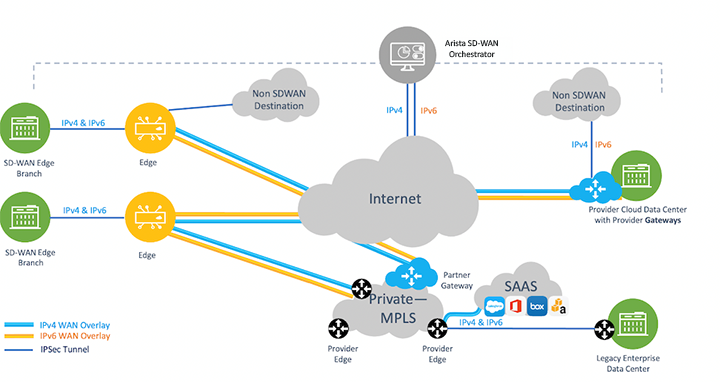
SD-WAN Components for Routing Purposes
- The SD-WAN Edge is an Enterprise-class device or virtualized cloud instance that provides secure and optimized connectivity to private, public, and hybrid applications and virtualized services. In SD-WAN routing, the Edge is a Border Gateway. An Edge can function as a regular Edge (with no Hub configuration), a Hub by itself or as part of a cluster, or a spoke (when Hubs are configured).
- The SD-WAN Gateway is autonomous, stateless, horizontally scalable, and cloud-delivered, to which Edges from multiple tenants can connect. For any SD-WAN deployment, several SD-WAN Gateways are deployed as a geographically distributed (for lower latency) and horizontally scalable (for capacity) network, with each Gateway acting as a Route-Reflector for its connected Edges. All locally learned routes on an Edge are sent to the Gateway based on the configuration. The Gateway then reflects these routes to other Edges in the enterprise, allowing for efficient full mesh VPN connectivity without building a full mesh of tunnels.
- The SASE Orchestrator is a multi-tenant cloud-based configuration and monitoring portal. In SD-WAN routing, the Orchestrator manages routes for all enterprises and can override default routing behavior.
See the following image for an illustration of the VeloCloud SD-WAN components for routing purposes.

Route Types
- Local Routes: Any route that is learned locally on a SD-WAN Edge. This can either be a connected subnet, statically configured route, or any route that is learned via BGP or OSPF.
- Remote Routes: Any route that is learned from VCRP, in other words, a route that is not locally present on an Edge is a remote route. This route originated from a different Edge and is reflected by the Gateway to other Edges in the customer enterprise based on the configuration.
SD-WAN uses a strict order to route traffic for non-dynamic routes (BGP and OSPF) that cannot be altered. However, in some scenarios, you can use the Longest Prefix Match technique to manipulate how the routing flows.
- Longest prefix length
- Local connected
- Local static if preferred option enabled (LAN static < WAN static). If preferred option is not enabled, overlay routes would be preferred
- NSD static routes local. NSD IPSec wins over NSD GRE.
- Remote NSD static
- Remote Edge connected
- Remote Edge LAN/WAN static
- PG static. PG secure static > PG non-secure static.
- Dynamic routes (Overlay Flow Control (OFC) or Distributed Cost Calculation Driven route order).
- Site Local (OSPF Inter/Intra, BGP non-uplink) is preferred than overly dynamic routes.
- Local OSPF inter/intra area routes wins over Local BGP.
- Local BGP wins over Local OSPF-external (OE1/OE2).
- Remote routes with preferred cost wins over non-preferred local route (OE1,OE2,UPLINK BGP).
- Within the remote dynamic routes preference is considered(lower preference wins).
- If preference is same, BGP attributes and OSPF metrics are compared).
- OSPF INTRA> INTER > OE1 > OE2
- BGP
- Higher Local preference
- Lower AS_PATH Length
- Smaller BGP metric
For more details on preference calculation, refer to the DCC section.
Connected and Static Routes
This section includes information regarding connected and static routes. A connected route is configured on a network directly attached to the interface. A static route is useful for special cases in which static routes are needed for existing network-attached devices, such as printers. For more information about static routes, see the topic Configure Static Route Settings section.
Connected Routes
- Activate Cloud VPN.
- Configure the connected route with a valid IP address.
- The Edge interface for this route must be up at Layer 1 and functional at Layers 2 and 3.
- VLANs associated with this Edge interface must be up.
- Set the Advertise flag on the Edge interface under Interface IP settings for the configured connected route.
- For a static route to be visible in SD-WAN, configure the following settings on the Orchestrator:
- Activate Cloud VPN.
- Select the Advertised check box in the static route configuration.
- Static routes forward traffic to the WAN underlay or LAN.
- Adding a static route bypasses the NAT on the Edge interface.
- ECMP (Equal-cost multi-path routing) with a static route is not supported, and only the first static route is used.
- Use an ICMP Probe to avoid black-holing traffic in case of failure in the next hop.
- A static route with the Preferred flag checked is preferred over any VPN route learned over the Overlay
The difference between the Preferred flag, and the Advertise flag: When the Preferred check box is selected, the static route will always be matched first, even if a VPN route with a lower cost is available.
Not selecting this option means that any available VPN route is matched over the static route, even when the VPN route has a higher cost than the static route. The static route is matched only when corresponding VPN routes are not available.
When the Advertise check box is selected, the static route is advertised over VPN and other SD-WAN Edges in the network will have access to the resource. This also enables static route redistribution into a routing protocol like local BGP/OSPF.
Do not select this option when a private resource like a remote worker's personal printer is configured as a static route and other users should be prevented from accessing the resource.
The OFC Global Advertise Flags control which routes are added to the overlay. By default, the following route types are not advertised into the overlay: External OSPF and Non SD-WAN Destination iBGP. In addition, if an Edge is acting as both Hub and Branch, the Global Advertise Flags configured for the Branch will be used, not the Hub.
There are two additional route types: Self Routes and Cloud Routes, which are installed on an Edge (depending on the Edge's configuration). Each route has a narrow application outlined below, which requires no additional treatment beyond their mention here:
A Self Route refers to an interface-based prefix using IP Longest prefix match (LPM) (for example: 172.16.1.10/32) which is installed locally on the Edge but is not advertised to remote Edges. Another term for Self Routes is "Interface Routes." In the Edge logs, self routes are displayed as route flag "s."
A self route differs from a connected route, as a connected route can be advertised into the overlay so that the remote Edge clients can reach back to clients belonging to the connected route on the source Edge side. Self routes are strictly local to the Edge itself.
A Cloud Route is indicated with a "v" flag and refers to a route installed on an Edge pointing to Primary VeloCloud SD-WAN Gateway for multi-path traffic destined for the Internet (in other words, Internet traffic using Dynamic Multi-Path Optimization (DMPO) which leverages a Gateway prior to reaching the Internet).
The Edge also uses a cloud route via a corresponding Gateway for management traffic destined for a Arista Edge Cloud Orchestrator, which is hosted on the public cloud.
Overlay Flow Control with Distributed Cost Calculation
This section discusses how a route order using OFC with DCC works.
This material is valid only for customers who have Distributed Cost Control (DCC) activated. DCC was first made available in SD-WAN Release 3.4.0 and is now recommended to be activated for all customers. This feature will automatically be activated for new customers in an upcoming release. For more information about DCC including best practices, see the topic Configure Distributed Cost Calculation.
Distributed Cost Calculation Overview
Distributed Cost Calculation (DCC) is a feature that leverages the SD-WAN Edges and Gateways for route preference calculation instead of relying on the SASE Orchestrator. The Edge and Gateway each insert the routes instantly upon learning them and then convey these preferences to the Orchestrator.
DCC resolves an issue seen in large scale deployments where relying solely on the Orchestrator can prevent timely route preference updates either because it could not be reached by an Edge or Gateway to receive updated routing preferences, or because the Orchestrator could not deliver route updates quickly when it is calculating a large number of them at one time. Distributing the responsibilities for route preference calculation to the Edges and Gateways ensures fast and reliable route updates.
How Distributed Cost Calculation Preference is Done
| Edge | Partner Gateway / Hosted Gateway |
|---|---|
| NSD E BGP | NSD E/I BGP |
| NSD I BGP | E/I BGP |
| NSD Uplink BGP | |
| OSPF O | |
| OSPF IA | |
| E BGP | |
| I BGP | |
| OSPF OE1 | |
| OSPF OE2 | |
| Uplink BGP |
| O = OSPF Intra area |
| IA = OSPF Inter area |
| OE1 = OSPF External Type-1 |
| OE2 = OSPF External Type-2 |
| E BGP = External BGP |
| I BGP = Internal BGP |
| NSD = Non SD-WAN Destination |
Non SD-WAN Destination (NSD) support with OFC is available from Release 4.3.0 and forward. For more information on NSDs, see the topic Configure a Non SD-WAN Destination.
| Device | Route Type | Default Preference |
|---|---|---|
| Edge/Hub | NSD E BGP | 997 |
| Edge/Hub | NSD I BGP | 998 |
| Gateway | NSD E/I BGP | 999 |
| Edge/Hub | NSD Uplink BGP | 1000 |
| Edge/Hub | OSPF O | 1001 |
| Edge/Hub | OSPF IA | 1002 |
| Edge/Hub | E BGP | 1003 |
| Edge/Hub | I BGP | 1004 |
| Partner Gateway | E/I BGP | 1005 |
| Edge/Hub | OSFP OE1 | 1001006 |
| Edge/Hub | OSPF OE2 | 1001007 |
| Hub/Edge | BGP Uplink | 1001008 |
- The Edge or Gateway learns a dynamic route.
- SD-WAN internally identifies what type of route it is and its default preference value.
- SD-WAN assigns the correct preference value and installs the route in the routing information base (RIB) and forwarding information base (FIB).
- SD-WAN considers the default advertising action configured for this route. Based on the advertising action, SD-WAN either advertises the route across the customer enterprise (advertised) or takes no action apart from adding the route locally into the RIB and FIB (not advertised).
- SD-WAN then synchronizes this route to the Orchestrator which displays it on the Orchestrator.
Preferred VPN Exit Points
Preferred VPN Exit Points
This section discusses Preferred VPN Exit Points and describes what routes can fall into which categories, and using route pinning to override default values.
In the SD-WAN service of the Enterprise portal, navigate to Configure Overlay Flow Control and then Preferred VPN Exits. This section displays default priorities and marks some route categories to be preferred over others.
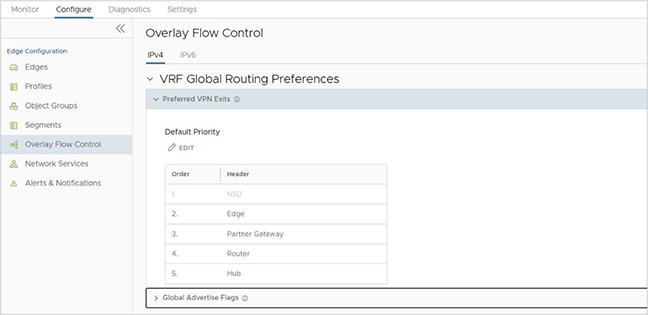
- Edge - Any internal route learned either on a Hub or Spoke Edge falls under this category and is marked with the highest priority. An internal route cannot be an OSPF OE 1 / OE 2 or BGP Uplink type route.
- Hub - Any external Route learned on an Edge/Hub falls into the Hub category and typically has a lower priority. Hub routes include OSPF OE1/2 and BGP Uplink.
- Partner Gateway - Any route learned on a Partner Gateway.
- Router - A router represents any route prefix learned by an Edge with a BGP or OSPF and determines the preference assigned to a dynamic route. Typically, all exit points above the Router in the VPN Exit receive a low preference value (preferred cost) and more preferred, while all exit points below the Router receive a higher preference value and less preferred.
- For example, when activating DCC, all routes that belong to VPN Exit Points, including Edge, Partner Gateway, or Hub, above a Router receive a preference value of less than 1,000,000, and the routes below Router receive a preference value greater than 1,000,000.
- In the following example, the VPN Exit Points above the Router, NSD, Edge, and Partner Gateway receive a preference value less than 1,000,000 and Hub receives a preference value greater than 1,000,000.
Figure 5. Overlay Flow Control - VRF Global Routing Preferences 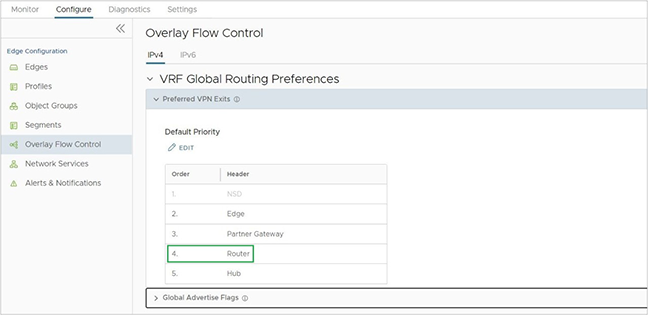
Pinning a Route to Override a Default Preference Value
SD-WAN provides a Route Pinning feature that allows a user to override the default preference value assigned to any dynamic route. After learning a dynamic route and synchronizing with the Orchestrator, navigate to the Overlay Flow Control page and override the default order for that route.
A user pins a route on the Overlay Flow Control page using one of the following options:
- On the Routes List, select one or more routes and then select Pin Learned Route Preference.
- Modifying the order of the Preferred VPN Exits by selecting Edit.
- The Orchestrator sends this routing event to the relevant Edges in the customer enterprise.
- The Edges override the previous preference value to match the pinned order.
- The preference values that get assigned to pinned routes start from 1, 2, 3, the lowest values and thus the highest preferences, and this matches the order of the routes on the Overlay Flow Control page. For more information on pinning a route, see Configure Subnets.
Tie-Breaking Scenarios for All Types of Routes
Tie-Breaking Scenarios for All Types of Routes
A potential scenario in SD-WAN deployments uses the same prefix to be advertised from two different Edges or Partner Gateways. With VeloCloud SD-WAN, if the subnets exist within the same category, Edge, Hub, or Partner Gateway, and have the same preference value, the BGP attributes or OSPF metrics are first considered for route sorting.
If there is still a tie, SD-WAN uses the logical ID (which is derived from the Edge or Gateway's universally unique identifier (UUID)) of the next hop device to break the tie. The next hop device can be a Gateway or a Hub Edge depending on the type of Branch to Branch VPN used. If the customer enterprise is using Branch to Branch via Gateway, the next hop is a Gateway, while a customer using Branch to Hub would have the next hop be a Hub Edge.
There is a final tie-breaker if multiple Gateways advertise the same exact route type and preference. This final tie-breaker prefers the oldest route learned. To ensure the routing outcome you want, you can either pin certain routes or configure the BGP attributes and costs to favor some routes over others.
Customers do not have control over how a logical ID (LID) is generated and you cannot change its value. LID values are not directly comparable. Instead, they are compared using an internal software algorithm that breaks down a LID into four blocks and compares them one by one. For example, lid1-data1 is greater than lid1-data2, and lid1-data2 is greater than lid2-data2.
See the example topology for an illustration of preference calculation and route sorting for dynamic routes.
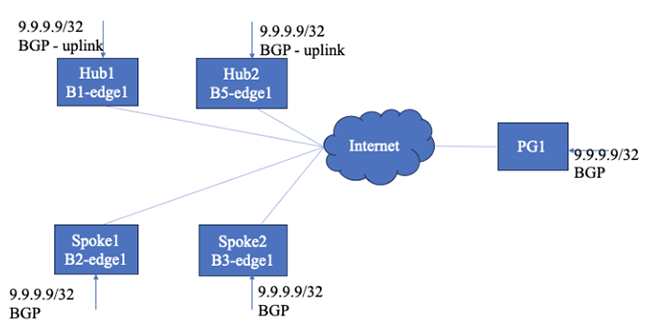
- Spoke1 and Spoke2 learn the route as BGP routes (non-uplink).
- Hub1 and Hub2 learn the routes as uplink BGP routes.
- PG1 also learns the same route.
- Branch to branch via Hub1 and Hub2 is enabled in spoke profile.
- Since spoke1 and spoke2 learn the route as BGP, they pick the preferred cost value (the preference value is referred to as cost in this section) is 1003, as per the DCC preference mapping table.
- Route 9.9.9.9/32 will be installed in FIB of Spoke1 and Spoke2 with a reference cost of 1000000. As always, the underlay route will be installed in FIB with a reference cost only. The derived cost/preference from the DCC preference table is for remote SD-WAN entities (Edges/Gateway) to use for route sorting.
- Spoke1 and Spoke2 redistribute the route over VCRP with a derived cost of 1003 to the Gateway and remote Edges/Hubs.
Figure 7. Derived Cost or Preference in Spokes 
- Similarly Hub1 and Hub2 learn the route and derive the non-preferred cost (1001008), since they learn the route as an uplink route. Hubs redistribute the route to Gateways and other Edges with this cost.
Figure 8. Derived Cost or Preference in Hubs 
- PG1 learns the same route from BGP and uses cost 1005 and redistributes it to the Edges. The below output shows the derived cost/preference in PG.
Figure 9. Derived Cost or Preference in PG 
- Spoke1 receives the route from Hub1 and Hub2 with the non-preferred cost of 1001008. Spoke1 has the preferred cost of 003. Hence, spoke1’s own underlay route will be preferred and Hub routes will be installed below the underlay route (SB). Within the Hub routes, if the preference (cost) is the same, BGP attributes will be compared for route sorting. If BGP attributes are also the same, then the Hub order will be used to install the routes.
- Spoke1 receives a route from Spoke2 and PG1 with costs 1003 and 1005, respectively. Since Spoke1 is having preferred cost 1003, and receives routes from Spoke2 and PG1 with a preferred cost (<100000), Spoke1 adds the reference cost 1000000 to the incoming preferred cost and install the routes in FIB. In this case, Spoke2’s route installs with a cost of 1001003 and PG1’s route installs with a cost of 1001005.
Figure 10. Installing Routes 
- The same route sorting logic is applied in Spoke2 or even Hubs if they learn the route as non-uplink route.
- If there is no underlay route learned in any entity, there will not be any correction to the received route preference/cost. The routes will be installed as per the received preference/cost.
Route Ordering in Hub with Uplink Routes
- Hubs install an underlay route (SB) with a reference cost of 1000000 in FIB.
- Hubs receive spoke routes with a preferred cost of 1003. Since cost is same between the spokes, BGP attributes will be compared and sorted based on that. If BGP attributes are also same, then spoke logical id will be used for sorting(lower destination logical ID wins the tie-breaker). The spoke’s routes will be installed with received cost as it is.
- The Hub receives PG1’s route with preferred cost. Therefore, it installs with that cost as is.
Figure 11. PG1 Route on the Hub 
Route Ordering in PG
- PG1 installs its own underlay route (PB) with preference 100000.
- PG1 receives spoke routes and Hub route with corresponding preference. Routes are placed in the FIB based on the preference value. If preference are same, BGP attributes are considered. If they are also same, then logical ID will be used for sorting.
- In PG, there is no preference/cost correction.
Figure 12. No Preference or Cost Correction 
Behavior if DCC is Not Enabled
- If DCC is not enabled, the advertisement verdict and the preference calculation is performed by the Orchestrator. Each entity (Edge or Gateway) sends the learned routes to the Orchestrator and expects to receive a reply from the Orchestrator. Upon receiving the reply from the Orchestrator, Edge, or Gateway would begin redistributing the routes to other SDWAN entities if the advertise flag is "true" in the reply.
- The route ordering remains the same, as is the case of DCC being enabled, but the preference values are not fixed in this scenario of DCC being disabled.
- The reference preference/cost is 512 for the Orchestrator based preference calculation. The preference/cost < 512 is the preferred cost, whereas > 512 is given to non-preferred routes (UPLINK routes, OSPF external routes). Other route sorting logic remains the same as when DCC is enabled.
- If spoke2 learns the route first and sends it to the Orchestrator, the Orchestrator will begin assigning the preference based on the entity and route type. Since spoke2 learns as non-uplink, the Orchestrator will assign the preference value (for example,64). Later, when spoke1 sends the same route to the Orchestrator, the Orchestrator will compare the entity, route type, and route attributes. If it is better, it will assign the preference to < 64. If it is worse, it will assign the preference to > 64.
- Hubs learn the routes as uplink routes and send them to the Orchestrator. The Orchestrator assigns a non-preferred cost (>512); in this example, it is 4096. If the preference is the same, the Hub order will be used to sort the routes in the spokes.
- When DCC is disabled, the route order in spoke1 (with a non-uplink route) will look like the following image.
Figure 13. Disabling DCC and Route Order in Spoke1 without an Uplink Route 
- The router order in Hubs with an uplink route looks like the following:
Figure 14. Router Order in Hubs with an Uplink Route 
- The route order in PG looks like the following:
Figure 15. Route Order in PG 
- Longest prefix length.
- NSD static routes local .
- Remote NSD static.
- PG secure static.
- Enterprise level PG static route wins over Global Level PG static.
- Remote connected/static.
- Edge logical_id becomes the tie breaker (higher logical ID wins).
- Dynamic routes (Overlay Flow Control (OFC) or Distributed Cost Calculation Driven route order).
- Dynamic route sorting will be based on preference value. Lower preference wins.
- Unlike an Edge, there is no preference in auto correction in Gateway. For dynamic routes, the Gateway installs the routes with the received preference. The local route will always be installed with the reference preference of 1000000.
- PG non-secure static.
Dynamic Multipath Optimization (DMPO)
This section provides an in-depth overview of Dynamic Multipath Optimization (DMPO) as used by the VeloCloud SD-WAN service.
Overview
VeloCloud SD-WAN™ provides a solution that lets enterprise and service providers use multiple WAN transports at the same time. This way, they can increase bandwidth and ensure application performance. The solution works for both on-premise and cloud applications (SaaS/IaaS). It uses a Cloud-Delivered architecture that builds an overlay network with multiple tunnels. It monitors and adapts to the changes in the WAN transports in real time. Dynamic Multipath Optimization (DMPO) is a technology that VeloCloud SD-WAN has developed to make the overlay network more resilient. It considers the real time performance of the WAN links. This document explains the key features and benefits of DMPO.
The following diagram depicts a typical SD-WAN deployment with Multi Cloud Non SDWAN Destinations.
Key Functionalities
- For enterprise locations (Branch to Branch or Branch to Hub), the Edges create DMPO tunnels with each other.
- For cloud applications, each Edge creates DMPO tunnels with one or more Gateways.
Continuous Monitoring
Automated Bandwidth Discovery- Once the WAN link is detected by the VeloCloud Edge, it first establishes DMPO tunnels with one or more VeloCloud Gateways and runs bandwidth test with the closest Gateway. The bandwidth test is performed by sending short bursts of bi-directional traffic and measuring the received rate at each end. Since the Gateway is deployed at the Internet PoPs, it can also identify the real public IP address of the WAN link in case the Edge interface is behind a NAT or PAT device. A similar process applies for a private link. For the Edges acting as the Hub or headend, the WAN bandwidth is statically defined. However, when the branch Edge establishes a DMPO tunnel with the Hub Edges, they follow the same bandwidth test procedures similar to how it is done between an Edge and a Gateway on the public link.
Continuous Path Monitoring:- Dynamic Multipath Optimization (DMPO) performs continuous, uni-directional measurements of performance metrics- loss, latency and jitter of every packet, on every tunnel between any two DMPO endpoints, Edge or Gateway. VeloCloud SD-WAN’s per-packet steering allows independent decisions in both uplink and downlink directions without introducing any asymmetric routing. DMPO uses both passive and active monitoring approaches. While there is user-traffic, DMPO tunnel header contains additional performance metrics, including sequence number and timestamp. This enables the DMPO endpoints to identify lost and out-of-order packets, and calculate jitter and latency in each direction. The DMPO endpoints communicate the performance metrics of the path between each other every 100 ms.
While there is no user traffic, an active probe is sent every 100 ms and, after 5 minutes of no high priority user-traffic, the probe frequency is reduced to 500 ms. This comprehensive measurement enables the DMPO to react very quickly to the change in the underlying WAN condition, resulting in the ability to deliver sub-second protection against sudden drops in bandwidth capacity and outages in the WAN.
MPLS Class of Service (CoS)- For a private link that has CoS agreement, DMPO can be configured to take CoS into account for both monitoring and application steering decisions.
Dynamic Application Steering
Application-aware Per-packet Steering - Dynamic Multipath Optimization (DMPO) identifies traffic using layer 2 to 7 attributes, e.g., VLAN, IP address, protocol, and applications. VeloCloud SD-WAN performs application-aware per-packet steering based on business policy configuration and real-time link conditions. The business policy contains out of the box Smart Defaults that specifies the default steering behavior and priority of more than 2500 applications: Customers can immediately use dynamic packet steering and application-aware prioritization without having to define any policy.
Throughout its lifetime, any traffic flow is steered onto one or more DMPO tunnels, in the middle of the communication, with no impact to the flow. A link that is completely down is referred to as having an outage condition. A link that is unable to deliver SLA for a given application is referred to as having a brownout condition. VeloCloud SD-WAN offers sub-second outage and sudden drops in bandwidth capacity protection. With the continuous monitoring of all the WAN links, DMPO detects sudden loss of SLA or outage condition within 300-500 ms and immediately steers traffic flow to protect the application performance, while ensuring no impact to the active flow and user experience. There is one minute hold time from the time that the brownout or outage condition on the link is cleared before DMPO steers the traffic flow back onto the preferred link if specified in the business policy.
Intelligent learning enables application steering based on the first packet of the application by caching classification results. This is necessary for application-based redirection, e.g., redirect Netflix onto the branch Internet link, bypassing the DMPO tunnel, while backhauling Office 365 to the enterprise regional hub or data center.
For example, Smart Defaults specifies that Microsoft Skype for Business is High Priority and is Real-Time application. Assuming there are two links with latency of 50 ms and 60ms respectively. Assume all other SLAs are equal or met. DMPO will chose the link the better latency, i.e. link with 50ms latency. If the current link to which the Skype for Business traffic is steered experiences high latency of 200 ms, within less than a second the packets for the Skype for Business flow is steered on to another link which has better latency of 60 ms.
Bandwidth Aggregation for Single Flow- For the type of applications that can benefit from more bandwidth, such as file transfer, DMPO performs per-packet load balancing, utilizing all available links to deliver all packets of a single flow to the destination. DMPO takes into account the real time WAN performance and decides which paths should be use for sending the packets of the flow. It also performs resequencing at the receiving end to ensure there is no out-of-order packets introduced as a result of per-packet load balancing.
For example, two 50 Mbps links deliver 100Mbps of aggregated capacity for a single traffic flow. QoS is applied at both the aggregate and individual link level.
On-demand Remediation
Error and Jitter Correction- In a scenario where it may not be possible to steer the traffic flow onto the better link, e.g., single link deployment, or multiple links having issues at the same time, Dynamic Multipath Optimization (DMPO) can enable error corrections for the duration the WAN links have issues. The type of error corrections used depends on the type of applications and the type of errors.
Real-time applications such as voice and video flows can benefit from Forward Error Correction (FEC) when there is packet loss. DMPO automatically enables FEC on single or multiple links. When there are multiple links, DMPO will select up to two of the best links at any given time for FEC. Duplicated packets are discarded and out-of-order packets are re-ordered at the receiving end before delivering to the final destination.
DMPO enables jitter buffer for the real-time applications when the WAN links experience jitter. TCP applications such as file transfer benefit from Negative Acknowledgement (NACK). Upon the detection of a missing packet, the receiving DMPO endpoint informs the sending DMPO endpoint to retransmit the missing packet. Doing so protects the end applications from detecting packet loss and, as a result, maximizes TCP window and delivers high TCP throughput even during lossy condition.
- Transactional/Bulk traffic- In this case, VeloCloud applies a NACK based retransmit algorithm, which is done at the VCMP protocol level attempting to correct the error condition before handing over the packet to the application.
- Realtime traffic- In this case, VeloCloud applies adaptive FEC to replicate packets (activate/deactivate upon loss SLA violation) and/or jitter buffer correction (upon jitter SLA violation – this one can only be activated and will persist for the life of the flow).
The link SLA (loss, latency, jitter) is continually being monitored and measured on a periodic basis and FEC (packet duplication) will be activated upon threshold violation for real-time traffic (different values for voice vs. video applications).
In a single WAN link scenario, duplicate packets transmit on the same link adjacent to one another. Since packet drops due to congestion are random, it is statistically unlikely that two adjacent packets will be dropped, greatly increasing the likelihood that one of the packets will make it through to the destination. The replicated packets are sent on separate links in the case of two or more WAN links.
Adaptive FEC is triggered on a per-flow basis in real-time based on measured packet loss thresholds, and disabled in real-time once packet loss no longer exceeds the activation threshold. This ensures that available bandwidth is used as efficiently as possible, unnecessary packet duplication is avoided, and resource overhead is reduced. Another significant benefit of VeloCloud Adaptive FEC approach is that the effect of packet loss in the transport network on end-user devices is minimized or eliminated. When end-user devices do not see packet drops, they avoid retransmissions and TCP congestion avoidance mechanisms like slow start, which can negatively impact overall throughput, application performance, and end-user experience.
DMPO Real World Results
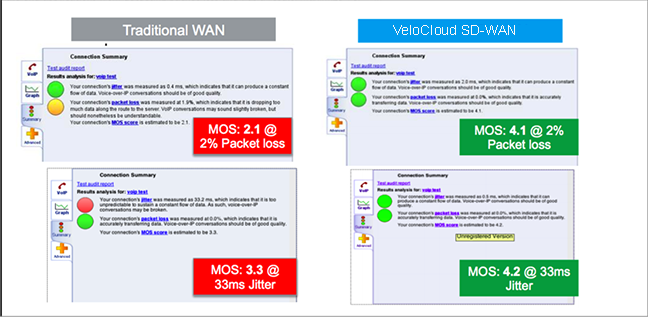
Scenario 1- Branch-to-branch VoIP call on a single link. The results in the below figure demonstrate the benefits of on-demand remediation using FEC and jitter remediation on a single Internet link with traditional WAN and VeloCloud SD-WAN. A mean opinion score (MOS) of less than 3.5 is unacceptable quality for a voice or video call.
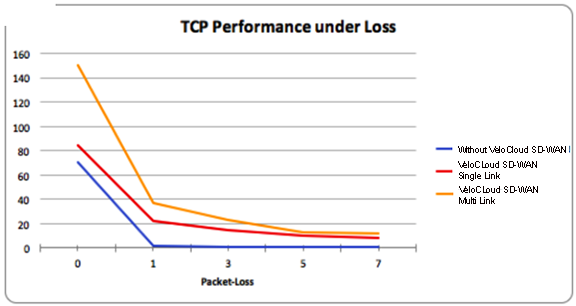
Scenario 2- TCP Performance with and without VeloCloud SD-WAN for Single and Multiple Links. These results show how NACK enables per-packet load balancing.
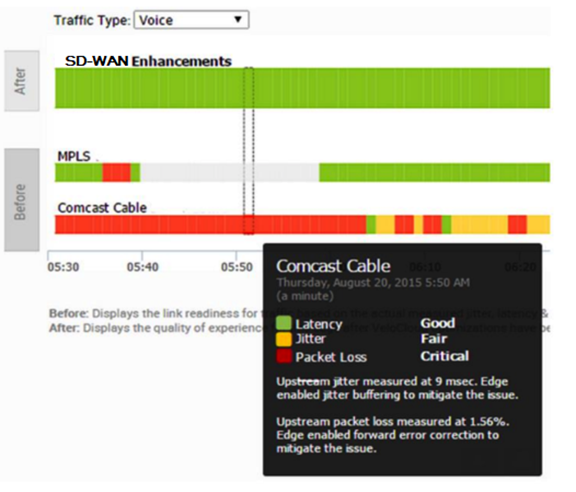
Scenario 3- Hybrid WAN scenario with an outage on the MPLS link and both jitter and loss on the Internet (Comcast) link. These results show how DMPO protects applications from sub-second outages by steering them to Internet links and enabling on-demand remediation on the Internet link.
Business Policy Framework and Smart Defaults
The business policy lets the IT administrator control QoS, steering, and services for the application traffic. Smart Defaults provides a ready-made business policy that supports over 2500 applications. DMPO makes steering decisions based on the type of application, real time link condition (congestion, latency, jitter, and packet loss), and the business policy. Here is an example of a business policy.
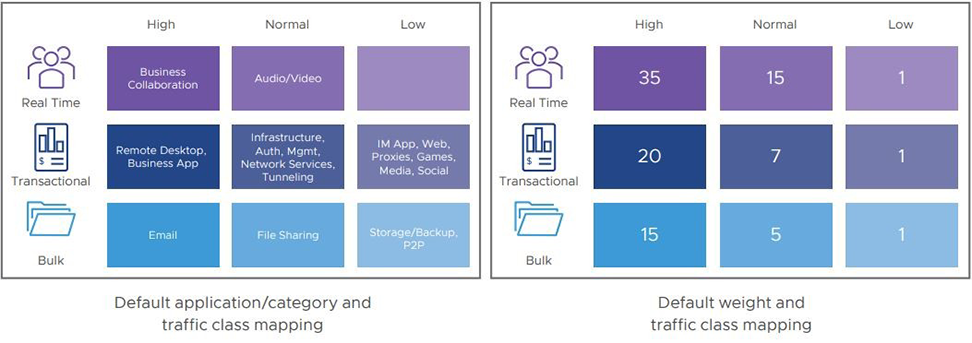
Each application has a category. Each category has a default action, which is a combination of Business Priority, Network Service, Link Steering, and Service Class. You can also define custom applications.
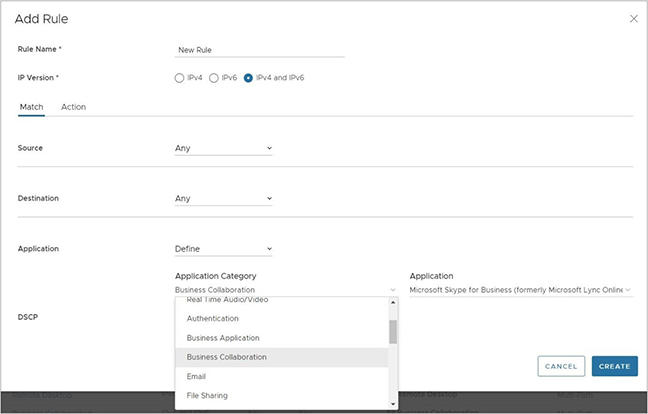
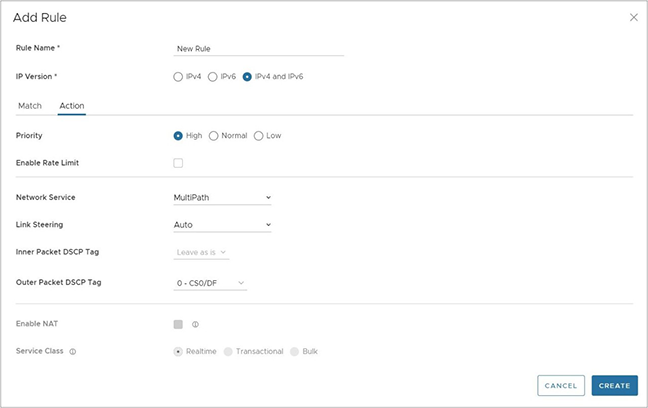
Each application has a Service Class: Real Time, Transactional, or Bulk. The Service Class determines how DMPO handles the application traffic. You cannot change the Service Class for the default applications, but you can specify it for your own custom applications.
Each application also has a Business Priority: High, Normal, or Low. The Business Priority determines how DMPO prioritizes and applies QoS to the application traffic. You can change the Business Priority for any application.
- Direct- This action is typically used for non-critical, trusted Internet applications that should be sent directly, bypassing DMPO tunnel. An example is Netflix. Netflix is considered a non-business, high-bandwidth application and should not be sent over the DMPO tunnels. The traffic sent directly can be load balanced at the flow level. By default, all the low priority applications are given the Direct action for Network Service.
- MultiPath- This action is typically given for important applications. By inserting the Multipath service, the Internet-based traffic is sent to the VeloCloud Gateway. The table below shows the default link steering and on-demand remediation technique for a given Service Class. By default, high and normal priority applications are given the Multipath action for Network Service.
- Internet Backhaul- This action redirects the Internet applications to an enterprise location that may or may not have the VeloCloud Edge. The typical use case is to force important Internet applications through a site that has security devices such as firewall, IPS, and content filtering before the traffic is allowed to exit to the Internet.
Link Steering Abstraction With Transport Group
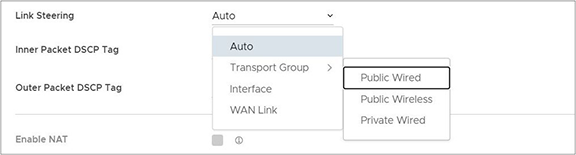
Across different branch and hub locations, there may be different models of the VeloCloud Edge with different WAN interfaces and carriers. In order to enforce the centralized link steering policy using Profile, it is important that the interfaces and carries are abstracted. Transport Group provides the abstraction of the actual interfaces of the devices and carriers used at various locations. The business policy at the Profile level can be applied to the Transport Group instead, while the business policy at the individual Edge level can be applied to Transport Group, WAN Link (carrier), and Interfaces.
Link Steering by Transport Group
Different locations may have different WAN transports, e.g. WAN carrier name, WAN interface name, DMPO uses the concept of transport group to abstract the underlying WAN carriers or interfaces from the business policy configuration. The business policy configuration can specify the transport group (public wired, public wireless, private wired, etc.) in the steering policy so that the same business policy configuration can be applied across different device types or locations, which may have completely different WAN carriers and WAN interfaces, etc. When the DMPO performs the WAN link discovery, it also assigns the transport group to the WAN link. This is the most desirable option for specifying the links in the business policy because it eliminates the need for IT administrators to know the physical connectivity or WAN carrier.
Link Steering by Interface
The link steering policy can be applied to the interface, e.g. GE2, GE3, which will be different depending on the Edge model and the location. This is the least desirable option to use in the business policy because IT administrators have to be fully aware of how the Edge is connected to be able to specify which interface to use.
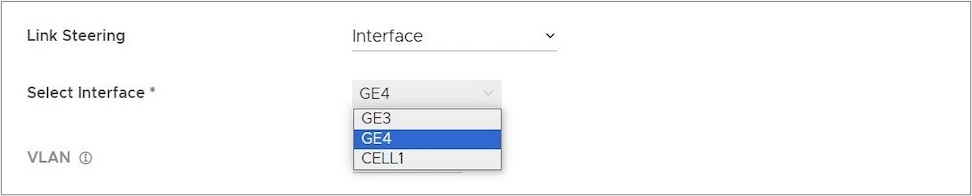
Link Steering and On-demand Remediation
There are four possible options for Link Steering – Auto, Preferred, Mandatory, and Available.
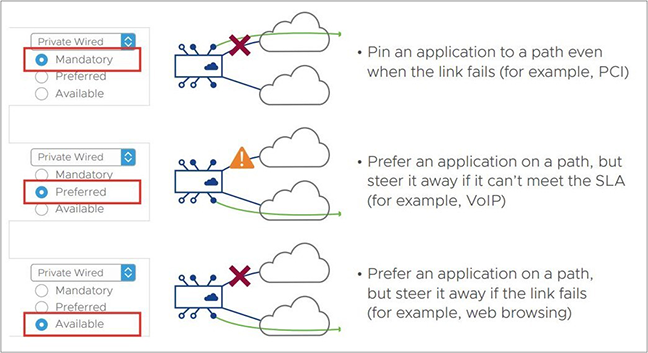
Link Selection Mandatory– Pin the traffic to the link or the transport group. The traffic is never steered away regardless of the condition of the link including outage. On-demand remediation is triggered to mitigate brownout condition such as packet loss and jitter.
For example, Netflix is a low priority application and is required to stay on the public wired links at all times.
- When the preferred Internet link has multiple public WAN link alternatives. Application traffic stays on the preferred link as long as it meets SLA for that application, and steers to other public links once the preferred link cannot deliver the SLA needed by the application. In the situation that there is no link to steer to, meaning all public links fail to deliver the SLA needed by the application, on-demand remediation is enabled. Alternatively, instead of steering the application away as soon as the current link cannot deliver the SLA needed by the application, DMPO can enable the on-demand remediation until the degradation is too severe to be remediated, then DMPO will steer the application to the better link.
- Example: Prefer the video collaboration application on the Internet link until it fails to deliver the SLA needed by video, then steer to a public link that meets this application's SLA.
- When the preferred Internet link has multiple public WAN link and private WAN link alternatives: Application traffic stays on the preferred link as long as it meets SLA for that application, and steers to another public link once the preferred link cannot deliver the SLA needed by the application. The preferred link will NOT steer to a private link in the event of an SLA failure, and would only steer to that private link in the event both the preferred link and another public link were both either unstable or down completely. In the situation that there is no link to steer to, meaning another public links failed to deliver the SLA needed by the application, on-demand remediation is enabled. Alternatively, instead of steering the application away as soon as the current link cannot deliver the SLA needed by the application, DMPO can enable the on-demand remediation until the degradation is too severe to be remediated, then DMPO will steer the application to a better link.
- Example A: Prefer the video collaboration application on the Internet link until it fails to deliver the SLA needed by video, then steer to a public link that meets this application's SLA.
- Example B: Prefer the video collaboration application on the Internet link until it goes unstable or drops completely, other public links are also unstable or have also dropped completely, then steer to an available private link.
- When the preferred Internet link has only private WAN link alternatives: Application traffic stays on the preferred link regardless of the SLA status for that application, and will not steer to another private links even if the preferred link cannot deliver the SLA needed by the application. In place of steering to the private links on an SLA failure for that application, on-demand remediation is enabled. The preferred link would steer to the private link(s) would only steer to another private link(s) in the event that the preferred link was either unstable or down completely.
- Example: Prefer the video collaboration application on the Internet link until the link goes unstable or drops completely, and then steer to an available private link.
The default manner in which a private link is treated with reference to a preferred link (in other words, that a preferred link will only steer to a private link if the preferred link is unstable or offline) is configurable through a setting on the Orchestrator UI.
Link Selection Available– This option picks the available link as long as it is up. DMPO enables on-demand remediation if the link fails to meet the SLA. DMPO will not steer the application flows to another link unless the link is down.
Example: Web traffic is backhauled over the Internet link to the hub site using the Internet link as long as it is active, regardless of SLA.
Link Selection Auto– This is the default option for all applications. DMPO automatically picks the best links based on the type of application and enables on-demand remediation when needed. There are four possible combinations of Link steering and On-demand Remediation for Internet applications. Traffic within the enterprise (VPN) always goes through the DMPO tunnels, so it always gets the benefits of on-demand remediation.
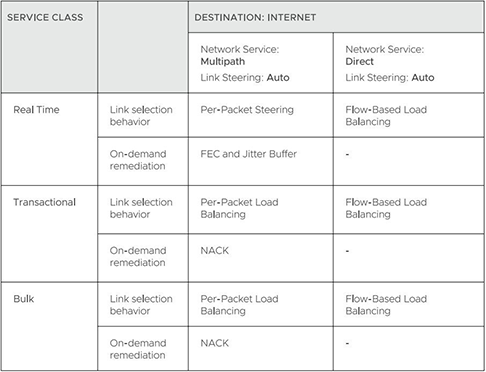
The below examples explain the default DMPO behavior for different type of applications and link conditions. Please see the appendix section for the default SLA for different application types.
- Scenario- There is one link that meets the SLA for the application. Expected DMPO behavior: It picks the best available link.
- Scenario- There is one link with packet loss above the SLA for the application. Expected DMPO behavior: It enables FEC for the real-time applications on this link.
- Scenario- There are two links with loss on only one link. Expected DMPO behavior: It enables FEC on both links.
- Scenario- There are multiple links with loss on multiple links. Expected DMPO behavior: It enables FEC on the two best links.
- Scenario- There are two links but one link is unstable, i.e. it misses three consecutive heartbeats. Expected DMPO behavior: It marks the link as unusable and steers the flow to the next best available link.
- Scenario- There are two links with both jitter and loss. Expected DMPO behavior: It enables FEC and jitter buffer on both links. Jitter buffer is enabled when jitter is more than 7 ms for voice and more than 5 ms for video. The sending DMPO endpoint tells the receiving DMPO endpoint to enable jitter buffer. The receiving DMPO endpoint buffers up to 10 packets or 200 ms of traffic, whichever is first. It uses the original timestamp in the DMPO header to calculate the flow rate for de-jitter buffer. If the flow is not constant, it disables jitter buffering.
Example: Transactional and bulk applications. Enables NACK if packet loss exceeds the threshold that is acceptable per application type (see the appendix for this value).
Secure Traffic Transmission
DMPO encrypts both the payload and the tunnel header with IP sec transport mode end-to-end for private or internal traffic. The payload contains the user traffic. DMPO supports AES128 and AES256 for encryption. It uses the PKI and IKEv2 protocols for IP sec key management and authentication.
Protocols and Ports
- UDP/2426 – UDP/2426: This port is for overlay tunnel management and information exchange between the two DMPO endpoints (Edges and Gateways). It is also for data traffic that is already secured or not important, such as SFDC traffic from branch to the cloud between Edge and Gateway. SFDC traffic is encrypted with TLS.
- UDP/500 and UDP/4500 – These ports are for IKEv2 negotiation and for IPSec NAT transparency.
- IP/50 – This protocol is for IPSec over native IP protocol 50 (ESP) when there is no NAT between the two DMPO endpoints.
Appendix- QoE threshold and Application SLA
DMPO uses the SLA threshold below for different types of applications. It will immediately take action to steer the affected application flows or perform on-demand remediation when the WAN link condition exceeds one or more thresholds. Packet loss is calculated by dividing the number of lost packets by the total packets in the last 1-minute interval. The DMPO endpoints communicate the number of lost packets every second. The QoE report also reflects this threshold.
DMPO also takes action immediately when it loses communications (no user data or probes) within 300 ms.
Beginning in Release 5.2.0, users have the capability to modify the threshold values for latency for video, voice, and transactional traffic types through a Customizable QoE feature. This means that customers can include high latency links as part of the selection process and the Orchestrator applies the new values to the QoE monitoring page.
Solution Components
This section describes Arista VeloCloud SD-WAN solution components.
VeloCloud Edge
A thin “Edge” with zero IT touch provisioned from the cloud for secured, optimized connectivity to your apps and virtualized services. Edges are zero-touch, enterprise-class devices or virtual software that provide secure and optimized connectivity to private, public, and hybrid applications and compute and virtualized services. Edges perform deep application recognition, application and per-packet steering, on-demand remediation performance metrics, and end-to-end quality of service (QoS) in addition to hosting Virtual Network Function (VNF) services. An Edge pair deployment provides High Availability (HA). You can deploy Edges in branches, large sites, and data centers. All other network infrastructure is available on demand in the cloud.
VeloCloud Edge Cloud Orchestrator
The Arista Edge Cloud Orchestrator is hosted on AWS GovCloud (US) and provides centralized enterprise-wide configuration and real-time monitoring. It also orchestrates the data flow into and through the SD-WAN overlay network and provides one-click provisioning of virtual services across Edges on AWS GovCloud (US).
VeloCloud Gateways
The VeloCloud SD-WAN network consists of Gateways deployed at AWS GovCloud (US), providing SD-WAN services to the doorstep of SaaS, IaaS, and cloud network services and access to private backbones. Multi-tenant, virtual Gateways are deployed by Arista VeloCloud SD-WAN on AWS GovCloud (US)™. The Gateways provide the advantage of an on-demand, scalable, and redundant cloud network for optimized paths to cloud destinations and zero-installation applications.
For more information about the VeloCloud Gateways functionality and resiliency, see Arista.
SD-WAN Edge Performance and Scale Data
This section covers the VeloCloud SD-WAN edge's performance and scale architecture. It provides recommendations based on tests conducted on various Edge configurations with specific service combinations and explains performance and scale data points and how to use them.
Introduction
The tests represent common deployment scenarios to provide recommendations for most deployments. The test data herein are neither all-inclusive metrics nor performance or scale limits. There are implementations where the observed performance exceeds the test results, and others where specific services, extremely small packet sizes, or other factors can reduce performance below the test results.
Customers are welcome to perform independent tests, and results could vary. However, recommendations based on our test results are adequate for most deployments.
VeloCloud Edge
Arista VeloCloud SD-WAN Edges are zero-touch, enterprise-class appliances that provide secure optimized connectivity to private, public, and hybrid applications and compute and virtualized services. VeloCloud Edges perform deep application recognition of traffic flows, performance metrics measurements of underlay transport, and end-to-end service quality by applying packet-based link steering and on-demand application remediation, in addition to supporting other virtualized network services.
Throughput Performance Test Topologies
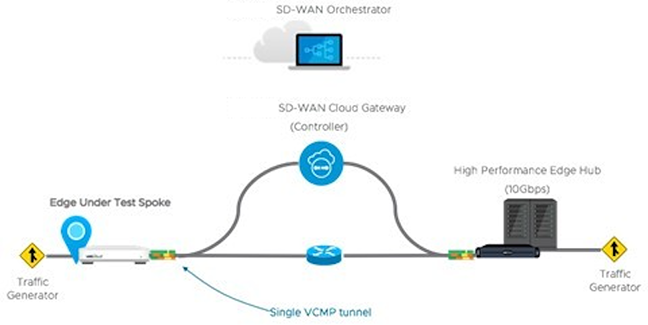
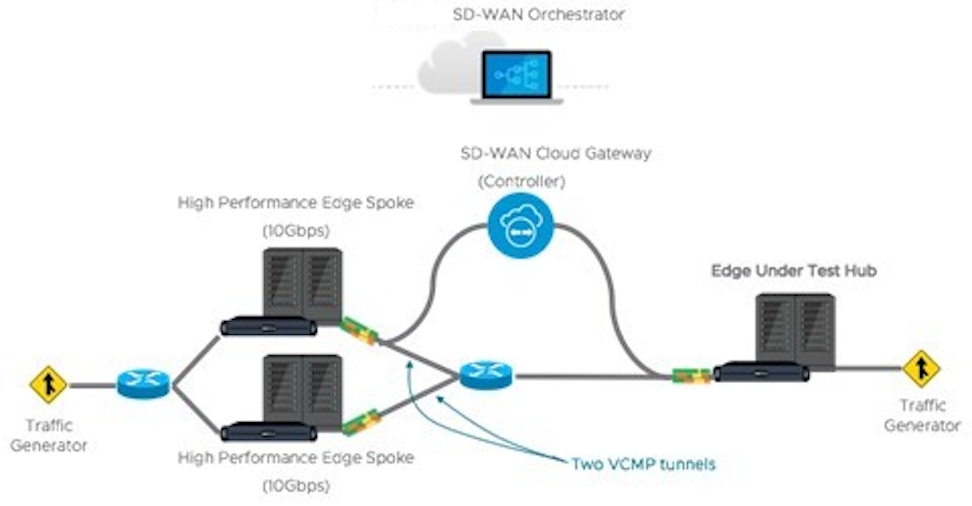
Test Methodology
This subsection details the performance and scale test methodology used to derive the results.
Performance Test Methodology
- Performance is measured using a fully operational SD-WAN network overlay (DMPO tunnels) test topology in order to exercise the SD-WAN features and obtain results that can be used to size WAN networks appropriately. Testing is conducted using stateful traffic that establishes multiple flows (connections) and is a mix of well-known applications. The number of flows depends on the platform model being tested. Platforms are divided by expected aggregate performance of under 1 Gbps and over 1 Gbps models. Typically, hundreds of flows are needed to fully exercise and determine the max throughput of platforms expected to perform under 1 Gbps, and thousands of flows are used to exercise platforms of over 1 Gbps. The traffic profiles simulate two network traffic conditions:
- Large Packet- a 1300-byte condition.
- IMIX- a mix of packet sizes that average to a 417-byte condition.
- Performance results are recorded at a packet drop rate (PDR) of 0.01%. The PDR mark provides a more realistic performance result which accounts for normal packet drop that may occur within the SD-WAN packet pipeline in the device. A PDR of 0.01% does not impact application experience even in single link deployment scenarios.
- The device under test is configured with the following DMPO features: IPsec encrypted using AES-128 and SHA1 for hashing, Application Recognition, link SLA measurements, and per-packet forwarding. Business Policy is configured to match all traffic as bulk/low priority to prevent DMPO NACK or FEC from executing and incorrectly altering the traffic generator’s packet count tracking.
Test Results
VeloCloud Edge Performance and Scale Results
Performance metrics are based on the Test Methodology detailed earlier.
Switched Port Performance: Arista VeloCloud Edges are designed to be deployed as gateway routers between the LAN and the WAN. However, the Edges also provide the flexibility of meeting a variety of other deployment topologies. For example, SD-WAN Edges can have their interfaces configured to operate as switched ports—allowing the switching of LAN traffic between various LAN interfaces without the need for an external device.
- The Edge device's Maximum Throughput is the sum of throughput across all interfaces of the Edge under test.
- Overall traffic is the “aggregate” of all traffic flows going to and from an Edge device.
| VeloCloud Edge | 510, 510N | 510-LTE | 520 | 520V | 540 | 610, 610C, 610N | 610-LTE | 710-W |
|---|---|---|---|---|---|---|---|---|
| Maximum Throughput Large Packet (1300-byte) | ||||||||
| Routed Mode All Ports | 850 Mbps | 850 Mbps | 850 Mbps | 850 Mbps | 1.5 Gbps | 850 Mbps | 850 Mbps | 950 Mbps |
| Maximum Throughput Internet Traffic (IMIX) | ||||||||
| Routed Mode All Ports | 300 Mbps | 300 Mbps | 300 Mbps | 300 Mbps | 650 Mbps | 300 Mbps | 300 Mbps | 350 Mbps |
| Routed Mode All Ports with IPS, Malicious IP Filtering, and Stateful Firewall activated. | 150 Mbps | 150 Mbps | 150 Mbps | 150 Mbps | 350 Mbps | 175 Mbps | 175 Mbps | 250 Mbps |
| Other Scale Vectors | ||||||||
| Maximum Tunnel Scale | 50 | 50 | 50 | 50 | 100 | 50 | 50 | 50 |
| Flows Per Second | 2,400 | 2,400 | 2,400 | 2,400 | 4,800 | 2,400 | 2,400 | 4,000 |
| Maximum Concurrent Flows | 225K | 225K | 225K | 225K | 225K | 225K | 225K | 225K |
| Maximum Concurrent Flows with IPS, Malicious IP Filtering, and Stateful Firewall activated. | 110K | 110K | 110K | 110K | 110K | 110K | 110K | 110K |
| Maximum Number of BGP Routes | 100K | 100K | 100K | 100K | 100K | 100K | 100K | 110K |
| Maximum Number of Segments | 32 | 32 | 32 | 32 | 32 | 32 | 32 | 32 |
| Maximum Number of NAT Entries | 225K | 225K | 225K | 225K | 225K | 225K | 225K | 225K |
| VeloCloud Edge | 620, 620C, 620N | 640, 640C, 640N | 680, 680C, 680N | 840 | 2000 | 3400, 3400C | 3800, 3800C | 3810 |
|---|---|---|---|---|---|---|---|---|
| Maximum Throughput Large Packet (1300-byte) | ||||||||
| Routed Mode All Ports | 1.55 Gbps | 5.5 Gbps | 8.5 Gbps | 6.5 Gbps | 15.5 Gbps | 11 Gbps | 16 Gbps | 16 Gbps |
| Maximum Throughput Internet Traffic (IMIX) | ||||||||
| Routed Mode All Ports | 950 Mbps | 2.2 Gbps | 3.2 Gbps | 2.2 Gbps | 6.2 Gbps | 3.6 Gbps | 6.5 Gbps | 6.5 Gbps |
| Routed Mode All Ports with IPS, Malicious IP Filtering, and Stateful Firewall activated. | 600 Mbps | 800 Mbps | 1.5 Gbps | 1.0 Gbps | 4.0 Gbps | 2.3 Gbps | 4.5 Gbps | 4.5 Gbps |
| Other Scale Vectors | ||||||||
| Maximum Tunnel Scale | 100 | 400 | 800 | 400 | 6,000 | 4,000 | 6,000 | 6,000 |
| Flows Per Second | 4,800 | 19,200 | 19,200 | 19,200 | 50,000 | 38,400 | 50,000 | 50,000 |
| Maximum Concurrent Flows | 460K | 1.15M | 1.9M | 1.9M | 1.9M | 1.9M | 3.8M | 3.8M |
| Maximum Concurrent Flows with IPS, Malicious IP Filtering, and Stateful Firewall activated. | 230K | 460K | 960K | 460K | 1.9M | 960K | 1.9M | 1.9M |
| Maximum Number of BGP Routes | 100K | 100K | 100K | 100K | 100K | 100K | 100K | 100K |
| Maximum Number of Segments | 128 | 128 | 128 | 128 | 128 | 128 | 128 | 128 |
| Maximum Number of NAT Entries | 460K | 960K | 960K | 960K | 1.9M | 960K | 1.9M | 1.9M |
| VeloCloud Edge | 720 | 740 | 4100 | 5100 |
|---|---|---|---|---|
| Max throughput per Edge with routed-mode ports (1300-byte) | 3 Gbps | 10 Gbps | 30 Gbps | 100 Gbps |
| Max throughput per Edge with routed-mode ports (IMIX)2 | 1.5 Gbps | 4.2 Gbps | 12 Gbps | 40 Gbps |
| Max tunnel scale | 400 | 800 | 12,000 | 20,000 |
| Flow per second | 18,000 | 26,000 | 50,000 | 180,000 |
| Max number of BGP routes | 100K | 100K | 100,000 | 100,000 |
| Max segments | 128 | 128 | 128 | 128 |
| Maximum NAT entries | 460K | 960K | 1.9M | 1.9M |
- Large Packet performance is based on a large packet (1300-byte) payload with AES-128 encryption and DPI turned on.
- Internet Traffic (IMIX) performance is based on an average packet size of 417-byte payload with AES-128 encryption and DPI turned on.
- IPS and Stateful Firewall performance numbers were measured using TREX setup with an average packet size of 400-bytes.
| Edge Model | 520V | 620, 620C, 620N | 640, 640C, 640N | 680, 680C, 680N | 840 | 3400, 3400C | 3800, 3800C | 3810 |
|---|---|---|---|---|---|---|---|---|
| Max. Throughput with FW VNF (1300-byte) | 100 Mbps | 300 Mbps | 600 Mbps | 1 Gbps | 1 Gbps | 2 Gbps | 3 Gbps | 3 Gbps |
| Edge Model | 510, 510N | 510-LTE | 520, 520v | 540 | 610, 610C, 610N | 610-LTE | 710-W |
|---|---|---|---|---|---|---|---|
| Maximum Throughput (IMIX) Across Enhanced HA Link | 220 Mbps | 220 Mbps | 220 Mbps | 480 Mbps | 220 Mbps | 220 Mbps | 260 Mbps |
| Edge Model | 620, 620C, 620N | 640, 640C, 640N | 680, 680C, 680N | 840 | 2000 | 3400, 3400C | 3800, 3800C | 3810 |
|---|---|---|---|---|---|---|---|---|
| Maximum Throughput (IMIX) Across Enhanced HA Link | 700 Mbps | 1 Gbps | 2 Gbps | 1 Gbps | 4 Gbps | 2.5 Gbps | 5 Gbps | 5 Gbps |
Platform Independent Edge Scale Numbers
The Edge Scale numbers listed in the following table are platform independent and are valid for all Edge models, both hardware and virtual.
| Feature | Supported Number | |
|---|---|---|
| IPv4 | IPv6 | |
| Maximum number of Port Forwarding rules on a single segment | 128 | 128 |
| Maximum number of Port Forwarding rules across 16 segments | 128 | 128 |
| Maximum number of Port Forwarding rules across 128 segments | 128 | 128 |
| Maximum number of Outbound Firewall Rules on a single segment | 2040 | 2040 |
| Maximum number of Outbound Firewall Rules across 16 segments | 2040 | 2040 |
| Maximum number of Outbound Firewall Rules across 128 segments | 2040 | 2040 |
| Maximum number of 1:1 NAT rules on a single segment | 128 | 128 |
| Maximum number of 1:1 NAT rules across 16 segments | 128 | 128 |
| Maximum number of 1:1 NAT rules across 128 segments | 128 | 128 |
| Maximum number of LAN side NAT rules on a single segment | 256 | - |
| Maximum number of LAN side NAT rules across 16 segments | 256 | - |
| Maximum number of LAN side NAT rules across 128 segments | 256 | - |
| Maximum number of Object Groups (1000 business policies, each business policy assigned to one object group, each object group supports 255 address groups) | 1000 | 1000 |
Virtual Edge
| Edge Device | Maximum Throughput | Maximum Number of Tunnels | Flows Per Second | Maximum Concurrent Flows | Maximum Number of Routes | Maximum Number of Segments | |
|---|---|---|---|---|---|---|---|
| ESXi Virtual Edge (2-core, VMXNET3) | 1.5 Gbps (1300-byte)900 Mbps (IMIX) | 50 | 2400 | 240K | 35K | 128 | |
| KVM Virtual Edge (2-core, Linux Bridge) | 800 Mbps (1300-byte)250 Mbps (IMIX) | 50 | 2400 | 240K | 35K | 128 | |
| KVM Virtual Edge (2-core, SR-IOV) | 1.5 Gbps (1300-byte)900 Mbps (IMIX) | 50 | 2400 | 240K | 35K | 128 | |
| ESXi Virtual Edge (4-core, VMXNET3) | 4 Gbps (1300-byte)1.5 Gbps (IMIX) | 400 | 4800 | 480K | 35K | 128 | |
| ESXi Virtual Edge (4-core, SR-IOV) | 5 Gbps (1300-byte)1.5 Gbps (IMIX) | 400 | 4800 | 480K | 35K | 128 | |
| KVM Virtual Edge (4-core, Linux Bridge) | 1 Gbps (1300-byte)350 Mbps (IMIX) | 400 | 4800 | 480K | 35K | 128 | |
| KVM Virtual Edge (4-core, SR-IOV) | 4 Gbps (1300-byte)1.5 Gbps (IMIX) | 400 | 4800 | 480K | 35K | 128 | |
| ESXi Virtual Edge (8-core, VMXNET3) | 6 Gbps (1300-byte)2 Gbps (IMIX) | 800 | 28800 | 1.9M | 35K | 128 | |
| ESXi Virtual Edge (8-core, SR-IOV) | 6 Gbps (1300-byte)3 Gbps (IMIX) | 800 | 28800 | 1.9M | 35K | 128 | |
| KVM Virtual Edge (8-core, SR-IOV | 6.5 Gbps (1300-byte)3.2 Gbps (IMIX) | 800 | 28800 | 1.9M | 35K | 128 | |
| 2 vCPU | 4vCPU | 8vCPU | 10vCPU | |
|---|---|---|---|---|
| Minimum Memory (DRAM) | 8 GB | 16 GB | 32 GB | 32 GB |
| Minimum Storage | 8 GB | 8 GB | 16 GB | 16 GB |
| Supported Hypervisors | Software version 4.0 and above:
|
|||
| Supported Public Cloud | AWS, Azure, GCP, and Alibaba | |||
| Support Network I/O | SR-IOV, VirtIO, VMXNET3 | |||
| Recommended Host Settings | CPUs at 2.0 GHz or higher CPU configuration:
|
|||
Public Cloud
| AWS Instance Type | c5.large | c5.xlarge | c5.2xlarge | c5.4xlarge |
|---|---|---|---|---|
| Maximum Throughput | 100 Mbps (1300-byte)50 Mbps (IMIX) | 200 Mbps (1300-byte)100 Mbps (IMIX) | 1.5 Gbps (1300-byte)450 Mbps (IMIX) | 4 Gbps (1300-byte)1 Gbps (IMIX) |
| Maximum Tunnels | 50 | 400 | 800 | 2,000 |
| Flows Per Second | 1,200 | 2,400 | 4,800 | 9,600 |
| Maximum Concurrent Flows | 125,000 | 250,000 | 550,000 | 1.9M |
| Maximum Number of Routes | 35,000 | 35,000 | 35,000 | 35,000 |
| Maximum Number of Segments | 128 | 128 | 128 | 128 |
| Azure VM Series | D2d v4 | D4d v4 | D8d v4 | D16d v4 |
|---|---|---|---|---|
| Maximum Throughput | 100 Mbps (1300-byte)50 Mbps (IMIX) | 200 Mbps (1300-byte)100 Mbps (IMIX) | 1 Gbps (1300-byte)450 Mbps (IMIX) | 1 Gbps (1300-byte)450 Mbps (IMIX) |
| Maximum Tunnels | 50 | 400 | 800 | 2000 |
| Flows Per Second | 1,200 | 2,400 | 4,800 | 4,800 |
| Maximum Concurrent Flows | 125,000 | 250,000 | 550,000 | 550,000 |
| Maximum Number of Routes | 35,000 | 35,000 | 35,000 | 35,000 |
| Maximum Number of Segments | 128 | 128 | 128 | 128 |
| Azure VM Series | Ds3 v2 | Ds4 v2 | Ds5 v2 | D4d v5 | D8d v5 | D16d v5 |
|---|---|---|---|---|---|---|
| Maximum Throughput | 2.5 Gbps (1300-byte)1.5 Gbps (IMIX) | 5.3 Gbps (1300-byte)2.7 Gbps (IMIX) | 6.5 Gbps (1300-byte)3.1 Gbps (IMIX) | 4.5 Gbps (1300-byte)1.3 Gbps (IMIX) | 6.3 Gbps (1300-byte)2.7 Gbps (IMIX) | 6.4 Gbps (1300-byte)2.9 Gbps (IMIX) |
| Maximum Tunnels | 400 | 800 | 2000 | 400 | 800 | 2000 |
| Flows Per Second | 2,400 | 4,800 | 4,800 | 2,400 | 4,800 | 4,800 |
| Maximum Concurrent Flows | 250,000 | 550,000 | 550,000 | 250,000 | 550,000 | 550,000 |
| Maximum Number of Routes | 35,000 | 35,000 | 35,000 | 35,000 | 35,000 | 35,000 |
| Maximum Number of Segments | 128 | 128 | 128 | 128 | 128 | 128 |
- Azure Accelerated Networking is supported only from release 5.4.0.
- Accelerated Networking is supported only on ConnectX-4 and ConnectX-5 NICs.
| GCP Instance Type | n2-highcpu-4 | n2-highcpu-8 | n2-highcpu-16 |
|---|---|---|---|
| Maximum Throughput | 850 Mbps (1300-byte)500 Mbps (IMIX) | 4.5 Gbps (1300-byte)1.6 Gbps (IMIX) | 6.5 Gbps (1300-byte)1.9 Gbps (IMIX) |
| Maximum Tunnels | 50 | 400 | 800 |
| Flows Per Second | 1,200 | 2,400 | 4,800 |
| Maximum Concurrent Flows | 125,000 | 250,000 | 550,000 |
| Maximum Number of Routes | 35,000 | 35,000 | 35,000 |
| Maximum Number of Segments | 128 | 128 | 128 |
Use of DPDK on VeloCloud Edges
To improve packet throughput performance, VeloCloud Edges take advantage of Data Plane Development Kit (DPDK) technology. DPDK is a set of data plane libraries and drivers provided by Intel for offloading TCP packet processing from the operating system kernel to processes running in user space and results in higher packet throughput. For more details, see https://www.dpdk.org/.
Edge hardware models 620 and higher and all virtual Edges use DPDK by default on their routed interfaces. Edges do not use DPDK on their switched interfaces. A user cannot activate or deactivate DPDK for an Edge interface.
Capabilities
This section describes VeloCloud SD-WAN capabilities.
Dynamic Multi-path Optimization
VeloCloud SD-WAN Dynamic Multi-path Optimization comprises automatic link monitoring, dynamic link steering, and on-demand remediation.
Link Steering and Remediation
Dynamic, application-aware per-packet link steering is performed automatically based on the business priority of the application, embedded knowledge of the application's network requirements, and the real-time capacity and performance of each link. On-demand mitigation of individual link degradation through forward error correction, jitter buffering, and negative acknowledgment proxy also protects the performance of priority and network-sensitive applications. The dynamic per-packet link steering and on-demand mitigation combine to deliver robust, sub-second blocked, and limited protection to improve application availability, performance, and end-user experience.
Cloud VPN
Cloud VPN is a 1-click, site-to-site, VPNC-compliant, IPsec VPN that connects VeloCloud SD-WAN and non-SD-WAN destinations while delivering real-time status and the health of the sites. The Cloud VPN establishes dynamic edge-to-edge communication for all branches based on service level objectives and application performance. Cloud VPN also delivers secure connectivity across all branches with PKI scalable key management. New branches join the VPN network automatically with access to all resources in other branches, enterprise data centers, and 3rd party data centers, like Amazon AWS.
Firewall
VeloCloud SD-WAN delivers stateful and context-aware (application, user, device) integrated application-aware firewall with granular control of sub-applications, support for protocol-hopping applications, such as Skype and other peer-to-peer applications (for example, turn off Skype video and chat, but allow Skype audio). The secure firewall service is user- and device OS-aware and can separate voice, video, data, and compliance traffic. On the corporate network, you can easily control the policies for BYOD devices (such as Apple iOS, Android, Windows, and Mac OS).
Network Service Insertion
The VeloCloud SD-WAN Solution supports a platform to host multiple virtualized network functions to eliminate single-function appliances and reduce branch IT complexity. VeloCloud SD-WAN service-chains traffic from the branch to cloud-based and enterprise regional hub services, with assured performance, security, and manageability. Branches leverage consolidated security and network services, including those from partners like Zscaler and Websense. You can insert services in the cloud and on-premise with application-specific policies using a simple click-to-enable interface.
Activation
Edge appliances automatically authenticate, connect, and receive configuration instructions after they are connected to the Internet in a zero-touch deployment. They deliver a highly available deployment with Edge redundancy protocol and integrate with the existing network with support for Open Shortest Path First (OSPF) and Border Gateway Protocol (BGP) routing protocols, leveraging benefits from dynamic learning and automation.
Overlay Flow Control
The Edge learns routes from adjacent routers through OSPF and BGP. It sends the learned routes to the Gateway/Controller. The Gateway/Controller acts like a route reflector and sends the learned routes to other Edge. The Overlay Flow Control (OFC) facilitates enterprise-wide route visibility and control allowing for easy programming for full and partial overlay.
OSPF
VeloCloud SD-WAN supports inbound/outbound filters to OSPF neighbors, OE1/OE2 route types, and MD5 authentication. Routes learned through OSPF will be automatically redistributed to the Controller hosted in the cloud or on-premises.
BGP
VeloCloud SD-WAN supports inbound/outbound filters that can be set to Deny or optionally add/change the BGP attribute to influence the path selection, that is, RFC 1998 community, MED, AS-Path prepend, and local preference.
Segmentation
Network segmentation is an important feature for both enterprises and service providers. In the most basic form, segmentation provides network isolation for management and security reasons. The most common forms of segmentation are VLANs for L2 and VRFs for L3.
Typical Use Cases for Segmentation:
- Line of Business Separation: Engineering, HR, etc., for Security/Audit
- User Data Separation: Guest, PCI, and Corporate traffic separation
- Enterprise uses overlapping IP addresses in different VRFs
However, the previous approach is limited to a single box or two physically connected devices. To extend the functionality, segmentation information must be carried across the network.
VeloCloud SD-WAN offers end-to-end segmentation. When the packet traverses through the Edge, the Segment ID is added to the packet and is forwarded to the Hub and cloud Gateway, allowing network service isolation from the Edge to the cloud and data center. This allows prefixes to be grouped into a unique routing table, making the business policy segment aware.
Routing
In Dynamic Routing, Edge learns routes from adjacent routers through OSPF or BGP. The Orchestrator maintains all the dynamically learned routes in a global routing table called the Overlay Flow Control (OFC). The Overlay Flow Control allows management of dynamic routes in the case of "Overlay Flow Control sync" and "change in Inbound/Outbound filtering configuration." The change in inbound filtering for a prefix from IGNORE to LEARN would fetch the prefix from the Overlay Flow Control and install it into the Unified routing table.
For more information, see Configuring Dynamic Routing with OSPF or BGP.
Business Policy Framework
Quality of Service (QoS), resource allocations, link/path steering, and error correction are automatically applied based on business policies and application priorities. Orchestrate traffic based on transport groups defined by private and public links, policy definition, and link characteristics.
Tunnel Overhead and MTU
VeloCloud, like any overlay, imposes additional overhead on traffic that traverses the network. This section first describes the overhead added in a traditional IPsec network and how it compares with VeloCloud, followed by an explanation of how this added overhead relates to MTU and packet fragmentation behaviors in the network.
IPsec Tunnel Overhead
- Padding
- AES encrypts data in 16-byte blocks, called block size.
- If the body of a packet is smaller than or indivisible by the block size, it is padded to match the block size.
- Examples:
- A 1-byte packet will become 16 bytes with 15 bytes of padding.
- A 1400-byte packet will become 1408 bytes with 8 bytes of padding.
- A 64-byte packet does not require any padding.
- IPsec headers and trailers:
- UDP header for NAT Traversal (NAT-T).
- IP header for IPsec tunnel mode.
- ESP header and trailer.
| Element | Size in Bytes |
|---|---|
| IP Header | 20 |
| UDP Header | 8 |
| IPsec Sequence Number | 4 |
| IPsec SPI | 4 |
| Initialization Vector | 16 |
| Padding | 0 – 15 |
| Padding Length | 1 |
| Next Header | 1 |
| Authentication Data | 12 |
| Total | 66-81 |
VeloCloud Tunnel Overhead
To support Dynamic Multipath Optimization™ (DMPO), VeloCloud encapsulates packets in a protocol called the VeloCloud Multipath Protocol (VCMP). VCMP adds 31 bytes of overhead for user packets to support resequencing, error correction, network analysis, and network segmentation within a single tunnel. VCMP operates on an IANA-registered port of UDP 2426. To ensure consistent behavior in all potential scenarios (unencrypted, encrypted and behind a NAT, encrypted but not behind a NAT), VCMP is encrypted using transport mode IPsec and forces NAT-T to be true with a special NAT-T port of 2426.
Packets sent to the Internet via the SD-WAN Gateway are not encrypted by default, since they will egress to the open Internet upon exiting the Gateway. As a result, the overhead for Internet Multipath traffic is less than that of VPN traffic.
| Element | Size in Bytes |
|---|---|
| IP Header | 20 |
| UDP Header | 8 |
| IPsec Sequence Number | 4 |
| IPsec SPI | 4 |
| VCMP Header | 23 |
| VCMP Data Header | 8 |
| Initialization Vector | 16 |
| Padding | 0 – 15 |
| Padding Length | 1 |
| Next Header | 1 |
| Authentication Data | 12 |
| Total | 97 – 112 |
| Element | Size in Bytes |
|---|---|
| IP Header | 20 |
| UDP Header | 8 |
| VCMP Header | 23 |
| VCMP Data Header | 8 |
| Total | 59 |
Impact of IPv6 Tunnel on MTU
VeloCloud SD-WAN supports IPv6 addresses to configure the Edge Interfaces and Edge WAN Overlay settings.
You can set up the VCMP tunnel in the following environments: IPv4 only, IPv6 only, and dual stack. For more information, see IPv6 Settings.
When a branch has at least one IPv6 tunnel, DMPO uses this tunnel seamlessly along with other IPv4 tunnels. The packets for any specific flow can take any tunnel, IPv4 or IPv6, based on the real-time health of the tunnel. An example of specific flow is the path selection score for load-balanced traffic. In such cases, the increased size of the IPv6 header (additional 20 bytes) should be taken into account, and as a result, the effective path MTU will be reduced by 20 bytes. In addition, this reduced effective MTU will be propagated to the other remote branches through the Gateway so that the incoming routes into this local branch from other remote branches reflect the reduced MTU.
Path MTU Discovery
- For public Internet WAN links:
- Path MTU discovery is performed to all Gateways.
- The MTU for all tunnels will be set to the minimum MTU discovered.
- For private WAN links:
- Path MTU discovery is performed to all other Edges in the customer network.
- The MTU for each tunnel is set based on the results of Path MTU discovery.
The Edge will first attempt Path MTU discovery (RFC 1191), where a packet of the current known link MTU (Default: 1500 bytes) is sent to the peer with the Don’t Fragment (DF) bit set in the IP header. If this packet is received on the remote Edge or Gateway, an acknowledgment packet of the same size is returned to the Edge. If the packet cannot reach the remote Edge or Gateway due to MTU constraints, the intermediate device is expected to send an ICMP destination unreachable (fragmentation needed) message. When the Edge receives the ICMP unreachable message, it will validate the message (to ensure the MTU value reported is sane). After the validation, adjust the MTU. The process then repeats until the MTU is discovered.
In some cases (for example, USB LTE dongles), the intermediate device will not send an ICMP unreachable message even if the packet is too large. If RFC 1191 fails (the Edge did not receive an acknowledgment or ICMP unreachable), it will fall back to RFC 4821 Packetization Layer Path MTU Discovery. The Edge will attempt to perform a binary search to discover the MTU.
VPN Traffic and MTU
Now that the SD-WAN Edge has discovered the MTU and calculated the overheads, an effective MTU can be computed for client traffic. The Edge will attempt to enforce this MTU as efficiently as possible for the various potential types of traffic received.
TCP Traffic
The Edge automatically performs TCP MSS (Maximum Segment Size) adjustment for TCP packets received. As SYN and SYN|ACK packets traverse the Edge, the MSS is rewritten based on the Effective Packet MTU.
Non-TCP Traffic without DF bit set
If the packet is larger than the Effective Packet MTU, the Edge automatically performs IP fragmentation as per RFC 791.
Non-TCP Traffic with DF bit set.
- The first time a packet is received for this flow (IP 5-tuple), the Edge drops the packet and sends an ICMP Destination unreachable (fragmentation needed) as per RFC 791.
- If subsequent packets are received for the same flow which are still too large, these packets are fragmented into multiple VCMP packets and reassembled transparently before hand-off at the remote end.
Jumbo Frame Limitation
VeloCloud SD-WAN does not support jumbo frames as of Release 5.0. The maximum IP MTU supported for packets sent across the overlay without fragmentation is 1500.
Network Topologies
This section describes network topologies for branches and data centers.
Branches to Private Third Party (VPN)
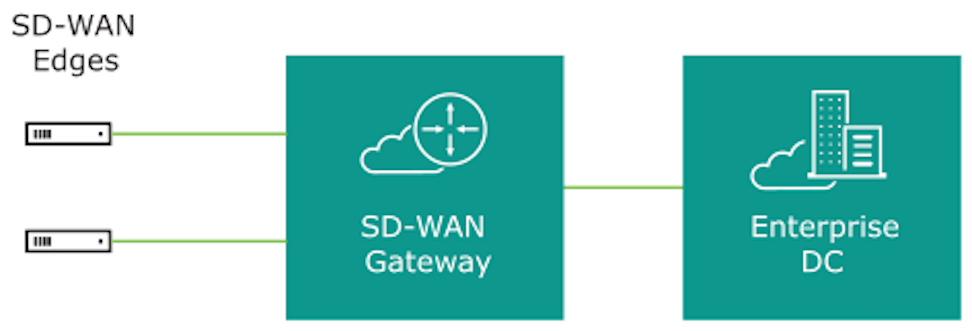
Data Center Network Topology
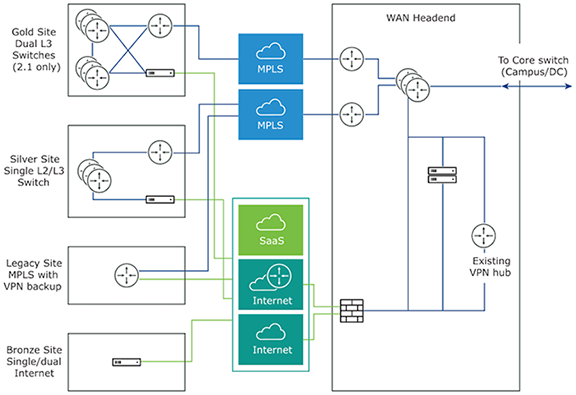
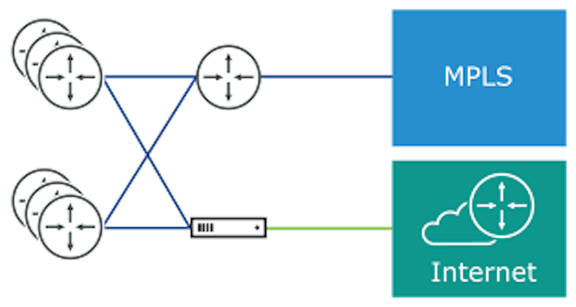
The Data Center Network topology consists of two hubs and multiple branches, with or without Edge. Each hub has hybrid WAN connectivity. There are several branch types. The MPLS network runs BGP and peers with all the CE routers. At Hub 1, Hub 2, and Silver 1 sites, the L3 switch runs OSPF, or BGP with the CE router and firewall (in case of hub sites).
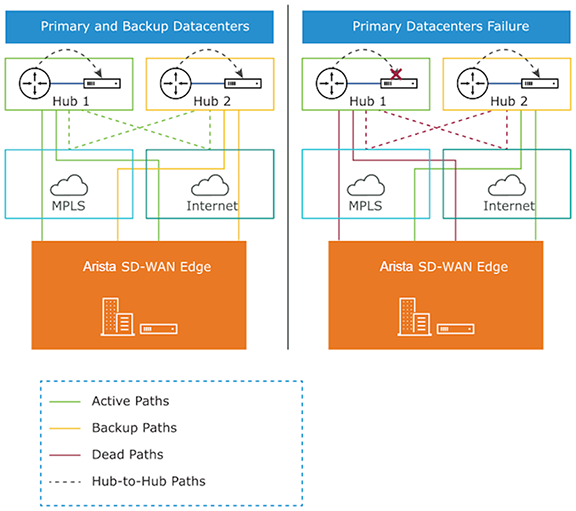
In some cases, there may be redundant data centers which advertise the same subnets with different costs. In this scenario, both data centers can be configured as edge-to-edge VPN hubs. Since all edges connect directly to each hub, the hubs in fact also connect directly to each other. Based on route cost, traffic is steered to the preferred active data center.
In previous versions, users could create an enterprise object using Zscaler or Palo Alto Networks as a generic Non SD-WAN Destination. In 4.0 version, that object will now become a first-class citizen as a Non SD-WAN Destination.
The Cloud-Delivered solution of Arista combines the economics and flexibility of the hybrid WAN with the deployment speed and low maintenance of cloud-based services. It dramatically simplifies the WAN by delivering virtualized services from the cloud to branch offices. Arista customer-premise equipment, Edge, aggregates multiple broadband links (e.g., Cable, DSL, 4G-LTE) at the branch office, and sends the traffic to Gateways. Using cloud-based orchestration, the service can connect the branch office to any type of data center: enterprise, cloud, or Software-as-a-Service.
Edge is a compact, thin Edge device that is zero-IT-touch provisioned from the cloud for secure, optimized connectivity to applications and data. A cluster of gateways is deployed globally at top-tier cloud data centers to provide scalable and on-demand cloud network services. Working with the Edge, the cluster delivers Dynamic Multi-path Optimization so multiple, ordinary broadband links appear as a single, high bandwidth link. Orchestrator management provides centralized configuration, real-time monitoring, and one-click provisioning of virtual services.
Branch Site Topologies
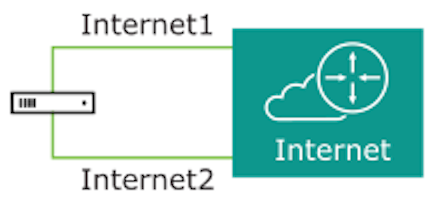
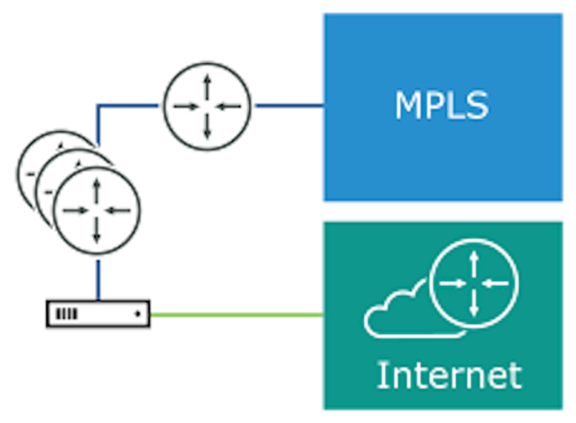
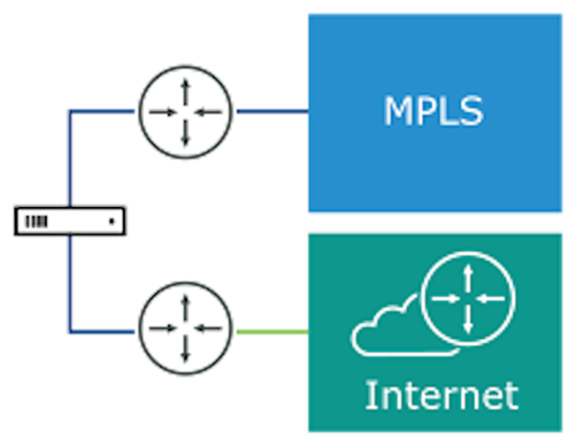
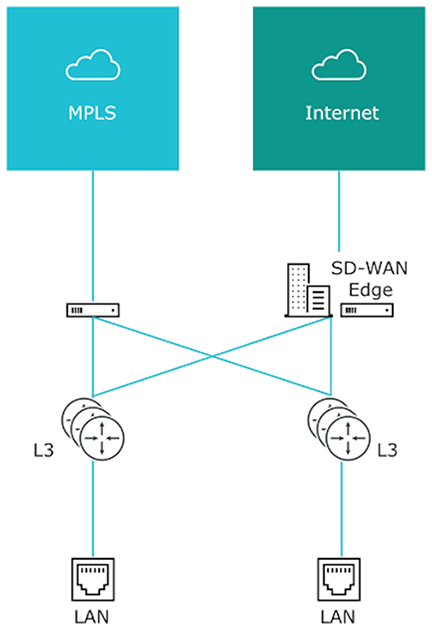
The Arista service defines two or more different branch topologies designated as Bronze, Silver, and Gold. In addition, pairs of Edges can be configured in a High Availability (HA) configuration at a branch location.
Bronze Site Topology
Silver Site Topology
Gold Site Topology
High Availability (HA) Configuration
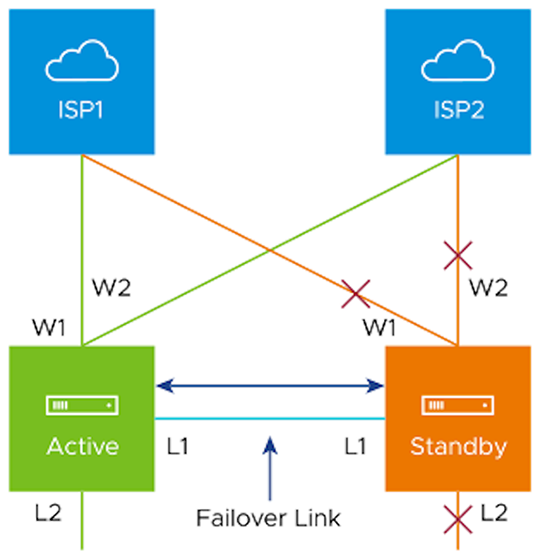
Connecting the L1 ports on each edge is used to establish a failover link. The standby Edge blocks all ports except the L1 port for the failover link.
On-premise Topology
The on-premise topology consists of two hubs and multiple branches, with or without Edge. Each hub has hybrid WAN connectivity. There are several branch types.
In previous versions, users could create an enterprise object using Zscaler or Palo Alto Network as a generic Non SD-WAN Destination. In 4.0 version, that object will now become a first-class citizen as a Non SD-WAN Destination.
The Cloud-Delivered solution of Arista combines the economics and flexibility of the hybrid WAN with the deployment speed and low maintenance of cloud-based services. It dramatically simplifies the WAN by delivering virtualized services from the cloud to branch offices. Arista customer-premise equipment, Edge, aggregates multiple broadband links (e.g., Cable, DSL, 4G-LTE) at the branch office, and sends the traffic to Gateways. Using cloud-based orchestration, the service can connect the branch office to any of type of data center: enterprise, cloud, or Software-as-a-Service.
Edge is a compact, thin Edge device that is zero-IT-touch provisioned from the cloud for secure, optimized connectivity to applications and data. A cluster of gateways is deployed in AWS GovCloud (US) to provide scalable and on-demand cloud network services. Working with the Edge, the cluster delivers dynamic, multi-path optimization so multiple, ordinary broadband links appear as a single, high bandwidth link. Orchestrator management provides centralized configuration, real-time monitoring, and one-click
Roles and Privilege Levels
- IT Administrator (or Administrator)
- Site Contact at each site where an Edge device is deployed.
Administrator
| Administrator Role | Description |
|---|---|
| Enterprise Standard Administrator | Can perform all configuration and monitoring tasks. |
| Enterprise Superuser | Can perform the same tasks as an Enterprise Standard Admin and can also create additional users with the Enterprise Standard Admin, Enterprise MSP, and Customer Support role. |
| Enterprise Support | Can perform configuration review and monitoring tasks but cannot view user identifiable application statistics and can only view configuration information. |
Site Contact
The Site Contact is responsible for Edge physical installation and activation with the Arista VeloCloud SD-WAN service. The Site Contact is a non-IT person who can receive an email and perform the instructions in the email for Edge activation.
User Role Matrix
This section describes feature access according to Arista VeloCloud SD-WAN user roles.
Enterprise-level Orchestrator Features User Role Matrix
- R: Read
- W: Write (Modify/Edit)
- D: Delete
- NA: No Access
| Orchestrator Feature | Enterprise: Super User | Enterprise: Standard Admin | Customer Support | Read Only |
|---|---|---|---|---|
| Monitor > Edges | R | R | R | R |
| Monitor > Network Services | R | R | R | R |
| Monitor > Routing | R | R | R | NA |
| Monitor > Alerts | R | R | R | NA |
| Monitor > Events | R | R | R | NA |
| Monitor > Reports | RWD | RWD | R | R |
| Configure > Edges | RWD | RWD | R | NA |
| Configure > Profiles | RWD | RWD | R | NA |
| Configure > Networks | RWD | RWD | R | NA |
| Configure > Segments | RWD | RWD | R | NA |
| Configure > Overlay Flow Control | RWD | RWD | R | NA |
| Configure > Network Services | RWD | RWD | R | NA |
| Configure > Alerts & Notifications | RW | RW | R | NA |
| Test & Troubleshoot > Remote Diagnostics | RW | RW | RW | NA |
| Test & Troubleshoot > Remote Actions | RW | RW | RW | NA |
| Test & Troubleshoot > Packet Capture | RW | RW | RW | NA |
| Test & Troubleshoot > Diagnostic Bundles | RWD | RWD | RWD | NA |
| Administration > System Settings | RW | RW | RW | NA |
| Administration > Administrators | RW | R | R | NA |
Key Concepts
This section discusses the key concepts and the core configurations of Orchestrator.
Configurations
| Configuration | Description |
|---|---|
| Network | Defines basic network configurations, such as IP addressing and VLANs. Networks can be designated as Corporate or Guest and there can be multiple definitions for each network. |
| Network Services | Define several common services used by the VeloCloud Service, such as Backhaul Sites, Cloud VPN Hubs, Non SD-WAN Destinations, Cloud Proxy Services, DNS services, and Authentication Services. |
| Profile | Defines a template configuration that can be applied to multiple Edges. A Profile is configured by selecting a Network and Network Services. A profile can be applied to one or more Edge models and defines the settings for the LAN, Internet, Wireless LAN, and WAN Edge Interfaces. Profiles can also provide settings for Wi-Fi Radio, SNMP, Netflow, Business Policies and Firewall configuration. |
| Edge | Configurations provide a complete group of settings that can be downloaded to an Edge device. The Edge configuration is a composite of settings from a selected Profile, a selected Network, and Network Services. An Edge configuration can also override settings or add ordered policies to those defined in the Profile, Network, and Network Services. |
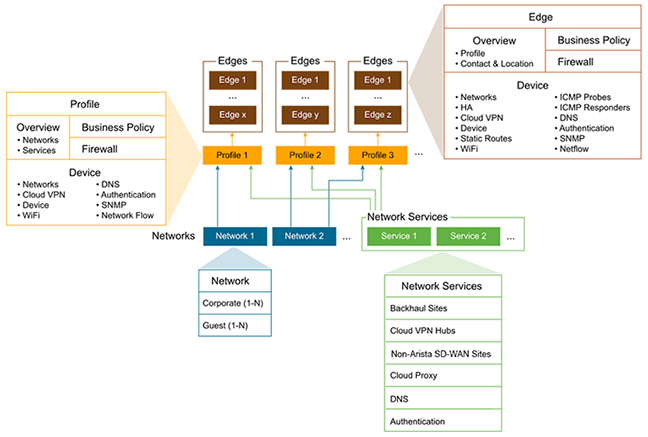
Networks
- Corporate or trusted networks, which can be configured with either overlapping addresses or non-overlapping addresses.
- Guest or untrusted networks, which always use overlapping addresses.
With overlapping addresses, all Edges that use the Network have the same address space. Overlapping addresses are associated with non-VPN configurations.
With non-overlapping addresses, an address space is divided into blocks of an equal number of addresses. Non-overlapping addresses are associated with VPN configurations. The address blocks are assigned to Edges that use the Network so that each Edge has a unique set of addresses. Non-overlapping addresses are required for Edge-to-Edge and Edge-to-Non SD-WAN Destination VPN communication. The configuration creates the required information to access an Enterprise Data Center Gateway for VPN access. An administrator for the Enterprise Data Center Gateway uses the IPSec configuration information generated during Non SD-WAN Destination VPN configuration to configure the VPN tunnel to the Non SD-WAN Destination.
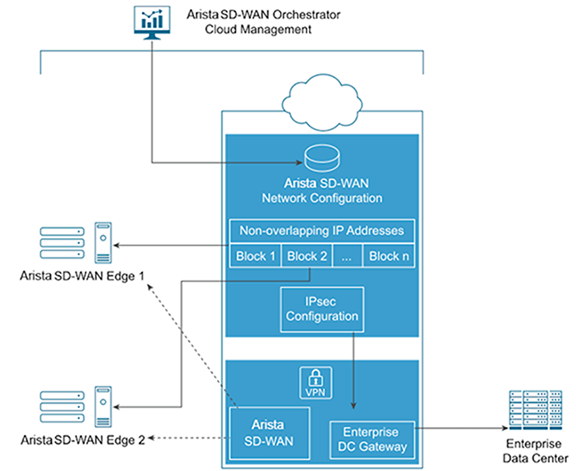
Network Services
You can define your Enterprise Network Services and use them across all the Profiles. This includes services for Authentication, Cloud Proxy, Non SD-WAN Destinations, and DNS. The defined Network Services are used only when they are assigned to a Profile.Profiles
A profile is a named configuration that defines a list of VLANs, Cloud VPN settings, wired and wireless Interface Settings, and Network Services such as DNS Settings, Authentication Settings, Cloud Proxy Settings, and VPN connections to Non SD-WAN Destinations. You can define a standard configuration for one or more Edges using the profiles.Profiles provide Cloud VPN settings for Edges configured for VPN. The Cloud VPN Settings can activate or deactivate Edge-to-Edge and Edge-to- Non SD-WAN Destination VPN connections.
Profiles can also define rules and configuration for the Business Policies and Firewall settings.
Edges
You can assign a profile to an Edge and the Edge derives most of the configuration from the Profile.You can use most of the settings defined in a Profile, Network, or Network Services without modification in an Edge configuration. However, you can override the settings for the Edge configuration elements to tailor an Edge for a specific scenario. This includes settings for Interfaces, Wi-Fi Radio Settings, DNS, Authentication, Business Policy, and Firewall.
In addition, you can configure an Edge to augment settings that are not present in Profile or Network configuration. This includes Subnet Addressing, Static Route settings, and Inbound Firewall Rules for Port Forwarding and 1:1 NAT.
Orchestrator Configuration Workflow
VeloCloud supports multiple configuration scenarios. The following table lists some of the common scenarios:| Scenario | Description |
|---|---|
| SaaS | Used for Edges that do not require VPN connections between Edges, to a Non SD-WAN Destination, or to a VeloCloud Site. The workflow assumes the addressing for the Corporate Network using overlapping addresses. |
| Non SD-WAN Destination via VPN | Used for Edges that require VPN connections to a Non SD-WAN Destination such as Amazon Web Services, Zscaler, Cisco ISR, or ASR 1000 Series. The workflow assumes the addressing for the Corporate Network using non-overlapping addresses and the Non SD-WAN Destinations are defined in the profile. |
| VeloCloud Site VPN | Used for Edges that require VPN connections to a VeloCloud Site such as an Edge Hub or a Cloud VPN Hub. The workflow assumes the addressing for the Corporate Network using non-overlapping addresses and the VeloCloud Sites are defined in the profile. |
- Network
- Network Services
- Profile
- Edge
| Quick Start Configuration Steps | SaaS | Non SD-WAN Destination VPN | VeloCloud Site VPN |
|---|---|---|---|
| Step 1: Network | Select Quick Start Internet Network | Select Quick Start VPN Network | Select Quick Start VPN Network |
| Step 2: Network Service | Use pre-configured Network Services | Use pre-configured Network Services | Use pre-configured Network Services |
| Step 3: Profile | Select Quick Start Internet Profile | Select Quick Start VPN Profile
Activate Cloud VPN and configure Non SD-WAN Destinations |
Select Quick Start VPN Profile
Activate Cloud VPN and configure VeloCloud Sites |
| Step 4: Edge | Add New Edge and activate the Edge | Add New Edge and activate the Edge | Add New Edge and activate the Edge |
Supported Browsers
| Browsers Qualified | Browser Version |
|---|---|
| Google Chrome | 77 – 79.0.3945.130 |
| Mozilla Firefox | 69.0.2 - 72.0.2 |
| Microsoft Edge | 42.17134.1.0 - 44.18362.449.0 |
| Apple Safari | 12.1.2 - 13.0.3 |
Supported USB Modems
This section lists the Supported USB Modems on Edge devices.
| CARRIER/MANUFACTURER | MODEL |
|---|---|
| Any/Inseego | Skyus 160 LTE Gateway |
| Any/Inseego | Skyus DS2 |
| AT&T/Inseego | Global Modem USB800 |
| Any/Inseego | Inseego USB 8 |
Important Notes
- Any customer procuring a USB modem for a Arista VeloCloud SD-WAN needs to select one from the above list to ensure support on their Edge.
- The four USB modems listed as supported provide worldwide coverage for all VeloCloud SD-WAN Customers.
- While all of the above may not be available in a specific market, at least one of the four should be procurable.
- For customers deploying a modem not listed above but which was previously listed as supported (referred to as "legacy" modems):
- Note that the existing legacy modems will continue to work on Edges, but rather that VeloCloud SD-WAN Engineering is no longer testing those modems against the latest Edge software and should not be expected to provide fixes for issues arising from these legacy modems.
- Any future modem purchases need to be made from the above list.