
EVPN Type-5 Routes: IP Prefix Advertisement
The EVPN type 2 routes can be used to advertise IP prefixes by making use of the optional IP address and IP address length fields in the route. However, they are explicitly linked to the MAC address advertised within the route. The EVPN type-5 route defined within the IETF draft, provides the ability to decouple the advertisement of an IP prefix from any specific MAC address, providing the ability to support floating IP addresses, optimize the mechanism for advertising external IP prefixes, and reduce the churn when withdrawing IP prefixes.
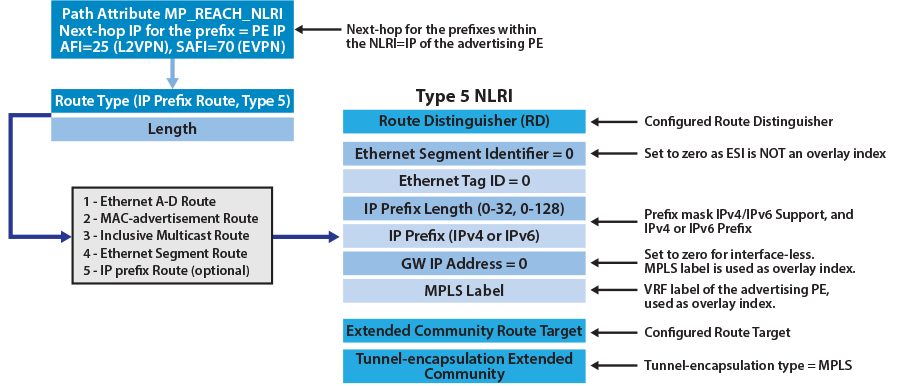
- Advertising IP prefixes behind an appliance when the appliance is not running a routing protocol and only supporting static routes. This could be the typical use case for a Virtual Firewall with several local subnets directly attached. Still, the firewall is only supporting static routes into the associated EVI.
- Support for active-standby deployment of appliances using a shared floating IP model. This is an extension of the previous case where there is now a virtual IP (or VIP) for clustering the appliances, rather than a dedicated physical IP address on the appliance.
- Support for Layer 2 appliances, acting as a “bump in the wire” with no physical IP addresses configured, where instead of the appliances having an IP next-hop, there is only a MAC next-hop.
- IP-VRF to IP-VRF model, which is similar to inter-subnet forwarding for host routes (detailed in the symmetric/asymmetric section), except only Type-5 routes and IP prefixes are advertised, allowing announcement of IP prefixes into a tenant’s EVI domain for external connectivity outside the domain.
Interface-less
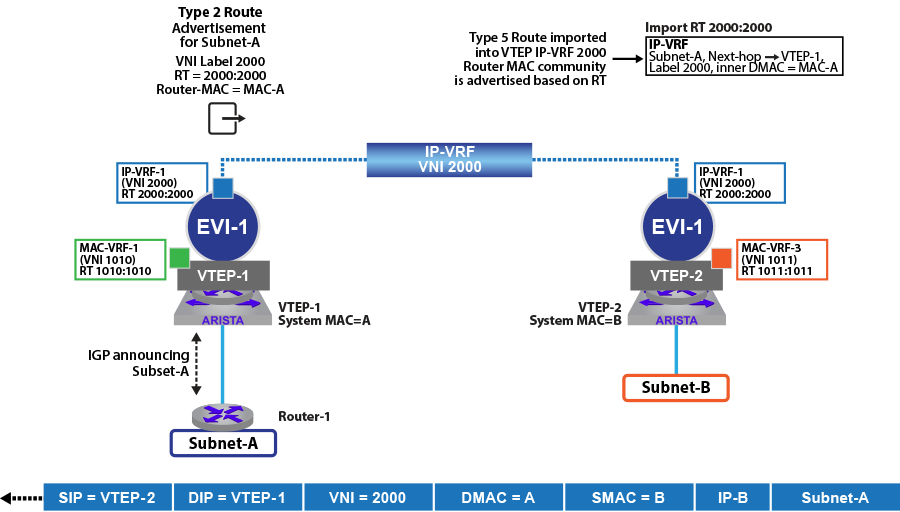
As illustrated above, the IP prefix (subnet-A) residing behind the router (Rtr-1) is learned via an IGP in EVI-1 on VTEP-1. The prefix is announced and learned by the remote VTEPs residing in the same EVI, via the type-5 route announcement. The type-5 route, is advertised along with the prefix, with a route-target (2000:2000) and a VNI label (2000) equal to the IP-VRF which interconnects the VTEPs in the EVI, the router-mac extended community of the route is used to define the inner DMAC (equal to system MAC of VTEP-1) for any VXLAN frame destined to advertised IP prefix.
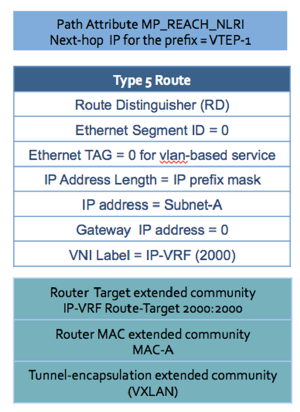
In this model, the VTEPs forming the EVI are interconnected via an IP-VRF, meaning there is no IRB interface (MAC and IP) created for the interconnection on each of the VTEPs, hence the term “interface-less”. With no IRB interface the gateway IP address within the type-5 route is set to 0, traffic is routed to the prefix based on the next-hop of the route (VTEP IP) as well as MAC address conveyed within the Router MAC extended community, which represents the inner destination MAC of the VXLAN encapsulated frame.