
VCS to EVPN Hitless Migration
VCS to EVPN Hitless Migration enables support for migrating from only using VCS as the control plane to only using EVPN as a control plane in a hitless manner concerning L2 reachability information.
Configuring EVPN VXLAN Single-Gateway Centralized Routing
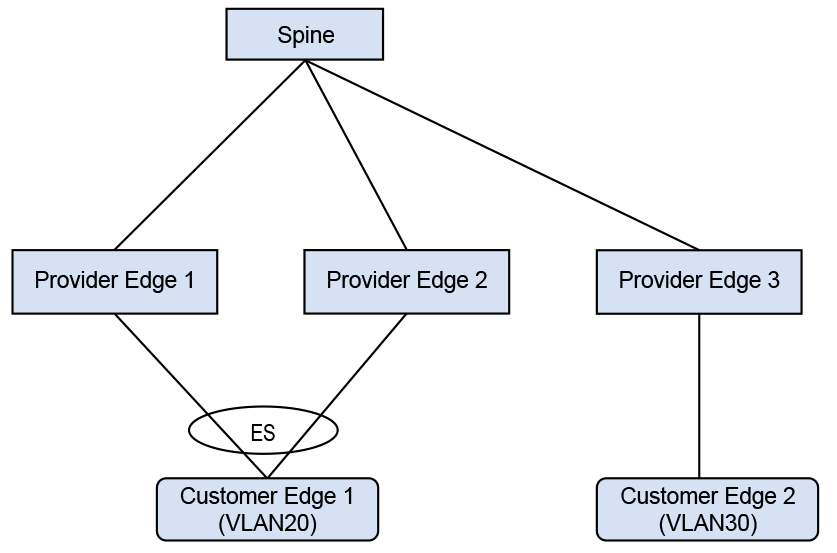
Configuring the Example Topology
In the example, CE1 is a multi-homed CE in VLAN20 with CE2 as a remote CE in VLAN30, and an asymmetric IRB configured for inter-VLAN traffic.
switch(config)# interface Port-Channel100
switch(config-if-Po100)# switchport access vlan 20
!
switch(config-if-Po100)# evpn ethernet-segment
switch(config-evpn-es)# identifier 0033:3333:3333:3333:3333
switch(config-evpn-es)# route-target import 00:03:00:03:00:03
switch(config-evpn-es)# lacp system-id 1234.5678.0123
!
switch(config)# interface Ethernet1
switch(config-if-Et1)# switchport mode trunk
switch(config-if-Et1)# channel-group 100 mode on
!
switch(config)# interface Loopback0
switch(config-if-Lo0)# ip address 10.255.0.0/32
!
switch(config)# interface Vlan20
switch(config-if-Vl20)# ip address virtual 20.0.20.1/24
!
switch(config)# interface Vlan30
switch(config-if-Vl30)# ip address virtual 20.0.30.1/24
!
switch(config)# interface VXLAN1
switch(config=if-Vx1)# VXLAN source-interface Loopback0
switch(config=if-Vx1)# VXLAN udp-port 4789
switch(config=if-Vx1)# VXLAN vlan 20 vni 10020
switch(config=if-Vx1)# VXLAN vlan 30 vni 10030
!
switch(config)# ip virtual-router mac-address 00:00:80:00:00:00
!
switch(config)# router bgp 300
switch(config-router-bgp)# router-id 0.0.0.1
switch(config-router-bgp)# neighbor 10.0.0.1 remote-as 303
switch(config-router-bgp)# neighbor 10.0.0.1 ebgp-multihop
switch(config-router-bgp)# neighbor 10.0.0.1 send-community extended
switch(config-router-bgp)# neighbor 10.0.0.1 maximum-routes 12000
switch(config-router-bgp)# redistribute static
   !
switch(config-router-bgp)# vlan 20
switch(config-macvrf-20)# rd 10.255.0.0:20
switch(config-macvrf-20)# route-target both 64500:10020
switch(config-macvrf-20)# redistribute learned
   !
switch(config-router-bgp)# vlan 30
switch(config-macvrf-30)# rd 10.255.0.0:30
switch(config-macvrf-30)# route-target both 64500:10030
switch(config-macvrf-30)# redistribute learned
   !
switch(config-macvrf-30)# address-family evpn
switch(config-router-bgp-af)# neighbor 10.0.0.1 activate
The Ethernet segment to the multi-homed CE is configured on the port channel interface Port-Channel 100. SVI 20 and SVI 30 along with VARP IP are configured for inter-subnet routing. PE1 has a VARP MAC configured globally. The configuration on PE2 is similar to the previous configuration. On PE3, configure SVI 20 and SVI 30 with the VARP IP and VARP MAC.
Configuring Symmetric IRB with IPv4
switch(config)# vrf instance red
switch(config-vrf-red)# rd 10.255.0.0:0
!
switch(config-vrf-red)# interface Port-Channel100
switch(config-if-Po100)# switchport access vlan 20
!
switch(config-if-Po100)# evpn ethernet-segment
switch(config-evpn-es)# identifier 0033:3333:3333:3333:3333
switch(config-evpn-es)# route-target import 00:03:00:03:00:03
switch(config-evpn-es)# lacp system-id 1234.5678.0123
!
switch(config-if-Po100)# interface Ethernet6/6/1
switch(config-if-Et6/6/1)# switchport mode trunk
switch(config-if-Et6/6/1)# channel-group 100 mode on
!
switch(config-if-Et6/6/1)# interface Loopback0
switch(config-if-Lo0)# ip address 10.255.0.0/32
!
switch(config-if-Lo0)# interface Vlan20
switch(config-if-Vl20)# vrf red
switch(config-if-Vl20)# ip address virtual 20.0.20.1/24
!
switch(config-if-Vl20)# interface VXLAN1
switch(config-if-Vx1)# VXLAN source-interface Loopback0
switch(config-if-Vx1)# VXLAN udp-port 4789
switch(config-if-Vx1)# VXLAN vlan 10 vni 10010
switch(config-if-Vx1)# VXLAN vlan 20 vni 10020
switch(config-if-Vx1)# VXLAN vrf red vni 20000
!
switch(config-if-Vx1)# ip virtual-router mac-address 00:00:80:00:00:00
!
switch(config)# router bgp 300
switch(config-router-bgp)# router-id 0.0.0.1
switch(config-router-bgp)# maximum-paths 2
switch(config-router-bgp)# neighbor 10.0.0.1 remote-as 303
switch(config-router-bgp)# neighbor 10.0.0.1 ebgp-multihop
switch(config-router-bgp)# neighbor 10.0.0.1 send-community extended
switch(config-router-bgp)# neighbor 10.0.0.1 maximum-routes 12000
switch(config-router-bgp)# redistribute static
!
switch(config-router-bgp)# vlan 20
switch(config-macvrf-20)# rd 10.255.0.0:20
switch(config-macvrf-20)# route-target both 64500:10020
switch(config-macvrf-20)# redistribute learned
!
switch(config-macvrf-20)# address-family evpn
switch(config-router-bgp-af)# neighbor 10.0.0.1 activate
!
switch(config-router-bgp-af)# vrf red
switch(config-router-bgp-vrf-red)# rd 10.255.0.0:0
switch(config-router-bgp-vrf-red)# route-target import evpn 64500:20000
switch(config-router-bgp-vrf-red)# route-target export evpn 64500:20000
switch(config-router-bgp-vrf-red)# router-id 10.255.0.0
!
Configure the Ethernet segment to the multi-homed CE1 on the port channel interface Port-Channel 100. Configure SVI 20 with the VARP IP and VARP MAC. Also, configure the IP VRF for symmetric IRB. PE2 has a similar configuration. On PE3, IP VRF and SVI 30 are configured for symmetric IRB.
Configuring the VXLAN
A network with two VRFs, red and blue has VLANs 10 and 20 in red and VLANs 30 and 40 in blue. The spines act as a route reflectors. Multicast groups encapsulate traffic arriving in a VRF and deliver it to VTEPs with VRF provisioned.
switch(config)# interface loopback 0
switch(config-if-Lo0)# ip address 10.0.0.20/32
!
switch(config)# vlan 10
switch(config)# vlan 20
switch(config)# vlan 30
switch(config)# vlan 40
!
switch(config)# interface ethernet 2/1
switch(config-if-Et2/1)# switchport access vlan 10
!
switch(config)# interface ethernet 2/2
switch(config-if-Et2/2)# switchport access vlan 20
!
switch(config-if-Et2/2)# interface ethernet 2/3
qzd496.01:05:52(config-if-Et2/3)# switchport access vlan 30
!
switch(config)# interface ethernet 2/4
switch(config-if-Et2/4)# switchport access vlan 40
!
switch(config)# interface vlan 10
switch(config-if-Vl10)# vrf red
switch(config-if-Vl10)# ip address virtual 192.168.1.1/24
switch(config-if-Vl10)# ip igmp
switch(config-if-Vl10)# pim ipv4 local-interface loopback 0
!
switch(config)# interface vlan 20
switch(config-if-Vl20)# vrf red
switch(config-if-Vl20)# ip address virtual 192.168.2.1/24
switch(config-if-Vl20)# ip igmp
!
switch(config)# interface vlan 30
switch(config-if-Vl30)# vrf blue
switch(config-if-Vl30)# ip address virtual 192.168.1.1/24
switch(config-if-Vl30)# ip igmp
!
switch(config)# interface vlan 40
switch(config-if-Vl40)# vrf blue
switch(config-if-Vl40)# ip address virtual 192.168.1.2/24
switch(config-if-Vl40)# ip igmp
!
switch(config)# interface vxlan 1
switch(config-if-Vx1)# vxlan source-interface loopback 0
switch(config-if-Vx1)# vxlan vlan 10 vni 10
switch(config-if-Vx1)# vxlan vlan 20 vni 20
switch(config-if-Vx1)# vxlan vlan 30 vni 30
switch(config-if-Vx1)# vxlan vlan 40 vni 40
switch(config-if-Vx1)# vxlan vrf red vni 100
switch(config-if-Vx1)# vxlan vrf blue vni 200
switch(config-if-Vx1)# vxlan vlan 10 flood group 225.1.1.2
switch(config-if-Vx1)# vxlan vlan 20 flood group 225.1.1.3
switch(config-if-Vx1)# vxlan vlan 30 flood group 226.1.1.2
switch(config-if-Vx1)# vxlan vlan 40 flood group 226.1.1.3
switch(config-if-Vx1)# vxlan vrf red multicast group 225.1.1.1
switch(config-if-Vx1)# vxlan vrf blue multicast group 226.1.1.1
            !
Displaying ECPN VXLAN Information
The following examples are based on the sample topology and configuration in the previous sections.
switch# show bgp evpn route-type mac-ip 20.0.20.2
BGP routing table information for VRF default
Router identifier 0.0.3.1, local AS number 302
Route status codes: s - suppressed, * - valid, > - active, # - not installed, E - ECMP head,
                    e - ECMP S - Stale, c - Contributing to ECMP, b - backup
                    % - Pending BGP convergence
Origin codes: i - IGP, e - EGP, ? - incomplete
AS Path Attributes: Or-ID - Originator ID, C-LST - Cluster List, LL Nexthop - Link Local Nexthop

          Network                Next Hop              Metric  LocPref Weight  Path
 * >     RD: 10.255.0.0:20 mac-ip 0000.0101.0000 20.0.20.2
                                10.255.0.0            -       100     0       303 300 i
 * >     RD: 10.255.0.1:20 mac-ip 0000.0101.0000 20.0.20.2
                                10.255.0.1            -       100     0       303 301 i
As shown above, there are two EVPN MAC-IP routes for the multi-homed CE.
switch# show ip route vrf red 20.0.20.2/32

VRF: red
Codes: C - connected, S - static, K - kernel,
       O - OSPF, IA - OSPF inter area, E1 - OSPF external type 1,
       E2 - OSPF external type 2, N1 - OSPF NSSA external type 1,
       N2 - OSPF NSSA external type2, B - BGP, B I - iBGP, B E - eBGP,
       R - RIP, I L1 - IS-IS level 1, I L2 - IS-IS level 2,
       O3 - OSPFv3, A B - BGP Aggregate, A O - OSPF Summary,
       NG - Nexthop Group Static Route, V - VXLAN Control Service,
       DH - DHCP client installed default route, M - Martian,
       DP - Dynamic Policy Route, L - VRF Leaked

 B E      20.0.20.2/32 [200/0] via VTEP 10.255.0.0 VNI 20000 router-mac 00:00:78:01:00:00
                               via VTEP 10.255.0.1 VNI 20000 router-mac 00:00:78:04:00:00
Two routes to the multi-homed CE install from the two EVPN MAC-IP routes and form the L3 ECMP.
switch# show ip bgp 20.0.20.2/32 vrf red
BGP routing table information for VRF red
Router identifier 10.255.0.2, local AS number 302
BGP routing table entry for 20.0.20.2/32
 Paths: 2 available
  303 300
    10.255.0.0 from 10.0.2.1 (0.0.1.1), imported EVPN route, RD 10.255.0.0:20
      Origin IGP, metric 0, localpref 100, IGP metric 0, weight 0, received 00:14:43 ago,
      valid, external, ECMP head, ECMP, best, ECMP contributor
      Extended Community: Route-Target-AS:64500:10020 Route-Target-AS:64500:20000
      TunnelEncap:tunnelTypeVXLAN EvpnMacMobility:1 EvpnRouterMac:00:00:78:01:00:00
      Remote VNI: 20000
      Rx SAFI: Unicast
  303 301
    10.255.0.1 from 10.0.2.1 (0.0.1.1), imported EVPN route, RD 10.255.0.1:20
      Origin IGP, metric 0, localpref 100, IGP metric 0, weight 0, received 00:14:43 ago,
      valid, external, ECMP, ECMP contributor
      Extended Community: Route-Target-AS:64500:10020 Route-Target-AS:64500:20000
      TunnelEncap:tunnelTypeVXLAN EvpnMacMobility:1 EvpnRouterMac:00:00:78:04:00:00
      EvpnNdFlags:pflag
      Remote VNI: 20000
      Rx SAFI: Unicast
The second route has EvpnNdFlags:pflag and indicates a proxy MAC-IP route.
switch# show bgp evpn instance sbd red
EVPN instance: SBD red
  Route distinguisher: 100:1
  Service interface: VLAN-based
  Local IP address: 10.0.0.20
  Encapsulation type: VXLAN
vtep2#show bgp evpn instance sbd blue
EVPN instance: SBD red
  Route distinguisher: 200:1
  Service interface: VLAN-based
  Local IP address: 10.0.0.20
Encapsulation type: VXLANswitch# show bgp evpn route-type imet next-hop 10.0.0.10 detail
BGP routing table information for VRF default
Router identifier 0.0.0.1, local AS number 300
BGP routing table entry for imet 10.0.0.10, Route Distinguisher: 10:1
Paths: 1 available
Local
10.0.0.10 from 10.0.0.1 (0.0.1.1)
Origin IGP, metric -, localpref 100, weight 0, valid, internal, best
Extended Community: Route-Target-AS:10:1 TunnelEncap:tunnelTypeVXLAN
VNI: 10
PMSI Tunnel: PIM-SSM Tree, MPLS Label: 10, Leaf Information Required: false,
Tunnel ID: 10.0.0.10, 225.1.1.2
BGP routing table information for VRF default
Router identifier 0.0.0.1, local AS number 300
BGP routing table entry for imet 10.0.0.10, Route Distinguisher: 100:1
Paths: 1 available
Local
10.0.0.10 from 10.0.0.1 (0.0.1.1)
Origin IGP, metric -, localpref 100, weight 0, valid, internal, best
Extended Community: Route-Target-AS:100:1 TunnelEncap:tunnelTypeVXLAN Multicast
Flags: IGMP proxy, OISM-supported, SBD
VNI: 100
PMSI Tunnel: Ingress Replication, MPLS Label: 100, Leaf Information Required: false,
Tunnel ID: 10.0.0.10switch# show bgp evpn route-type smet multicast 228.1.1.1
BGP routing table information for VRF default
Router identifier 0.0.1.1, local AS number 300
Route status codes: s - suppressed, * - valid, > - active, E - ECMP head, e - ECMP
S - Stale, c - Contributing to ECMP, b - backup
% - Pending BGP convergence
Origin codes: i - IGP, e - EGP, ? - incomplete
AS Path Attributes: Or-ID - Originator ID, C-LST - Cluster List, LL Nexthop - Link Local Nexthop
Network Next Hop Metric LocPref Weight Path
* > RD: 100:1 smet (S, G): (*, 228.1.1.1) originating IP: 10.0.0.10
10.0.0.10 - 100 0 i
* > RD: 100:1 smet (S, G): (*, 228.1.1.1) originating IP: 10.0.0.20
- - - 0 i
* > RD: 100:1 smet (S, G): (*, 228.1.1.1) originating IP: 10.0.0.30
10.0.0.30 - 100 0 i
* > RD: 200:1 smet (S, G): (*, 228.1.1.1) originating IP: 10.0.0.20
- - - 0 i
* > RD: 200:1 smet (S, G): (*, 228.1.1.1) originating IP: 10.0.0.40
10.0.0.40 - 100 0 iswitch# show bgp evpn route-type spmsi
BGP routing table information for VRF defaultRouter identifier 0.0.0.1, local AS number 300
Route status codes: s - suppressed, * - valid, > - active, E - ECMP head, e - ECMP
S - Stale, c - Contributing to ECMP, b - backup
% - Pending BGP convergence
Origin codes: i - IGP, e - EGP, ? - incomplete
AS Path Attributes: Or-ID - Originator ID, C-LST - Cluster List, LL Nexthop - Link Local Nexthop
Network Next Hop Metric LocPref Weight Path
* > RD: 10:1 spmsi (S, G): (*, *) originating IP: 10.0.0.10
10.0.0.10 - 100 0 i
* > RD: 10:1 spmsi (S, G): (*, *) originating IP: 10.0.0.20
- - - 0 i
* > RD: 20:1 spmsi (S, G): (*, *) originating IP: 10.0.0.20
- - - 0 i
* > RD: 30:1 spmsi (S, G): (*, *) originating IP: 10.0.0.20
- - - 0 i
* > RD: 40:1 spmsi (S, G): (*, *) originating IP: 10.0.0.20
- - - 0 i
* > RD: 10:1 spmsi (S, G): (*, *) originating IP: 10.0.0.30
10.0.0.30 - 100 0 i
* > RD: 20:1 spmsi (S, G): (*, *) originating IP: 10.0.0.30
10.0.0.30 - 100 0 i
* > RD: 30:1 spmsi (S, G): (*, *) originating IP: 10.0.0.30
10.0.0.30 - 100 0 i
* > RD: 40:1 spmsi (S, G): (*, *) originating IP: 10.0.0.30
10.0.0.30 - 100 0 i
* > RD: 30:1 spmsi (S, G): (*, *) originating IP: 10.0.0.40
10.0.0.40 - 100 0 i
* > RD: 100:1 spmsi (S, G): (*, *) originating IP: 10.0.0.10
10.0.0.10 - 100 0 i
* > RD: 100:1 spmsi (S, G): (*, *) originating IP: 10.0.0.20
- - - 0 i
* > RD: 200:1 spmsi (S, G): (*, *) originating IP: 10.0.0.20
- - - 0 i
* > RD: 100:1 spmsi (S, G): (*, *) originating IP: 10.0.0.30
10.0.0.30 - 100 0 i
* > RD: 200:1 spmsi (S, G): (*, *) originating IP: 10.0.0.30
10.0.0.30 - 100 0 i
* > RD: 200:1 spmsi (S, G): (*, *) originating IP: 10.0.0.40
10.0.0.40 - 100 0 iConfiguration Considerations
- L2 loop-free protocols, such as Spanning Tree Protocol (STP) are not supported between PE-CE with EVPN VXLAN All-Active Multi-homing. The topology must be loop-free. STP must be disabled for the Multihomed VLANs on PEs and CEs.
- A limit of two multi-homing destinations are installed at one time for any particular MAC address. Any other valid destinations are ignored in the context of switching unicast traffic, until one of the active destinations is removed. The multi-homing PEs operate normally regardless of the number of PEs on the ethernet segment; this limitation only affects the selection of a destination for unicast traffic.
- VXLAN GPE is not supported, so packets cannot be flagged as having been broadcast. As a result, unicast packets that are known at the sender and unknown at the receiver are dropped if the receiving PE is not a designated forwarder. Similarly, unicast packets that are unknown at the sender and known at the receiver are duplicated at the receiving CE. This state automatically resolves itself as the BGP network distributes the appropriate type 1 auto-discovery and type 2 MAC/IP advertisement EVPN routes.
- Fast mass withdrawal is not supported, so there may be a delay if an interface harboring a large number of MAC addresses goes down.