
Enterprise Deployment and Operations for Orchestrator
This section provides information about the available options to monitor, backup, and upgrade Enterprise On-Premises deployments in a two-day operation scenario.
Overview
- Isolation of the solution: The VeloCloud team will not have access to apply hot fixes and upgrades.
- Restrictions on change management limit the frequency of patching and upgrades.
- Inadequate or insufficient solution monitoring: This situation may happen due to a lack of personnel capable of managing the infrastructure, resulting in functional issues, slower resolution of problems, and customer dissatisfaction.
This approach always requires a significant investment in people and time to manage, operate, and patch properly. The table below outlines some of the elements that must be considered when managing a system on-premises.
| System | Description | Arista Hosted Responsibility | On-Premises Responsibility |
|---|---|---|---|
| SD-WAN Orchestration | Application QoS and link steering policy | Yes | Yes |
| Security policy for apps and SD-WAN appliances | Yes | Yes | |
| SD-WAN appliance provisioning and troubleshooting | Yes | Yes | |
| Handling of SD-WAN alerting & events | Yes | Yes | |
| Link performance and capacity monitoring | Yes | Yes | |
| Hypervisor | Monitoring / alerting | No | Yes |
| Compute and memory resourcing | No | Yes | |
| Virtual networking and storage | No | Yes | |
| Backup | No | Yes | |
| Replication | No | Yes | |
| Infrastructure | CPU, memory, compute | No | Yes |
| Switching and routing | No | Yes | |
| Monitoring & management systems | No | Yes | |
| Capacity planning | No | Yes | |
| Software upgrades/patching | No | Yes | |
| Troubleshooting application/infrastructure issues | No | Yes | |
| Backup and Infrastructure DR | Backup infrastructure | No | Yes |
| Regular testing of backup regime | No | Yes | |
| DR infrastructure | No | Yes | |
| DR testing | No | Yes |
Two-day operation scenarios for Enterprise On-Premises deployments are explained in the two sections below, respectively (Day One Operations and Day Two Operations).
Day One Operations
Subscribe to Security Advisories
Security Advisories document remediation for security vulnerabilities that are reported in VeloCloud products. Please subscribe to the link below to receive an alert if an action is required in an on-prem component.
Deactivate Cloud-init on the Orchestrator
The data-source contains two sections: meta-data and user-data. Meta-data includes the instance ID and should not change during the lifetime of the instance, while user-data is a configuration applied on the first boot (for the instance ID in meta-data).
After the first boot up, it is recommended to deactivate the cloud-init file to speed up the Orchestrator boot sequence. To deactivate cloud-init, run:
./opt/vc/bin/cloud_init_ctl -d
- Go to the folder
/opt/vcrepo/pool/main/v/vco-tools - Install the Orchestrator tool package from the folder: “
sudo dpkg -i
vco-tools_3.4.1-R341-20200423-GA-69c0f688bf.deb
”. The vco-tools package name may change depending on your release. Check the correct file name with the command "ls vco-tools."
NTP Timezone
The Orchestrator and Gateway timezone must be set to "Etc/UTC."
vcadmin@vco1-example:~$ cat /etc/timezone Etc/UTC vcadmin@vco1-example:~$echo "Etc/UTC" | sudo tee /etc/timezone sudo dpkg-reconfigure --frontend noninteractive tzdataNTP Offset
The expectation is that the NTP offset is <= 15 milliseconds.
vcadmin@vco1-example:~$ sudo ntpq -p remote refid st t when poll reach delay offset jitter ============================================================================== *ntp1-us1.prod.v 74.120.81.219 3 u 474 1024 377 10.171 -1.183 1.033 ntp1-eu1-old.pr .INIT. 16 u - 1024 0 0.000 0.000 0.000 vcadmin@vco1-example:~$sudo service ntp stop sudo ntpdate <server> sudo service ntp startOrchestrator Storage
When the Orchestrator is initially deployed, three partitions are created: /, /store, /store2, /store3 (version 4.0 and onwards). The partitions are created with default sizes. Please follow the instructions in the section titled, "Increasing Storage in the Orchestrator" for guidance in modifying the default sizes to match the design.
Additional Tasks
- Configure System Properties.
- Set up the initial Operator Profile.
- Set up Operator accounts.
- Create Gateways.
- Setup Orchestrator.
- Create the customer account/partner account.
The configurations in the list above are out of this document's scope and can be found in the deployment guides in the Arista documentation. Detailed instructions can be found in the topic Install Orchestrator.
Day Two Operations
Orchestrator Backup
This section provides the available mechanisms to periodically backup the Orchestrator database to recover from Operator errors or catastrophic failure of both the Active and Standby Orchestrator.
Remember that the Disaster Recovery feature or DR is the preferred recovery method. It provides a Recovery Point Objective of nearly zero, as all configurations on the Active Orchestrator is instantly replicated. For additional details on the Disaster recovery feature, refer to the next section.
Backup Using the Embedded Script
The Orchestrator provides an in-built configuration backup mechanism to periodically Backup the configuration to recover from Operator errors or catastrophic failure of both the Active and Standby Orchestrator. The mechanism is script-driven and is located at /opt/vco/scripts/db_backup.sh.
The script essentially takes a database dump of the configuration data and events, while excluding some of the large monitoring tables during the database dump process. Once the script is executed, backup files are created in the local directory path provided as input to the above script.
The Backup consists of two .gzs files, one containing the database schema definition and the other one containing the actual data without definition. The administrator should ensure that the backup directory location has enough disk space for the Backup.
- Mount a remote location and configure the backup script to it. The remote location should have the same storage as
/storeif flows are also being Backup. - Before using the Backup Script, check the Disaster Recovery (DR) replication status from the Orchestrator replication page. They should be in sync, and no errors should be present.
- Additional to this, execute a MySQL query and check the replication lag.
SHOW SLAVE STATUS \G- In the above query, look at the field seconds_behind_master. Ideally, it should be zero, but under 10 would be sufficient as well.
- For the large Orchestrators, it is recommended to use the Standby for the Backup script execution. There will be no difference in the Backup that is generated from both Orchestrators.
Caveats- The Script only takes a backup of the configuration; flow stats or events are not included.
- Restoring the configuration requires assistance from the Support/Engineering team.
- How long does the Script take to run?
The duration of the Backup depends on the scale of the actual customer configuration. Since the monitoring tables are excluded from the Backup operation, it is expected that the configuration Backup operation will complete quickly. For a large Orchestrator with thousands of Edge and lots of historical events, it could take up to an hour, while a smaller Orchestrator should be completed within a few minutes.
- What is the recommended frequency to run the Backup script?
Depending on the size and time it takes to complete the initial backup, the Backup operation frequency can be determined. The Backup operation should be scheduled to run during off-peak hours to reduce the impact on Orchestrator resources.
- What if the root file system doesn't have enough space for the backup?
It is recommended that other mounted volumes are used to store the backup. Note, it is not a best practice to use the root file system for the backup.
- How does one verify if the Backup operation completed successfully?
The script
stdoutandstderrshould be sufficient to determine the success or failure of the Backup operation. If the script invocation is automated, the exit code can determine the Backup operation's success or failure. - How is the configuration recovered?
Currently, Arista requires that the customer work with Arista Support to recover the configuration data. Arista Support will help to recover the customer's configuration. Customers should refrain from making any additional configuration changes until the configuration is restored.
- What is the exact impact of executing this Script?
Even though a backup of the configuration should have little impact on performance, there will be an increase in resource utilization for the MySQL process. It is recommended that the Backup be run during off-peak hours.
- Are any configuration changes allowed during the run of the Backup operation?
It is safe to make configuration changes while the Backup operation is running. However, to ensure up-to-date backups, it is recommended that no configuration operations are done while the Backup is running.
- Can the configuration be restored on the original Orchestrator, or does it require a new Orchestrator?
Yes, the configuration can, and ideally should, be restored on the same Orchestrator if it is available. This will ensure that the monitoring data is utilized after the Restore operation is completed. If the original Orchestrator cannot be recovered and the Standby Orchestrator is down, the configuration can be restored on a new Orchestrator. In this instance, the monitoring data will be lost.
- What actions should be taken in case the configuration needs to be restored to a new Orchestrator?
Contact Arista Support for the recommended set of actions on the new Orchestrator as the steps vary depending on the actual deployment.
- Do Edges have to re-register on the newly restored Orchestrator?
No, Edges are not required to register on the new Orchestrator, as all needed information is preserved as part of the Backup.
Orchestrator Disaster Recovery
States
- Standalone (no DR configured)
- Active (DR configured, acting as the primary Orchestrator server)
- Standby (DR configured, acting as an inactive replica Orchestrator server)
- Zombie (DR formerly configured and Active, but no longer working as the Active or Standby)
| Phases | Orchestrator A Role | Orchestrator B Role |
|---|---|---|
| Initial | Standalone | Standalone |
| Pairing | Active | Standby |
| Failover | Zombie | Standalone |
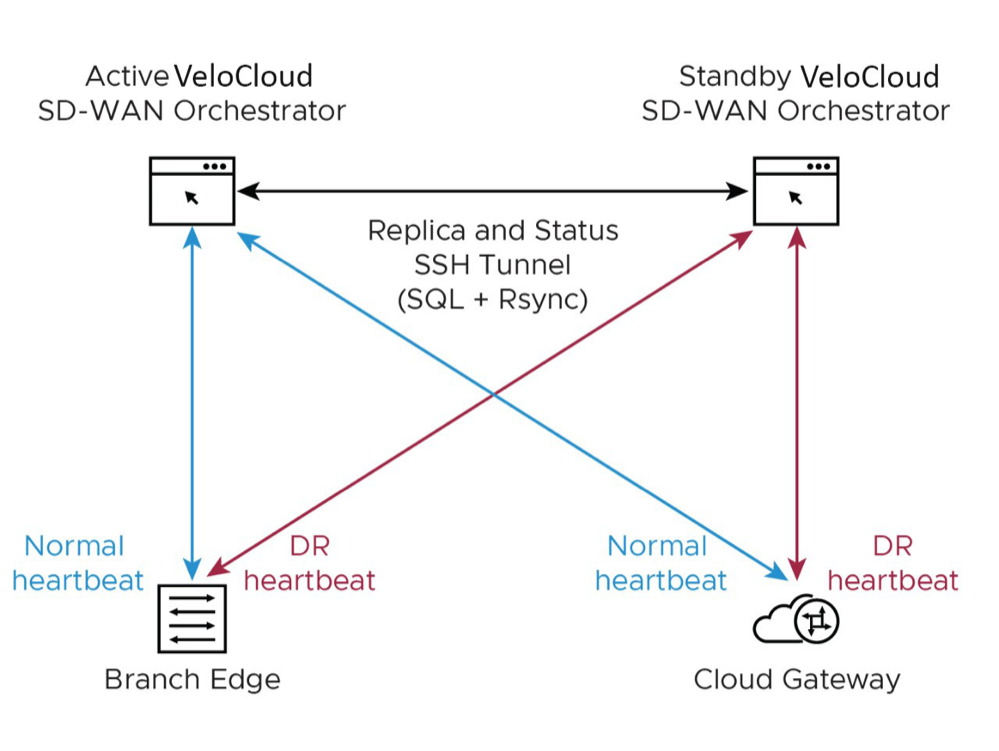
- Locate the Orchestrator DR in a geographically separate datacenter.
- Before promoting a Standby Orchestrator as Active, confirm that the DR replication Status is in Sync. The previously Active Orchestrator will no longer be able to manage the inventory and configuration.
Figure 2. Active Orchestrator 
- If the Standby can communicate with the formerly Active Orchestrator, it will instruct that Orchestrator to enter a Zombie state. In the Zombie state, the Orchestrator communicates with its clients ( Edges, Gateways, UI/API) that it is no longer Active, and they must communicate with the newly promoted Orchestrator.
- If the promoted Standby cannot communicate with the formerly Active Orchestrator, the Operator should, if possible, manually demote the previously Active.
- Detailed instructions can be found in the official Orchestrator documentation under "Configure Orchestrator Disaster Recovery."
Upgrade Procedure for the Orchestrator
- Arista Support will assist with the upgrade. Collect the following information before contacting Arista Support.
- Provide the current and target Orchestrator versions, for example, the current version (i.e., 3.4.2), target version (3.4.3).
Note: For the current version, this information can be found on the top, right corner of the Orchestrator by selecting the Help link and choosing About.
- Provide a screenshot of the replication dashboard of the Orchestrator, as shown below.
Figure 3. Replication Dashboard 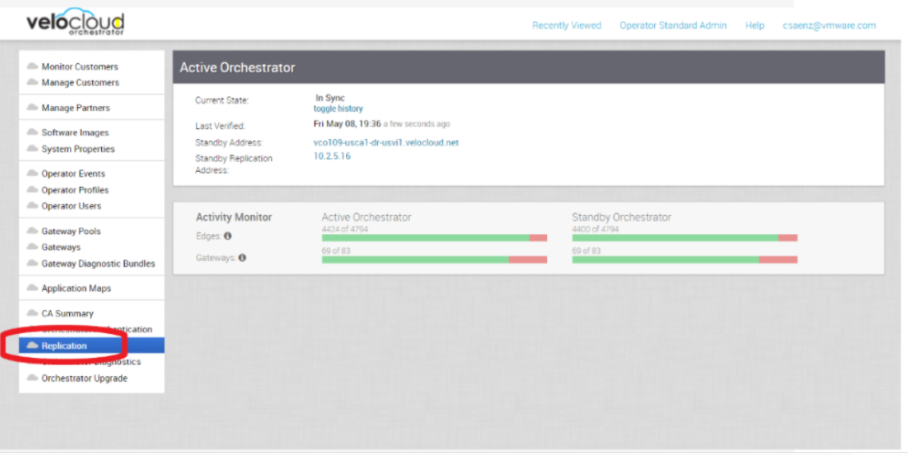
- Hypervisor Type and version (i.e., vSphere 6.7)
- Commands from the Orchestrator (Commands must be run as root (e.g. sudo <command> or sudo-i)).
- LVM layout
pvdisplay -vvgdisplay -vlvdisplay -vdf -hcat /etc/fstab
- Memory information
free -mcat /proc/meminfops -eftop -b -n 2
- CPU Information
cat /proc/cpuinfo
- Copy of
/var/logtar -czf /store/log-`date +%Y%M%S`.tar.gz --newer-mtime="36 hours ago" /var/log
- From the Standby Orchestrator:
sudo mysql
--defaults-extra-file=/etc/mysql/velocloud.cnf
velocloud -e 'SHOW SLAVE STATUS \G'
- From the Active Orchestrator:
sudo mysql
--defaults-extra-file=/etc/mysql/velocloud.cnf
velocloud -e 'SHOW MASTER STATUS \G'
- LVM layout
- Provide the current and target Orchestrator versions, for example, the current version (i.e., 3.4.2), target version (3.4.3).
- Contact Arista VeloCloud Support at with the above-mentioned information for assistance with the Orchestrator upgrade.
- ESXi Snapshot guidelines are provided in the next section in case the customer wants a quick rollback solution after an upgrade.
ESXi Snapshot
The ESXi snapshot capability can be used before the Orchestrator upgrades to provide a quick rollback to the previous Orchestrator version.
ESXi Snapshot Best Practices
- Standby and Active Orchestrator must be powered off before performing or restoring from the Snapshot to avoid any database inconsistencies.
- All Snapshot-related tasks must be done in the Standby and Active Orchestrator to avoid any database inconsistencies.
- It is essential to consolidate the Snapshot if the upgrade process was successful. The snapshot file continues to grow when it is retained for a more extended period. This can cause the snapshot storage location to run out of space and impact the system performance.
- Deactivate alerting in the Orchestrator while creating snapshots to avoid false alarms.
- Do not use a single snapshot for more than 72 hours.
- It is not recommended to use Snapshots as backups.
- Feature validation was done with ESXi 6.7 and Orchestrator version 3.4.4.
Snapshot best practices can be found in the following KB article Best practices for using ESXi snapshots in the vSphere environment.
Create ESXi Snapshot
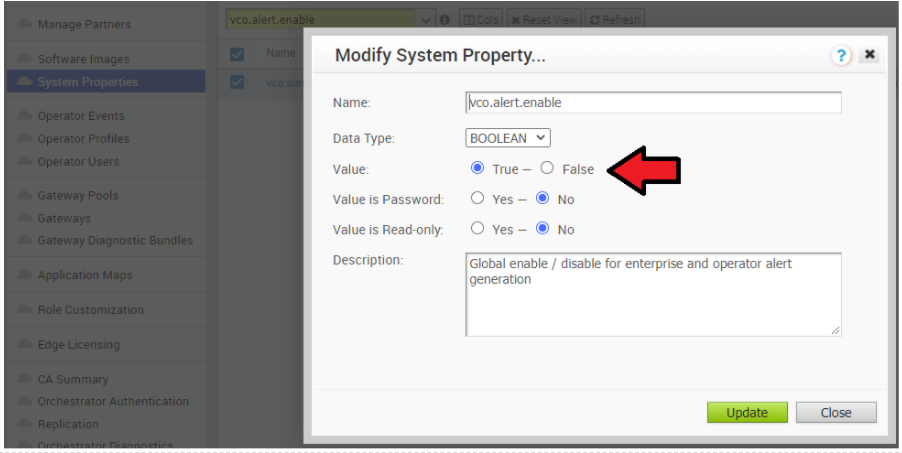
- Deactivate alert, notification, and monitoring System Properties on the Active Orchestrator. The approximate duration is 10 Minutes.
- In the Operator portal, select System Properties. Change the following System Properties to false.
vco.alert.enablevco.notification.enablevco.monitor.enable
Figure 4. Modify System Property 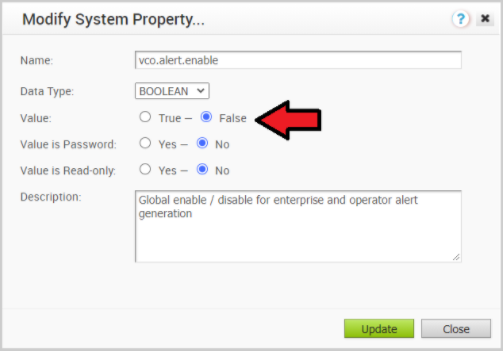
- In the Operator portal, select System Properties. Change the following System Properties to false.
- Deactivate alert, notification, and monitoring System Property on the Standby Orchestrator.
- Change the following System Properties to false.
vco.alert.enablevco.notification.enablevco.monitor.enable
- Change the following System Properties to false.
- Power off the Active Orchestrator.
Go to .
Figure 5. Power off Active Orchestrator 
- Power off the Standby Orchestrator.
Go to
- Take a Snapshot of the Active Orchestrator. Confirm that the VM is powered off before performing this step.
Go to .
Figure 6. Take Snapshot of Active Orchestrator 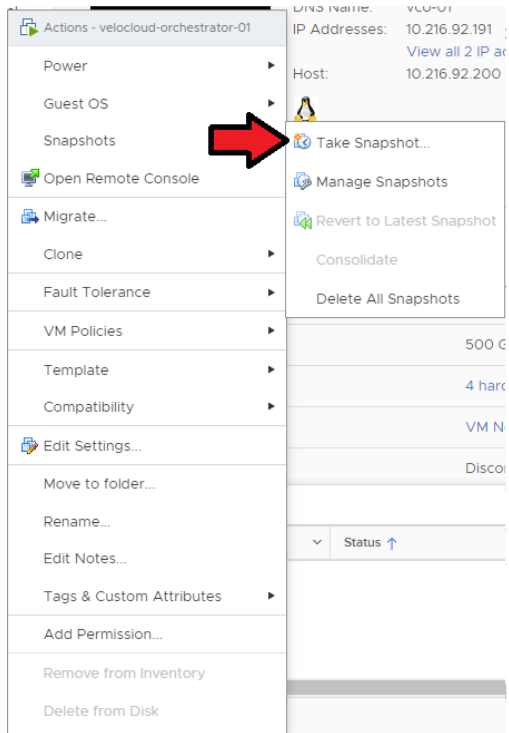
- Take a Snapshot of Standby Orchestrator. Confirm that the VM is powered off before performing this step.
Go to .
Consolidation of the ESXi Snapshot
- After confirming a successful upgrade on the Active and Standby Orchestrators, you can consolidate the Snapshots starting with the Active Orchestrator.
Go to .
Figure 7. Delete All Snapshots 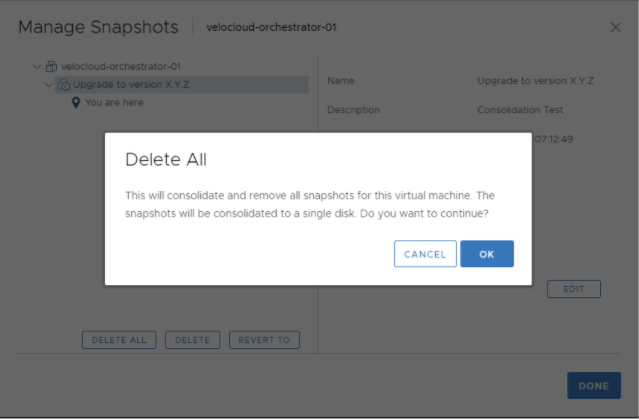
- Consolidate the Snapshot in the Standby Orchestrator.
Go to .
- Re-enable alert, notification, and monitoring System Properties on the Active Orchestrator and the Standby Orchestrator.
In the Operator portal, select System Properties. Change the following system properties to true.
vco.alert.enablevco.notification.enablevco.monitor.enable
Figure 8. Modify System Property 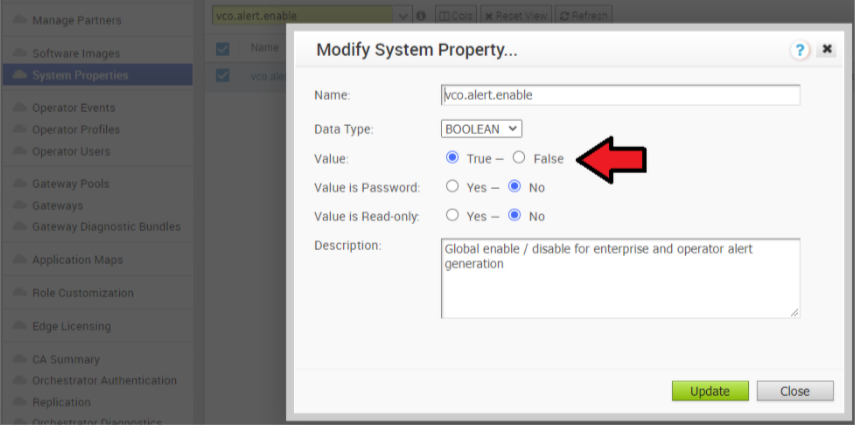
- If the Delete All snapshots does not work with vSphere 6.x/7.x, you can try to Consolidate Snapshots. For additional information, see the Consolidate Snapshots section in the vSphere Product Documentation.
Restore from the ESXi Snapshot
- Power off the Active Orchestrator.
Go to .
Figure 9. Power off the Active Orchestrator 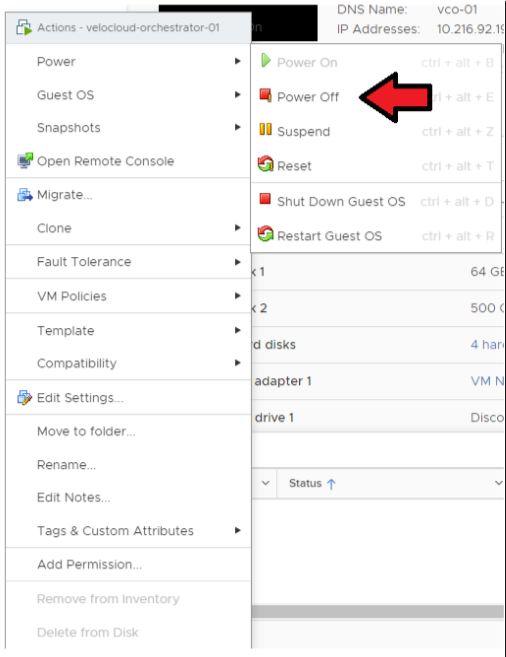
- Power off the Standby Orchestrator.
Go to .
- Restore the Snapshot of the Active Orchestrator.
Go to .
Select the Snapshot you want to restore the VM → Revert to.
Figure 10. Manage Snapshot 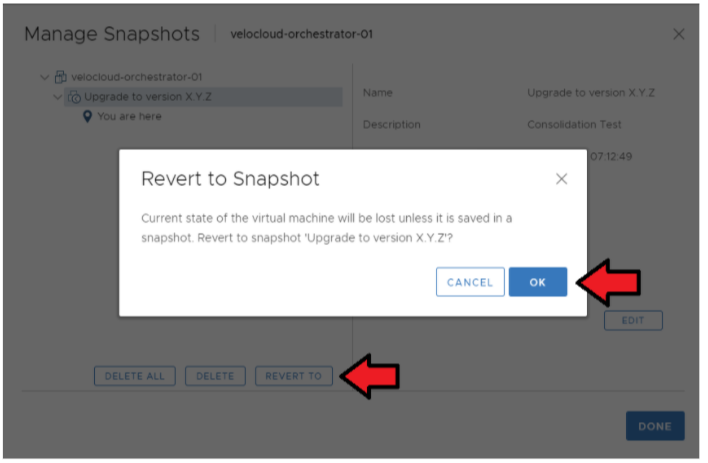
- Restore the Snapshot of Standby Orchestrator.
Go to .
Select the Snapshot you want to restore the .
- Re-enable the alert, notification, and monitoring System Properties on the Active Orchestrator and the Standby Orchestrator. In the Operator portal, select System Properties. Change the following System Properties to true.
vco.alert.enablevco.notification.enablevco.monitor.enable
Controller Minor Software Upgrade (Ex. from 3.3.2 P3 to3.4.4)
The software upgrade file contains Gateway and system updates. Do NOT run ‘apt-get update && apt-get –y upgrade.’
Before proceeding with the SD-WAN Controller's upgrade, ensure that the Orchestrator was upgraded before to the same or a higher version.
- Download the SD-WAN Controller update package.
- Upload the image to the SD-WAN Controller storage (using, for example, the SCP command). Copy the image to the following location on the system:
/var/lib/velocloud/software_update/vcg_update.tar. - Connect to the SD-WAN Controller console and run:
sudo /opt/vc/bin/vcg_software_update.
root@VCG:/var/lib/velocloud/software_update# wget -O 'vcg_update.tar' <image location>
Resolving <image location> (<image location>)... Connecting to <image location>
(<image location>)| <ip address>|:443... connected.
HTTP request sent, awaiting response... 200 OK Length: unspecified [application/octet-stream]
Saving to: 'vcg_update.tar' [ <=> ]
325,939,200 3.81MB/s in 82s 2020-05-23 21:59:27 (3.79 MB/s) - ‘vcg_update.tar’ saved [325939200]
Controller major software upgrade (Ex from 3.3.2 or 3.4 to 4.0)
- A new system disk layout based on LVM to allow more flexibility in volume management
- A new kernel version
- New and upgraded base OS packages
- Improved security hardening based on the Center for Internet Security benchmarks
Due to these changes, the standard upgrade procedure which uses the upgrade script does not work. A particular upgrade procedure is required. It is in the product manual below. This procedure is to replace the 3.3.2 or 3.4 Gateway VM with the new 4.0 Gateway VM. Refer to the following KB article: SD-WAN Partner Gateway Upgrade and Migration 3.3.2 or 3.4 to 4.0.
This upgrade procedure requires Orchestrator system property configuration, which only Orchestrator Operator accounts can run. Create a support ticket with the Arista Support team to request the System Property change.
Monitoring
- SD-WAN Controller Monitoring
You can monitor the status and usage data of Controllers available in the Operator portal.
The procedure is as follows:- In the Operator portal, select Gateways.
- The Gateways page displays the list of available Controllers.
- Select the link to a Gateway. The details of the selected Controller displays.
- Select the Monitor tab to view the usage data of the selected Controller.
The Monitor tab of the selected Controller displays the required details.
You can choose a specific period to view the Controller's details for the selected duration at the top of the page.
The page displays a graphical representation of usage details of the following parameters for the period of selected time duration, along with the minimum, maximum, and average values.
| Usage | Description |
|---|---|
| CPU Percentage | Percentage of usage of CPU |
| Memory Usage | Percentage of usage of memory |
| Flow Counts | Count of traffic flow |
| Handoff Queue Drops | Count of packets dropped due to queued handoff |
| Tunnel Count | Count of tunnel sessions |
SD-WAN Gateway Controller Recommended Values to Monitor
The following list shows values that should be monitored and their thresholds. The list below is given as a start point, and it is not exhaustive. Some deployments may require assessing additional components such as flows, packet loss, etc.
Whenever a warning threshold is reached, it is recommended to review the current device scale configuration and add more resources if required. When a critical alarm is triggered, it is crucial to contact Arista Support representatives to check the solution and provide further advice.
| Service Check | Service Check Description | Warn Threshold | Critical Threshold |
|---|---|---|---|
| CPU Load | Check System Load. | 60 | 80 |
| Memory | Checks the memory utilization buffer, cache, and used memory. | 70 | 80 |
| Tunnels | Number of tunnels from connected Edges. | 60% of max Scale | 80% of max Scale
Note: A sudden loss of all tunnels or an abnormal low quantity should also be a concern. |
| Handoff Drops | Due to the busy nature of traffic through a Controller, occasional drops are expected. | Consistent drops in specific queues may indicate a capacity problem. | |
| Disk Space | Current disk utilization | 40% Free | 20% Free |
| Controller NTP | Check for Time offset | Offset of 5 Seconds | Offset of 10 Seconds |
Orchestrator Integration with Monitoring Stacks
The Orchestrator comes with a built-in system metrics monitoring stack, which can attach to an external metrics collector and a time-series database. With the monitoring stack, you can quickly check the health condition and the system load for the Orchestrator.
-
- To enable the monitoring stack, run the following command on the Orchestrator:
sudo /opt/vc/scripts/vco_observability_manager.sh enable - To check the status of the monitoring stack, run:
sudo /opt/vc/scripts/vco_observability_manager.sh status - To deactivate the monitoring stack, run:
sudo /opt/vc/scripts/vco_observability_manager.sh disable
Figure 12. Orchestrator Integration with Monitoring Stacks 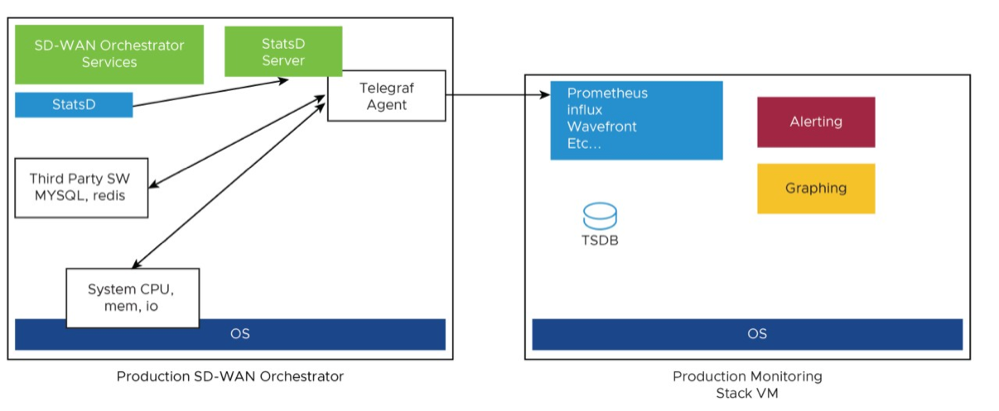
- To enable the monitoring stack, run the following command on the Orchestrator:
The Metrics Collector
| Metric Name | Description | Supported in Version |
|---|---|---|
| inputs.cpu | Metrics about CPU usage. | 3.4/4.0 |
| inputs.mem | Metrics about memory usage. | 3.4/4.0 |
| inputs.net | Metrics about network interfaces. | 4.0 |
| inputs.system | Metrics about system load and uptime. | 4.0 |
| inputs.processes | The number of processes grouped by status. | 4.0 |
| inputs.disk | Metrics about disk usage. | 4.0 |
| inputs.diskio | Metrics about disk IO by device. | 4.0 |
| inputs.procstat | CPU and memory usage for specific processes. | 4.0 |
| inputs.nginx | Nginx's basic status information (ngx_http_stub_status_module). |
4.0 |
| inputs.mysql | Statistic data from MySQL server. | 3.4/4.0 |
| inputs.redis | Metrics from one or many redis servers. | 3.4/4.0 |
| inputs.system | API and system metrics. | 3.4/4.0 (additional metrics are included in 4.0) |
| inputs.filecount | The number and the total size of files in specified directories. | 4.0 |
| inputs.ntpq | Standard NTP query metrics, requires ntpq executable. | 4.0 |
| Inputs.x509_cert | Metrics from a SSL certificate. | 4. |
sudo vi /etc/telegraf/telegraf.d/system_metrics_input.conf
sudo systemctl restart telegraf
The Time-series Database
A time Series Database can be used to store the system metrics collected by Telegraf. A time-series database (TSDB) is a database optimized for time series data.
Dashboard and Alerting Agent
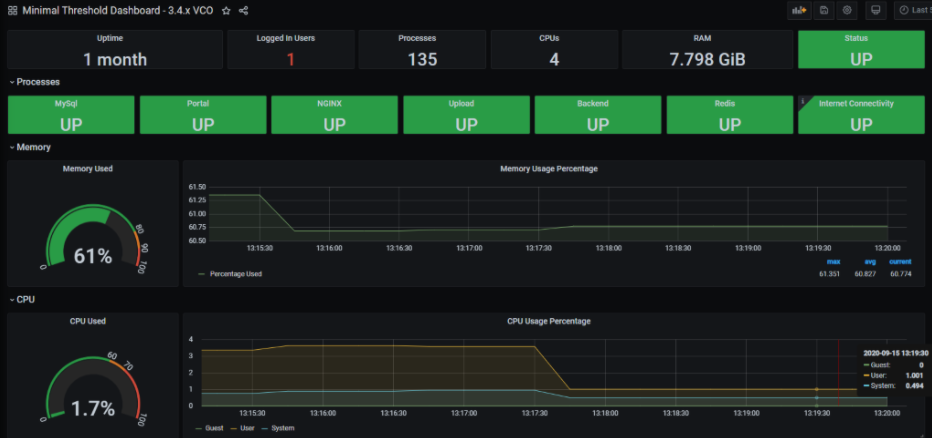
The Dashboard and Alerting Agent allows you to query, visualize, alert, and explore the data stored in the TSDB. The image is an example of a dashboard using Telegraph (a TSDB and a dashboard engine) that can be created to monitor the solution.
Time-series Database Setup
Follow the instructions below to setup the time-series database.
- Add the iptables entry to allow for external monitoring systems to access to telegraf port. The source IP address should be specified for security reasons.
- Example: The IP address of the external monitoring system is 191.168.0.200 Add "-A INPUT-p tcp -m tcp --source 191.168.0.200 --dport 9273 -m comment --comment "allow telegraf port" -j ACCEPT" to /etc/iptables/rules.v4
Figure 14. Add the iptables entry 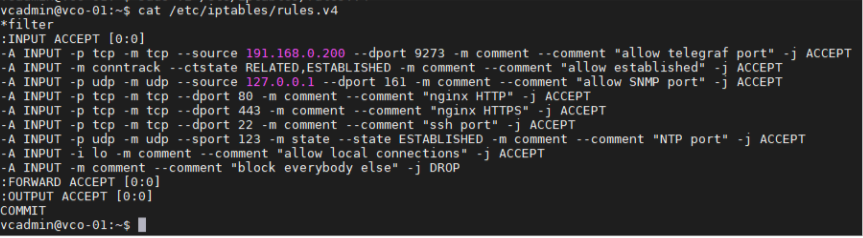
- Restart iptables.
sudo service iptables-persistent restart (Orchestrator 3.4.x)
sudo systemctl restart netfilter-persistent (Orchestrator 4.x)
- Make sure the iptables entry is added.
Figure 15. Verify the iptables is added 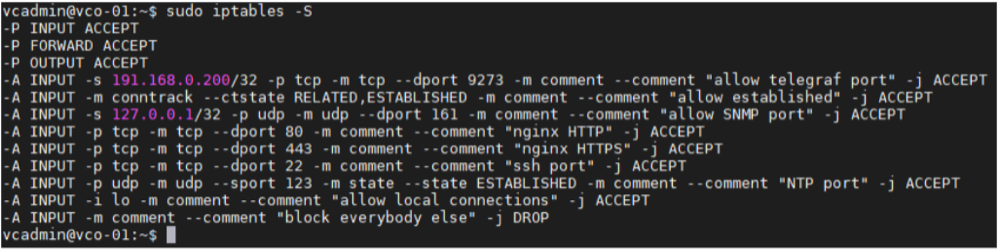
- Example: The IP address of the external monitoring system is 191.168.0.200 Add "-A INPUT-p tcp -m tcp --source 191.168.0.200 --dport 9273 -m comment --comment "allow telegraf port" -j ACCEPT" to /etc/iptables/rules.v4
- Add the time-series database details in the telegraf configuration. Create an output configuration file. Example with prometheus is as follows:
/etc/telegraf/telegraf.d/prometheus_out.confFigure 16. Add the time-series database details in the telegraf configuration 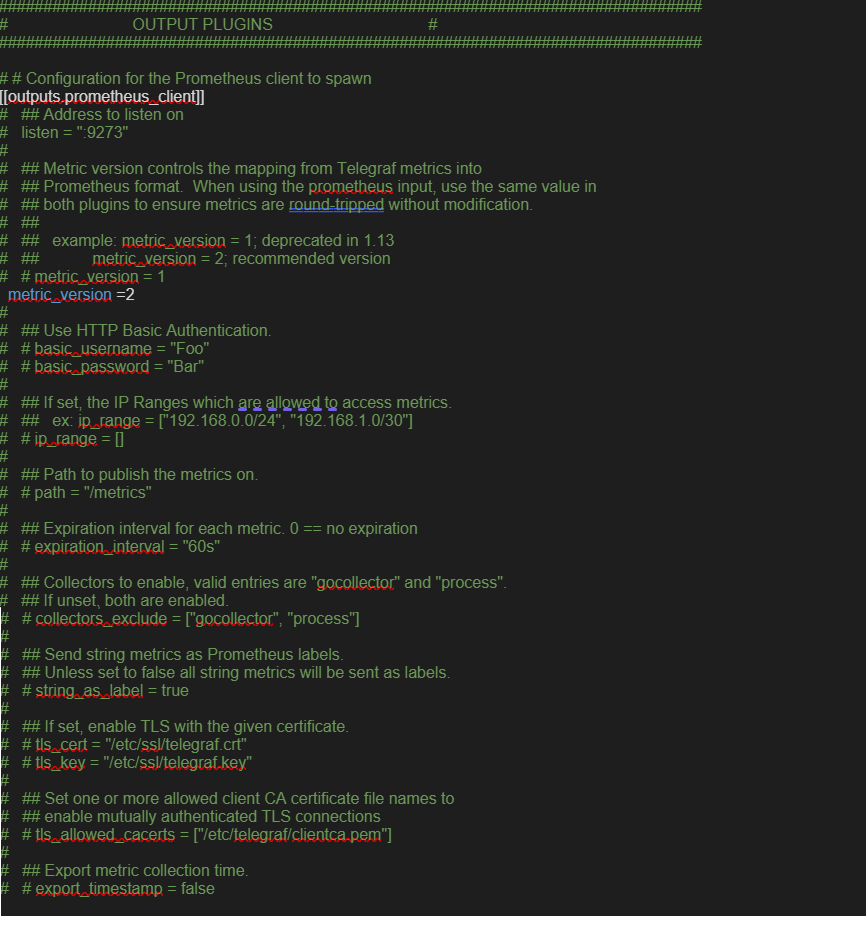
- Orchestrator Recommended Values to Monitor
The following list shows a list of values that should be monitored and their thresholds. The list below is given as a starting point, as it is not exhaustive. Some deployments may require assessing additional components such as database transactions, automatic backups, etc.
Whenever a warning threshold is reached, it is recommended to review the current device scale configuration and add more resources if required. When a critical alarm is triggered, it is crucial to contact the Arista Support representatives to check the solution and give further advice.Table 6. Orchestrator Recommended Values to Monitor Service Check Service Check Description Warn Threshold Critical Threshold CPU Load Check System Load – Telegraf input plugin: inputs.cpu. 60 70 Memory Checks the memory utilization buffer, cache, and used memory – Telegraf input plugin: inputs.memory. 70 80 Disk Usage Disk Utilization in the different Orchestrator partitions, /, /store, /store2 and /store3 (version 4.0 and onwards) – Telegraf input plugin: inputs.disk (version 4.0 and onwards). 40% Free 20% Free MySQL Server Checks MySQL Connections -Telegraf input plugin: inputs.mysql. Above 80% of max connection define in mysql.conf(/etc/mysql/my.cnf) Orchestrator Time Check for Time offset -Telegraf input plugin: inputs.ntpq (version 4.0 and onwards). Offset of 5 Seconds Offset of 10 Seconds Orchestrator SSL Certificate Checks Certificate Expiration - Telegraf input plugin: inputs.x509_cert (version 4.0 and onwards). 60 Days 30 Days Orchestrator Internet (not applicable for MPLS only topologies) Check for Internet access. Response time > 5 secs Response time > 10 secs Orchestrator HTTP Make sure HTTP on localhost is responding. The localhost is not responding. Orchestrator Total Cert Count Check Total – Example mysql query: SELECT count(id) FROM VELOCLOUD_EDGE_CERTIFICATE WHERE validFrom <= NOW() AND validTo >=NOW()', 'SELECT count(id) FROM VELOCLOUD_GATEWAY_CERTIFICATE WHERE validFrom <= NOW() AND validTo >=NOW()
CRL When Total Cert count exceeds 5000 DR Replication Status Confirm the Standby Orchestrator is up-to-date. Review that the DR Orchestrator is no more than 1000 seconds behind the Active Orchestrator. Seconds_Behind_Master: from mysql command: show slave STATUS\G;
DR Replication Edge Gateway delta Confirm that Edges and Gateways can talk to the DR Orchestrator. Different values between the Active and the Standby Orchestrators can be due to a difference in the timezone in Edges and Gateways.
The same amount of Edges talking with the Active Orchestrator should be able to reach the Standby Orchestrator. This value can be checked on the "replication" tab or via the API.
API Best Practices
- The Orchestrator Portal
The Orchestrator Portal allows network administrators (or scripts and applications acting on their behalf) to manage network and device configuration and query the current or historical network and device state. API clients may interact with the Portal via a JSON-RPC interface or a REST-like interface. It is possible to invoke all of the methods described in this document using either interface. There is no Portal functionality for which access is constrained exclusively to either JSON-RPC clients or REST-like ones.
Both interfaces accept exclusively HTTP POST requests. Both also expect that request bodies, when present, are JSON-formatted -- consistent with RFC 2616, clients are furthermore likely to formally assert where this is the case using the Content-Type request header, e.g., Content-Type: application/json.
additional information about the SD-WAN API can be found here: https://www.arista.com/en/support/product-documentation.
- Best Practices for enterprises and service providers Using APIs
Some of the best practices while using APIs are:
- Wherever possible, aggregate API calls should be preferred to enterprise-specific ones. e.g., a single call to
monitoring/getAggregateEdgeLinkMetricsmay be used to retrieve transport stats across all Edges concurrently. - Arista requests that clients limit the number of API calls in flight at any given time to no more than a handful (i.e., <2-4). If a user feels there is a compelling reason to parallelize API calls, Arista requests that they contact Arista Support to discuss alternative solutions.
- We ordinarily don't recommend polling the API for stats data more frequently than every 10 min. New stats data arrives at the Orchestrator every 5 minutes. Due to jitter in reporting/processing, clients polling every 5 minutes might observe "false-positive" cases where stats aren't reflected in API calls' results. Users tend to find the best result using request intervals of 10 minutes or greater in duration.
- Avoid querying the same information twice.
- Use sleep between APIs.
- For complex software automations, run your scripts and evaluate the CPU/Memory impact. Then adjust as required.
- Wherever possible, aggregate API calls should be preferred to enterprise-specific ones. e.g., a single call to
Orchestrator Syslog Configuration
The Orchestrator Syslog capability can be configured independently for the following Orchestrator processes: portal, upload, and backend.
- Portal: The Portal process runs as an internal HTTP server downstream from NGINX. The Portal service handles incoming API requests, either from the Orchestrator web interface or from an HTTP/SDK client, primarily in a synchronous fashion. These requests allow authenticated users to configure, monitor, and manage the various services provided by the Orchestrator.
This log is very useful for AAA activities as it has all actions taken by users in the Orchestrator.
Log files:
/var/log/portal/velocloud.log(Logs all info, warn, and error logs) - Upload: The Upload process runs as an internal HTTP server downstream from NGINX. The Upload service handles incoming requests from Edges and Gateways, either synchronously or asynchronously. These requests primarily consist of activations, heartbeats, flow statistics, link statistics, and routing information sent by Edges and Gateways.
Log files:
/var/log/upload/velocloud.log(Logs all info, warn, and error logs) - Backend: Job runner that primarily runs scheduled or queued jobs. Scheduled jobs consist of cleanup, rollup, or status update activities. Queued jobs consist of processing link and flow statistics.
Log files:
/var/log/backend/velocloud.log(Logs all info, warn, and error logs)
- Navigate to System Properties in the Orchestrator,
log.syslog.<server>(e.g. log.syslog.portal). Go to type “log.syslog” in the search bar. - Change the “enable”: false value to true for one or more of the servers. Change the Host IP and port accordingly to your implementation.
Increasing Storage in the Orchestrator
For detailed instructions to increase the Storage in the Orchestrator, see the topics Install Orchestrator and Expand Disk Size.
- Best Practices:
- Make sure that the same LVM distribution is applied to the Standby Orchestrator.
- It is not recommended to reduce the size of the volumes once they were increased. Use thin provisioning instead.
- In 3.4, when increasing the disk size, the following percentage/value distribution may be used:
- “
/” Volume: This volume is used for the operative system. Production Orchestrators are usually set to 140GBs and have from 40% to 60% usage. /Storeand/Store2: The proportion applied in production Orchestrators is close to 85% for/Storeand 15% for/Store2.
- “
- The following guidelines in the table below should be used in the 4.x release and onwards.
Table 7. Guidelines Instance Size /store /store2 /store3 /var/log Small (5000 Edges) 2 TB 500 GB 8 TB 100 GB Medium (10000 Edges) 2 TB 500 GB 12 TB 125 GB Large (15000 Edges) 2 TB 500 GB 16 TB `150 GB
Managing Certificates in the Orchestrator
The Orchestrator5 uses a built-in certificate server to manage the overall PKI lifecycle of all Edges and SD-WAN Controllers. X.509 certificates are issued to the devices in the network.
Detailed instructions to configure the CA can be found in the topics Install Orchestrator and Install an SSL Certificate.
- Management plane TLS 1.2 tunnels between the Orchestrator and Edge SD-WAN Controller.
- Control and Data plane IKEv2/IPsec tunnels between SD-WAN Edges and between Edge and SD-WAN Controller.
Certificate Revocation List
vcadmin@vcg1-example:~$ openssl crl -in /etc/vc-public/vco-ca-crl.pem -text | grep 'Serial Number' | wc -l 14 vcadmin@vcg1-example:~Support Interaction
Our Customer Support organization provides 24x7x365 world-class technical assistance and personalized guidance to Arista customers.
- Diagnostic Bundles
While investigating an incident, a diagnostic bundle of the Orchestrator and SD-WAN Controller can be created. The resulting file will assist the Arista Support team to further analyze the events around an issue.
- Share Access with Support
On occasion assistance from Arista Support representatives for the Orchestrator and SD-WAN Controllers may be required.
Some common ways to grant access are:- Remote sessions with Support: The customer would either grant remote control to the SSH jump server or follow the Support representative's instructions.
- Creating an account for the Support team in the Orchestrator. This helps the Support team gather logs without customer interaction.
- Through the Bastion Host: SSH permissions and keys can be configured to allow the Support engineers to access the on-premises Orchestrator and SD-WAN Controller using a Bastion Host.
When contacting Arista VeloCloud Support to assist triaging an issue, include the data described in the table below.
| Required | Suggested |
|---|---|
| Partner Case Number | Issue Start/Stop |
| Partner Return Email/Phone | Impacted Flow SRC/DST IP |
| Orchestrator URL | Impacted Flow SRC/DST Port |
| Customer Name in Orchestrator | Flow Path (E2E, E2GW, Direct) |
| Customer Impact (High/Med/Low) | SD-WAN Gateway Name(s) |
| Edge Name(s) | Link to PCAP in the Orchestrator |
| Link to Diagnostic Bundle in Orchestrator | |
| Short Problem Statement | |
| Analysis & Requested Assistance |